Posts

Articles Of The Week June 3, 2018

There is much debate about which treatments work best. Some even demand that some types of treatment don’t work at all, while others are the gold standard. But, in reality, who are we to say which is best, and in turn taking the choice away from the patient? This is a great article debating just that and is WELL worth the read.

“Using The Socratic Method Debate On The Debate About Passive Treatment” – Carl Davies

Hearing stories from those who deal with chronic pain can be a crucial component of being a therapist. This story is a good one. After being fearful of movement, a great therapist gradually exposed the patient to movements with a good explanation, which had a profound effect. Listening to the patients story, and some good education can go a long way in helping patients in pain.

“Why Goldilocks Is My Rehab Heroine” – Cheryl Lee

I don’t think any of us learn enough about business coming out of school, and going into business for yourself is a scary thing! However, all of us are small business owners, even if we don’t own the clinic. So, here’s some great advice from a successful entrepreneur in our industry on how to get started as a massage business owner.

“How To Start A Massage Business” – Rajam Roose

We all know there are lots of ‘myths’ within our industry. Here are seven myths related to health that you may be asked about in your practice. While the author doesn’t go into too much depth in their explanations, they are definitely myths we can forget about.

“7 Health Myths We Need To Forget About”  – Steven Baldwin

There are many aspects that can make us a good therapist. However, probably one of the most important, is how well we can coach our patients when it comes to homecare, or any kind of exercise prescription. If we are all focused on patient centred care, coaching and communication are crucial to beneficial outcomes for our patients.

“How Good Are We At Patient Education?” – Roma Forbes

Are Painful Flare Ups To Exercise, Just Like A Sunburn (and why we might need analogy anyway)

Whilst Exercise CAN be a wonderful tool to use during the rehab process we must remember it is not a stick on, we can’t just fire and forget or plug and play and for every success, there are also failures. There just is not such a thing as a magic bullet in rehab.

Sorry about dat!

Before we get to the analogy stuff we might want to first ask WHY we might want to help people understand what is happening to their bodies and how ANALOGY can help with that?

In some cases, it can be much more about HOW we do things rather than WHAT we actually do.

Why? 

For all the studies we have extolling the virtues of exercise, although make sure you consider the effects sizes, an important question to ask is how generalisable are they to the real world? If I was being all sciencey and shit we could term this the external validity of a study.

Why might these studies lack external validity? In the tightly controlled world of the scientific study participants probably tend to adhere a little bit more to the protocol laid out than they do on their own, otherwise, studies would never get finished. Researchers can also employ things like the “intention to treat” analysis (ITT) that are designed to scientifically smooth out things like dropouts and missing data.

Out in the real world when we throw in the complications of life, exercises, however evidence-based, in some cases can tend to fall by the wayside. This is a problem with human beings they don’t always just fit neatly into EBM boxes. In fact, they can render all the science a touch redundant through things like their beliefs, preferences and lifestyles.

Differences in the definition of adherence used, measurement and estimative of how many patients do not comply with their prescribed exercises vary, but evidence converge on a figure of 50% or higher”  *HERE*

We can all agree that that is a pretty high percentage of shit that is not getting done! What we CAN say is exercise is likely to infer some benefits IF IT GETS DONE! SO how do we go about doing that? And that, of course, is the $1 million question!

Barriers

This is an awesome piece of research that looks at barriers to people adhering to therapeutic exercise programs *HERE* One of the major reasons that people don’t adhere, or a much better term to use, commit, to exercises or exercise programs when they have pain is the fear of INCREASING that pain.

Here is a slide from my recent presentation at the San Diego pain summit.
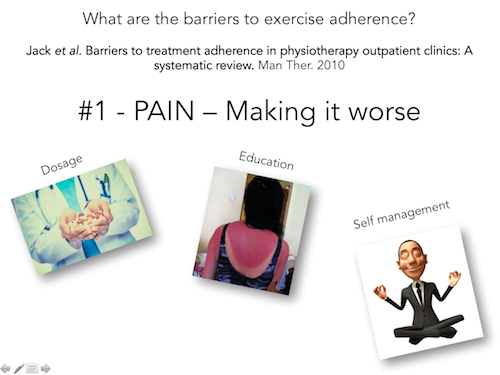
 

Now, this is completely understandable. Our fears drive our behaviours, so if I am scared of making the problem worse that may drive me to, well, simply not do it. It may then be key to help people make sense of what they feel and how they can manage that.

For a lot of people, the science of both pain and exercise are pretty alien subjects. What’s the difference between exercise-induced discomfort and actual pain? For someone who has never experienced the former then perhaps not a lot! I have been pretty sore from training before and found some activities really quite painful.

The likelihood of getting some DOMS from prescribed exercises for someone with no real history of exercise and a low ‘zone of homeostasis’ could be pretty high, so it is vital we can put these sensations into perspective, allay fears and help people to SELF-manage their rehab.

A useful phrase I picked up a long time ago is “go to the P in Pain not the Y in Agony” which is a really nice way to say go into some discomfort, which of course is normal, but try to avoid rip-roaring pain. We still don’t know if painful exercise is actually bad for outcomes but certainly, it may dissuade someone from carrying on with it.

Things can and will go wrong and setbacks are normal. These setbacks can be influenced by a whole bunch of factors including stress and lifestyle that can negatively affect recovery, and no rehab plan will ever follow a linear upwards trajectory, especially if we are attempting to push the envelope and ‘vaccinate’ against future reoccurrences.

*HERE* we see psychological stress actually impairs recovery from exercise so we must be mindful of this. It may not be the intensity of the sensation that some struggle with but how LONG it goes on for. Desired adaptations such as strength might also be affected by stress too. *HERE*

Pain is often accompanied by worry and stress and could be both a cause and an effect of the current state of the individual. This is why we must be aware that our rehab programs carry the possibility that they could cause an adverse reaction in times of stress.

Analogy

Equipping people with the knowledge to both understand AND address these factors is vital for self-efficacy, another key player in the COMMITMENT to a rehab program.

An analogy is a fantastic way of helping people understand subjects that they have very little background in and for many folks, both pain and exercise fall neatly into this bracket. One of my favourite analogies for exercise discomfort AND pain is SUNBURN. The reason for this is it (hopefully) places the pain or discomfort into perspective and allows it to be seen as a temporary thing and one that can be easily modified.

Rather than viewing an exercise as simply being WRONG, a comparison to sunburn allows it to be viewed more as an issue with the dosage applied and the bodies response. We generally don’t see the sun as a BAD thing, of course, some do but we could put that on the spectrum of fear avoidance! Most people will get sunburn at some point in their lives and just see it is a little bit too much of a GOOD thing!

So what do we do if we overdose on the sun? Generally just ALTER the dosage, simply get less sun the next day by sitting under the umbrella or covering up my burnt bits with a towel, we may have just tried to rush the natural adaptation.

The negative physical reaction is only temporary, often just like the pain triggered from overdosing on exercise, the angry red skin and spiky feeling when in the shower will, of course, go away if I just alter the dose and let nature run its course. What we do see if dosed correctly is a slow natural adaptation that leaves us positively glowing.

What do you usually do next after burning? Well just be more careful when re-exposing yourself. Spend less time in the sun or apply a higher factor. We don’t freak out, in fact often we berate ourselves for being stupid! We know this happens after all. We can do the same with our exercises, just take a little time off or reduce the amount we do before building up again.

Why might we overdose? Perhaps we have been previously been underdosed. Just like coming out of a long sunless winter, not having exercised for a while probably reduces the amount I can tolerate and hence potential adverse reactions. This may explain why just a few sets could leave me pretty sore.

If we have previously been good at a sport we tend to be able to play at a much higher intensity than perhaps we can CURRENTLY handle. In fact being good at something could actually be a risk factor for some! Our skill level may far outweigh our tolerance for the level of intensity we can play at. The same is true of tanning, we tend to remember the lazy long days at the END of a holiday applying Hawaiian tropic rather than the blotchy days in the beginning, piling on factor 30.

Some people can exercise till the cows come home and never feel a thing, a bit like those really annoying people who go an amazing shade of brown by just looking at the sun! We may be predisposed genetically to being LESS tolerant of physical activity. We see discussion of the role of genetics in sensitivity *HERE*

People with fair skin and red hair are often less tolerant of the sun by nature of their Celtic heritage and those of Mediterranean or African origin far better genetically equipped to handle a greater dosage of the sun.

Now, no analogy is free from a negative misinterpretation. Whilst the sun could be seen as having dangerous consequences such as skin cancer from extreme overdosing we also see problems with underdosing such as depression from reduced serotonin. Like all things, it has an OPTIMAL dosage, after all too much or little water or oxygen can also kill you too!

How can we alter the dosage?

  • Frequency – How often. More is not always better.
  • Intensity – How heavy or how fast.
  • Volume – How much. Sets, reps and rest.

Read more here about dosage *HERE*

Take Homes

  • People don’t just fit neatly into science
  • Increasing pain is a real worry with rehab exercises
  • Arm people with information about what to expect and what they are feeling
  • Be smart in the first place – Less can be more.
  • Self-management. Give them the tools to manage the dosage.
  • Give support. If it does go wrong to help people get back on track

Articles Of The Week May 27, 2018

Not all of our patients enjoy doing exercise, no matter how much it helps. But what if we could change the way it’s delivered, to get them to adhere to recommendations more? What if we could actually make it fun?

“Making Rehab Fun” – Jon Cain

There were a few questions floating around social media this week on plantar fasciitis. This is a great article outlining five things you can do to help patients with this.

“5 Tips For Better Self Management Of Plantar Fascitis For Athletes” – Ellie Somers

This is essentially a massive list Lars has put together of videos and interviews with some of the worlds leading pain researchers. There is a ton on this list, that could make your knowledge and learning about pain a lot easier.

“Pain Lectures With Pain Experts” – Lars Avemarie

No matter what part of the health industry you work in, there is always room for improvement. This article outlines many things I would never have thought of (but can certainly learn a lot from), and I’m sure it’s applicable no matter what part of healthcare you’re in.

“Making The Fitness Industry A Better Place”– Leigh Peele

We’ve all mismanaged time before and possibly messed up our schedule when booking patients in. As it turns out, one of the things that could prevent this from happening is taking better care of ourselves!

“Time Management And When It Goes Wrong” – Sinead Kelly-Barber


A Massage Therapy Discovery


*This post was written by an RMT who wishes to remain anonymous because it deals with legal issues. Their lawyer has advised them that while it is fine to share the information, to help us all, it is better to stay unidentified due to the legal concerns.  


So this is not the deep soul searching, self-reflective, becoming a better person type of discovery that I am talking about but rather an examination for discovery of the legal variety. 

That being said this legal discovery did help me discover that I dislike discoveries. I also discovered that lawyers can be pretty darn nice and helpful…at least the ones I interacted with.

Before I get into the Discovery itself I would like to say; I wish I could give the details as to what occurred but, as recommended by my lawyer, I cannot give any details which may affect client confidentiality. Due to my strong desire not to be sued, there will be no names, specific details, or any information directly related to the treatment. 

If the information was to get out and people began to talk I would then need to hire Jamie “Knuckles” Johnston for his…ahem… “silencing skills” but he is far too busy and his fees, although a great value, can add up quickly. 

What I can say is I have been an RMT for a good number of years, I had treated this patient quite a number of times over a few years, there was a long break between treatments and then there was an MVA followed by several treatments along with some underlying pathological issues on top of the typical MVA injuries.

A Legal Discovery

I think many of us have given a treatment when someone has had difficulty getting off the table, they were sorer afterwards, they were bruised, or perhaps there was a snap, crackle, or pop that occurred. On that fateful day, I gave one of those treatments and this is a bit of the process that followed.

After the treatment when the incident occurred I did a lot of thinking, rethinking, over thinking and then I thought about it some more. After all of the thinking, I felt very confident in the treatment I gave. The patient returned a few more times over the next few weeks and then life goes on and continues.

Fast forward 22 months after the incident. I received a 3rd party notice for Civil Claim from defendants of the MVA.

A claim of negligence:

  • failing to recognize the physical & medical condition of the plaintiff
  • failing to use reasonable care & skill
  • failing to properly examine, investigate, assess, test

*The clinic where I work also named in the lawsuit

I immediately contacted a lawyer, then my insurance company, and so the paper trail began. All of my notes for the treatments from the MVA and previous to the MVA were scanned and emailed.  In the first brief phone conversation with the lawyer, we discussed some of the basics from the treatments. I was told my charting was pretty good which should make things a bit easier. That was the first bit of good news I had received which helped make me slightly less stressed.

FYI: should you ever receive such a notice it states that you must respond within 21 days if you reside in Canada, 35 days if you reside in the U.S. and 49 days if you reside elsewhere.

Approximately 6 weeks after the 3rd party notice, 28 months after the incident, I received another envelope (really starting to develop a phobia of large envelopes at this point). It was a Notice of Civil Claim from my patient. Apparently, this is a normal part of the process that would allow the plaintiff to claim against me, as well as the MVA defendant.

Our Reply was sent a couple of weeks after the 2nd notice, so it seems the time period you must respond by was not quite as much of a “MUST DO” as originally stated. My Lawyer called their Lawyer and told them of our intentions so it was all good.

And now we wait.

During this waiting period, expert witnesses are used by both parties to review my clinic notes. The expert witness used by my Lawyer was of the view that I met the standard of care in the circumstances. Not gonna lie, I was really hoping for more of a statement like “there is absolutely no chance, no way, no how that I could ever in a million years have done anything even remotely wrong,” but I will take what I can get.

42 months after the incident I learned that bad news does not have to come in a large envelope as I received an email that did not make me happy. I received a notice that I have been requested for Discovery in two and a half weeks. There were many emails back & forth to my Lawyer over these next couple weeks as I had many questions while my anxiety grew. Although I am sure panic, stress, irrational thoughts, endless questions and emails are probably fairly normal with this type of procedure I can only imagine what my poor Lawyer must have been thinking about me.

Here are some of the tips that I received from my lawyer:

  • The Supreme Court Civil Rules allow each party an opportunity to question the other parties for up to 7 hours, I anticipate that counsel will likely only take half a day to ask you questions about your knowledge of the treatment that was provided to the plaintiff.
  • Answer the question being asked and not to offer any information. The general rule is that you answer with as little information as possible to address the specific question asked, so it is very important that you understand the question.
  • This is not your opportunity to “make your case” or to convince the other side that you did nothing wrong. An examination for discovery is a hurt not help situation. I cannot use anything that you say at the examination for discovery as evidence, however, the other side can. If we went to trial then we would make sure that you provided a full explanation of your background, training, and involvement with the plaintiff.
  • You cannot be asked about your opinion regarding the plaintiff’s condition or anything else at issue in the litigation. I will be present to ensure that the questions are not objectionable. Some examples of objectionable questions are those that are ambiguous, those that seek your opinion, or those that seek information which is covered by privilege. We can also object on the grounds of relevance, although the scope of what is relevant to discovery is quite broad.
  • If I do object, then I will instruct you not to answer the question and it is very important that you follow my instructions, even if you think the answer to the question might be helpful to our case.
  • The most important advice I can give you is that you listen very closely to the question you are asked and that you answer honestly and accurately (to the best of your ability).

Requests made by Defence Counsel, I needed to provide the following information/documents:

  • Advise as to what continuing education course you last took prior to the incident
  • Provide a copy of any contract that was in place between you and the clinic you work at as of the date of the incident.

Important Advice For Every Massage Therapist

D -Day Arrives(42 1/2 months )

I met with my Lawyer one hour before Discovery to further discuss, answer questions, and calm my frazzled nerves. I am feeling pretty good, although still quite nervous.

And so it begins.

In the conference room we all gather:  court recorder for transcript & audio recorder, ICBC lawyer for the MVA defendants, Lawyer for another healthcare practitioner, Lawyer for the Plaintiff, and last but not least my Lawyer, and of course myself. I am a little disappointed that not one of them is wearing the white wig you see on Canadian TV shows.

I was questioned only by the one Lawyer.

We went over and briefly discussed EACH and EVERY treatment. There were more specific questions if/when the treatments or any other details changed, and even more discussion/questions for the day of the “incident”. I can say that I did not feel pressured, harassed or intimidated. A couple of the questions did catch me off guard and made me think a bit, but nothing that wasn’t fair. The questioning lasted approximately two hours. At the end of the Discovery, I shook hands with the opposing Lawyers and exchange pleasantries that actually felt pretty genuine. The questioning Lawyer said something along the lines of; “would have been nice to meet under different circumstances.” We left the room but the other 3 Lawyers stayed behind to discuss their next step….that hopefully did not involve me being stepped on.

Thankfully I was able to have a bit of a post-discovery debriefing with my Lawyer. I was told I represented myself and my case well. There were a couple of points that I guess I didn’t pick up on but overall I felt good and I could begin to breathe again. Sadly I had to go back to work at this time even though I would have really liked to go to a pub to celebrate.

49 months after this all began I received an email that made me quite happy, it was the lawyer stating I am to be let out of legal action.  Thankfully the information gathered at my Discovery combined with my patient stating during her Discovery that during the treatment I did not do anything different than previous when “the incident” occurred allowed them to come to the conclusion I was not at fault.

What have I learned from all of this?

  1. Charting is important!!! VERY, VERY important! I was able to easily understand everything in my charts years after the treatments and the Lawyers could also understand them. Very little clarification needed.
  2. Listen to your gut. There were a couple of comments made by my patient in the treatments that immediately followed the incident that I wished I would have charted. I recall thinking that was an odd statement but then failed to put it in my notes. Chart that stuff too!!!!
  3. ALWAYS work within our scope of practice. I cannot even begin to imagine how this could have ended if I had done anything even remotely questionable.
  4. Insurance is a good thing. I know we all complain, at least sometimes, at that time of year when our fees are due. I will never complain again (at least not out loud).
  5. Lawyers are not like they are portrayed on TV….at least not all of them, BUT they are VERY expensive, so please go back and re-read point number four!
  6. Oh yes and one more thing large envelopes are very bad!!!

There are still some unanswered questions for me about this ordeal but it is not very likely that I will ever find the answers. I just have to be happy with the outcome and move on.

58 months later and I just got the official paperwork to say I am in the clear.

Articles Of The Week May 20, 2018

We’ve highlighted many times how important research is to our profession, and how we need more of it. Well, here are eight medical professionals who specialize in massage research and what they’re focusing on.

“8 Medical Experts Who Specialize In Massage Therapy Research” – Joe Neely

There have been lots of discussions this week on social media about massage therapy and pregnancy (it’s totally fine to use massage therapy during pregnancy). I’ve also heard in the past that some women use acupuncture to not only induce birth but also assist with becoming pregnant. Well, this study shows otherwise.

“Acupuncture Will Not Increase Your Chances Of Pregnancy on IVF, Study Shows” – Caroline Smith & Robert Norman

Many feel threatened by some of the new information coming out in regards to pain science and deem it as a ‘shiny new tool’ and a threat to practice. But this article shows how we need to put our clinical ego aside and embrace this new information.

“Pain Science, An Optional Tool?” – Mark Kargela

Is an interdisciplinary approach necessary for helping patients with chronic pain? Well, there are various factors that can both increase and decrease the success of this approach, and the ultimate goal should be patient improvements.

“Teamwork: Gaps Or Overlaps?” – Bronnie Thompson

Love that this article is coming from an Orthopedic Surgeon. Just because your patients MRI findings showed tears or wear, it doesn’t mean there is actually anything wrong with it, this could be completely normal.

“Shoulder MRI Findings In People With No Shoulder Pain: Are Some Tears ‘Normal'” – Howard J. Lukus

Tissue Loading During Remodelling Phase Of Healing

Over the past few weeks, we have been going over how to safely load tissues during the acute and sub-acute phases of an injury.

Along with instructions on loading, we have been reviewing what happens during the inflammatory and proliferative phases of healing.

This is all important because it’s crucial a therapist recognize what stage of healing the tissue is at in order to load the tissue safely, recognize when the tissue is taking too long to heal, and refer back to their doctor.

We are going to continue with the topic and look at the remodelling phase of healing, which is a longer, and increased changes occur. It also means we can be more aggressive in the movements we recommend and help our patients take part in. However, there is still a risk of re-injury that we must be mindful of as we progress through the rehab process.

As we have outlined in our past couple of posts on the topic, your clinical judgement and decision making is crucial for success, so we will look at how to implement and understand what’s happening during the remodelling phase with this post. 

Repair And Remodelling 

There are two phases to the remodelling phase; the consolidation, and the maturation stage.

During this consolidation phase, the tissue becomes more fibrous and stronger due to type III collagen becoming type I (due to macrophages breaking the type III collagen tissue down). The body starts to convert the wound into scar tissue and there is a carryover of functions that occurred in the remodelling phase that continues to take place (wound contraction). This lasts for 21-60 days, and scar tissue should stop increasing in size because of the wound contraction.

During the maturation phase takes place from days 60-360.  Collagen structure, arrangement, and turnover continues to occur and is the primary function at this point until (after about four months) the tissue becomes tendon-like, and this can continue for 12-18 months.

But remodelling time has some outside influences that can either hinder or encourage the process. The amount of time immobilized, stress on the area, vascularity, and location of injury can change the amount of time remodelling takes. During the proliferative phase, the fibres were laid down in a random direction, but the injury becomes stronger if the fibres are organized in a parallel direction. This happens due to external forces being applied to the injury site, and there is a window to assist with this remodelling for 10 weeks.

Now, when we talk about external forces, it is quite often promoted that doing massage on the area is an appropriate outside force in order to realign these fibers. However, one study shows that while physical force can alter connective tissue, there is almost no data that shows manual therapy techniques have any real ability to realign fibers. 

But, guess what does? Exercise!

Tissue Loading During Remodelling 

As we mentioned earlier, this is where we can get a bit more aggressive as far as load and movement, but we want to make sure not to overdo it.

But, we do want to start placing force along the lines of stress in order to help with the collagen tissue.

At this point there should be no signs of inflammation and movement should be getting easier. You’ve progressed your patient through some mobility, PROM, and AROM exercises along with some eccentric movements. Now you can start to ramp things up a bit. 

The movements can start to go from isolated, into more multidirectional patterns and movements. We have used the example of an ankle sprain in the past couple of articles, start to think about movements like side lunges to load into the injury site, or some active movements going from side to side cutting in different directions. Use concentric (the muscle shortens) and eccentric (muscle lengthens) movements along with weight-bearing exercises. Some you can even do on your table during the massage, just to get things going. For instance, you could manually resist at the ankle (with the patient prone) while they bend the knee as a hamstring contraction, then resist again as they lower the ankle to the table (if you were rehabbing a hamstring injury).

Hopefully, along the way, you’ve had some good communication with your patient as far as what goals they had in getting back to activities. This is where you can start to build some more active exercises. Have them start to do modifications of those activities.

If the patients activity is as simple as getting a jar out of the cupboard, have them start to practice with and an empty jar for a few repetitions until they have no problem doing it with a heavy full jar.

If your patient is an athlete, get them into modified versions of their activity. Recommend slower speed with a lighter load, until more of each can be tolerated. Once it can be tolerated start including plyometric movements (explosive movement ie: jumping) for example, standing on one leg, crouching down and jumping straight up on that previously injured ankle.

In any case, as more tolerance is attained, increase the repetitions and speed of each movement. But make sure you take the time to educate your patient. Show them how a little pain is okay, but not excessive so they can avoid any possibility of re-injuring the area. Also, whatever exercises you choose, make sure they are important to the person. Choose movements you know they will do, there’s no point in recommending a nice light walk to a crossfitter, or sprints to someone whose goal is to pick up their child pain-free. Make it applicable to each individual and their individual goals. Helping a patient rehab an injury doesn’t have to be complicated, it just takes your clinical knowledge and progressing movement properly, all of which you can do in your treatment room. If exercise prescription isn’t in your scope, AROM and PROM probably are, so there’s no reason you can’t implement various movements into your treatment whether on the table or off of it.