Posts

Articles Of The Week November 24, 2019

A tale of two nails shows us how thoughts, beliefs, perceptions, emotions, past experiences, context, and input from your body all affect your experience of pain. This also shows us (and our patients) how tissue damage is not an accurate indicator of tissue damage.

What Changes Pain? – Rachel Zoffness PhD

With our ever-growing technology, there is an increasing epidemic of loneliness and isolation in our modern society, which can have a major impact on our social culture. Part of what we can do as therapists is create a safe place for people to experience touch which is sadly lacking in our modern society. And the best part, it doesn’t have to be filled with fancy techniques to be helpful!

“Touch: The Need For Comfort In Times Of Isolation” – Heather Thuesen

For any athlete a warm-up before and a cool down after competition is important. However, the way we have done it for many years may not be the best way, and could even be causing harm. Research has told the Australian ballet that strengthening in end ranges to be more valuable than stretching.

“Why The Australian Ballet Dancers Quit Stretching” – Lara Bianca

I love this post because it preaches simplicity. All too often as therapists, we think some huge detailed exercise prescription is necessary to help a patient. But, you know what will help them more? The exercise they will actually do, and quite frankly…the simpler, the better.

“Less Is More…Some Thoughts On Exercise Prescription” – Mike James

Have you ever felt little nodules around the iliac crest on a patient? Turns out these have a name, and there is a possibility it could contribute to a patient’s pain experience.

“What In The World Are Back Mice” – Whitney Lowe


Functional Mobilization To Improve Squats


First things first, I used to give credit where credit was due. That was a key part of The Eclectic Approach and Modern Manual Therapy. However, I received cease and desists for using the terminology of Institutes I don’t teach for – it’s not like I’m not giving credit where I originally learned these concepts!

If you or your patient has pain with squatting, try these variations

  • Tibial IR and Femoral ER with closed chain flexion
  • Tibial ER and Femoral IR with closed chain extension (coming up from the squat)

The patient I am talking about in the example (but not the PT I’m demoing on) had a patellar dislocation a few months ago and has been afraid to have his knee go into extension in all closed chain activities. With this Functional Mobilization, I restored threat free knee extension and was able to overpressure it at end range. It was also easy enough for the patient to replicate hourly for his Recovery Plan (what I am now calling the HEP).

Articles Of The Week November 10, 2019

This one hits close to home but is amazing to see. Last year in Canada a junior hockey team was in a severe bus accident that killed some and left others paralyzed. With a new surgery, one of those players who were left paralyzed is actually moving his legs due to an implant that stimulates certain nerves.

“Paralyzed Humboldt Broncos player moves legs after experimental surgery in Thailand” – Joel Dryden

I always find this topic interesting, what does ‘deep tissue massage’ really mean? Another way to look at it is does this really matter? Should we be focusing on the modality or the person?

“Swedish or Deep Tissue Massage: What Do These Terms Really Mean?” – Nick Ng

Have any bad habits? I have about 1000 of them, so I could lend you one if you need it. However, this is probably a better approach, stopping bad habits. Here are nine ways you can stop them.

“How to Stop Bad Habits: 9 Scientifically Proven Methods” – Leon Ho

Here is a curated list of open access case reports on various topics surrounding massage therapy and it’s use. It might save you some time while looking for research.

“Open Access Case Reports For Massage Therapists” – Richard Lebert

As business owners, we are always looking at ways to market our business (even when it’s super busy at the end of the year with people trying to use up their benefits). So here’s something to share…reasons to give and get massage therapy as a gift.

“15 Reasons To Give (and Get) Massage as a Gift” – Raechel Haller

Anxiety, Crisis, And Recovery As A Massage Therapist


**The author of this post asked to remain anonymous, however, it is such an important topic we thought it VERY important to share and I can’t thank them enough for being brave enough to write this for all of our benefit. 


I made the mistake of going to a cadaver anatomy class, not really thinking if it was something I was fit to be doing, and signed up like you would any other continuing education.

I was at the height of a generalized anxiety disorder crisis that had been building for months, and my cognitive functioning was not letting me make the best choices.  I also failed to mention it to my psychologist who I had been seeing for three months and have a great relationship with. 

It wasn’t until I walked into the cadaver lab and the smell hit me, and I saw the people in bags on the tables that I realized I might have made a bad decision.

The bodies all looked like my Father, who I watched die and be put into the same bag two years before.  I was surrounded by them, laid out on stainless steel tables among buckets of tools from the hardware store and fans.

For some reason, because the money was non-refundable and I needed CEUs, I  justified staying when I should have left. I stuffed my nose with vaporub, put on a mask, and took breaks every 15 minutes.

We were able to touch, move, and dissect.

I kept my distance and observed, and forced my way through. There are many things I saw, which I feel today I should not have exposed myself to, although there are a few things I learned that were positive and do inform my massage therapy practice.

After throwing out my clothes and changing in the bathroom, I was tired and worn out. I drove home, showered, and went to bed.

Anxiety And Spiraling Negative Thoughts

The next day I was in shock without really understanding I was, I took a walk down to the lake. As I was walking I had some anxiety-provoking conversations on the phone with family and was in a complete daze.

As the day wore on, I got more and more anxious, and by 10 pm I was holding on just waiting for my partner to get home from work. Something snapped in me, feeling like I was full of anxiety on the inside like a container and it was everywhere all around me, there was no escape. 

I left the house and started walking really fast, blindly retracing my earlier walk. I was going to throw myself into the lake to escape the anxiety, thinking that hypothermia was the only way out.

I got to the lake but I could not see how to get in because it was dark and I was on an edge with a rock wall and vegetation, I didn’t want to mess it up. If I was going to do this I had to get it right. Delayed in confusion, I sat for a while on the ground.

Just then my partner called me.

I had left them a voicemail saying I was sorry and I had done everything I could, but it was too late. 

They kept alternating in a calm voice asking me where I was and telling me they loved me until I was able to respond and say where I was.

They came to get me and brought me to the hospital where I was put on a 17-hour hold. This was on a Tuesday when I was supposed to be in my university classes. On Wednesday I was let out and had an appointment with my psychologist, and was unable to really think or move or speak and was just wiped out mentally, emotionally and physically.

Massage Therapy Providing Comfort

The only thing I knew to do then was to keep moving through the things I normally do and had set up for the week, despite fully letting go of everything and giving up in my head.

I let myself physically go through the motions of doing things. On Friday I had a hair appointment, and the following Monday receiving a massage.

The feeling of being physically handled when you have given up is a thing I can’t describe. It’s like you have decided to fall into a giant hand and let it protect you. During each, I knew I could no longer comprehend caring for myself and was relying completely on the outside world, and the people touching me and making contact. 

It was complete helplessness with someone holding on to you.

I sunk deep into those hands and the relief I experienced with being able to shut down for a while and let others take over is the deepest relief I have ever felt in receiving massage and compassionate touch. I also kept all of my massage client appointments during this time, no matter how I felt or how long it took to get me to work. Once I was at work, I threw myself into my work and found extreme relief caring for others.

I spent most of the year working with my psychologist unraveling my anxiety that was now paired with suicidal ideation. 

I am proud to say that my anxiety is very much managed with my preventative care as well as my suicidal thoughts. This involves being vigilant about checking in with myself about my stress and anxiety levels, and determining what I need in terms of self-care for the day, and following through. I also make time regularly to reach out to the supportive people in my life and connect.

Showing up no matter what to my massage appointments and doing the work saves me, connects me to clients through touch and our therapeutic relationship. No matter how I am feeling, generally within 20 minutes of working on someone I feel better, and a day at work always makes me feel great, as well as the clients. I am so grateful there can be comfort on both sides, and I can make a massage session all about the other person while receiving human connection. I am also thankful to have worked with an amazing psychologist during that time and having school to occupy my mind, and a fantastic partner.

Massage continues to save me. Those days that I wake up and feel not quite like myself, when I get to work and focus on clients it brings me back, and generally, at the end of the day, I feel amazing and lucky. I also continue to feel a tremendous amount of relief from anxiety as the massage client.  I am unsure if it is the connection to people, or the actual massage process, or both that brings relief to me. I am grateful to massage therapy for helping my clients and helping me. 

If you are struggling with anxiety or suicidal ideation, it is important to reach out to someone. It can be difficult to break through the guilt and shame or even be able to talk about it. But, taking the first step is necessary because it is difficult to think clearly in that temporary irrational state, and you need the help of someone else to get through it. I have learned you don’t need to explain, just be clear and direct, and say, “I am having thoughts about ending my life.”  Start with calling or talking to someone you know, or if you can’t, go to or call your nearest community mental health center, or hospital emergency room. There is also calling 911 or the National Suicide Prevention Hotline, 1-800-273-8255 (U.S).

If you know someone that struggles with suicidal thoughts, call and check in with them occasionally, or spend some time with them. What keeps people well is human connection. 
 

Articles Of The Week November 3, 2019


It’s one of my favourite words and one of the most important things we can instill in our patients. Resilience.

“Resilience” – Adam Meakins

As business owners, it’s almost inevitable, we’re going to get the odd negative review (but hopefully rarely). But, is there really much we can do about it? While something called the “Consumer Review Fairness Act” may limit what we can do, there are still some options.

“Why You Can’t Stop Negative Reviews: Understanding The Consumer Review Fairness Act” – Erin Jackson

I’m sure it’s seen everywhere in health care, but it feels like we may face pseudoscience a bit more than others? At least it feels this way to me. So, why do so many people fall for it, and what can we do about it? A number of things, but working on our communication is a good start.

“Why People Fall For Pseudoscience And How Academics Can Fight Back” – Sian Townson

We shared one of her articles last week and she’s at it again with this great post on helping people with something called a “Window Of Tolerance” so we can understand how to work within a person’s tolerance, depending on what they are facing.

“The Window Of Tolerance And Massage Therapy” – Jennifer Fleming

This is great to see! Great that some organizations are changing with up to date research for the betterment of patients. They are opposing the use of degenerative disc disease as a diagnosis for back pain as this is a normal part of aging and not related to a disease.

“AAOMPT Opposes Use Of ‘Degenerative Disc Disease’ As Diagnostic Term For Neck, Back Pain” – Kate Anderson

Why Your Body Is A Hypocrite

What you see is affected by what you know, and what you hear, and what you touch, and vice versa. This is an example of multi-modal perception. The brain is very complex, and all its different parts integrate and share information acquired from any source – eyes, ears, touch, memories, predictions, expectations, Facebook, etc. We often think pain relates only to “issues in the tissues” but in fact other sources of information about the state of the body matter as well. It’s all connected.

Or is it?

I am currently reading a great book by Robert Kurzban called Why Everyone (Else) Is a Hypocrite. The title is a little bit misleading because the book is not so much about explaining why people lie, but more about working through implications of the modular theory of mind. Kurzban is an evolutionary psychologist, and one of EP’s main theoretical claims is that the mind is modular, meaning that it evolved to have certain specific competencies, as opposed to a general all-purpose problem-solving intelligence.

This idea is best understood in reference to creatures that are far less intelligent than humans, such as spiders. Spiders are architectural geniuses when it comes to building webs, and are also very good at solving problems related to getting food, avoiding predation, and finding mates. But outside these specific contexts, they are idiots.

Natural selection provides living things with specific cognitive competencies, not general all-purpose intelligence. We can look at the mind as a smartphone with various apps, or a swiss army knife with separate tools. Humans have far more computing power and apps than spiders, but it is the same basic modular operating system, which is why we are amazing geniuses in certain areas, such as motor control and language (where we outperform any computer), and not so strong in others, such as math computation (where we are put to shame by simple calculators.)

Kurzban’s interesting twist on this idea is that the different modules don’t necessarily share information with each other. They often work independently, and mistakes in one area can’t necessarily be corrected by more accurate information in another. He uses two common visual illusions to illustrate.

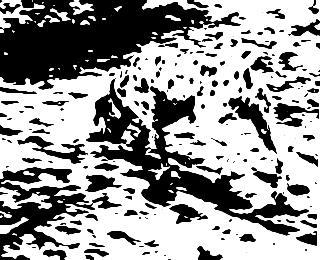
What do the dots in this picture show?

Hidden-Dalmatian.jpg

If you don’t already know the answer, you might struggle for a few minutes before you “see” the dalmatian. As soon as you know what’s in the picture, you can see it almost immediately, and in fact, it becomes hard to “unsee” as well. According to Kurzban, this means that a conscious module in the brain shared information about the picture with a visual processing module, and this affected its computations and therefore your perception of the picture. For similar reasons, this is why wine tastes better when we think it is expensive, and pain hurts more when we think it is caused by major damage in the body, as opposed to some innocuous healing process. But “top-down” information sharing won’t always change your perception.

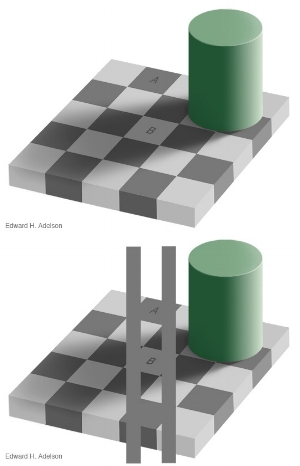
Consider the checkerboard illusion. Squares A and B are actually the same color!

Figure-ground_Organization_2.jpeg

There is a visual processing module that processes a ton of information to provide you with this (incorrect) perception. It considers the location of the cylinder, the shadow that it casts, the regularity of the squares on the checkerboard. Based on all of this computation, it “decides” that the squares are different colors, and therefore you see them that way. You are never provided with the “raw data”, the set of assumptions, or the thinking process that led to this conclusion. You just get the final product – a mental picture showing the squares as the same color.

And, interestingly, your conscious knowledge that the squares are in fact NOT the same color does nothing to change your perception. Unlike the dalmatian photo, conscious knowledge is not used by the visual processing module to make your perception more accurate. So the illusion remains. According to Kurzban, this is evidence that the work done by the modules is often fairly independent, immune to correction or maybe even input from other modules that know better.

(This is part of why Kurzban thinks we can be hypocrites – there is a social relations module in the brain – a public speaker – whose priority and function is giving you high social status. It doesn’t really care or maybe even know about information located in other modules of the mind, which proves that you aren’t as smart or moral or innocent as you claim in public. The separation of the modules creates “strategic ignorance.”)

Now consider this idea in the context of pain. Sometimes our knowledge and conscious thought processes about the body will affect how a body part feels. If we think that a body part is broken, degenerated, falling apart, unstable, this can make pain worse. And if we think that our body is robust, strong, and capable, this can make us feel better. This is multi-modal perception – sharing of information between the different modules. It explains why in the Dalmatian picture, conscious knowledge about the meaning of the picture affected our perception.

But pain is unfortunately sometimes more like the checkerboard illusion – immune to logic. People often have pain in areas where there is no damage, and sometimes in areas where there aren’t even body parts! Having conscious knowledge about these facts sometimes cannot affect perception. In terms of modules, we could say that the pain module is just not very interested in hearing corrective information from the cognitive modules. It was designed to be strategically ignorant about their conclusions. This is frustrating, but I think an interesting theoretical way to look at the problem of pain having “a mind of its own.” If the pain module won’t “listen” to the more cognitive modules, which modules might be better at speaking its “language?” The movement modules would be first on my list. If you move in a way that demonstrates strength, endurance, or skill, you will get a visceral “bottom-up” feeling of safety that speaks a different and more powerful language than Stuart Smally-style top-down daily affirmations.