Posts

Articles Of The Week April 1, 2018


This is great to see! A full interview with someone who has spent 4 decades treating veterans for pain, and is saying there is more to treating pain than opioids. He promotes a biopsychosocial approach and active movement therapies. Hopefully, his interdisciplinary approach will catch on!

“Researching Nondrug Approaches To Pain Management” – Robert Kearns PhD

When we are treating someone on our table, there is a lot of interaction going on. Mainly with the brain. We have to be careful how much credit we take for what we’re doing and empower the patient (and their brain) for their role in the whole process.

“Hey Hey, Ho Ho: Those Bogus Outdated Ill-Informed Egotistical Operative Tissue-Based Treatment Models Have Got To Go” – Diane Jacobs

With so many myths in our industry, this is one I had never actually considered. Fortunately, in this post, Harriet explains where the myth of drinking eight to ten glasses of water a day started, and why it’s false (could also lend itself to the myth of having to drink water after a massage).

“Do I Really Need To Drink 200 Ounces Of Water A Day?” – Harriet Hall

MORE MYTHS! This post goes to work on dispelling the myth about massage releasing or flushing toxins from your body (again lends itself to the myth of having to drink water after a massage).

“Old Myths Die Hard: The Truth About Toxins” – Sandy Fritz

This is really cool! We all know how important touch is, but this post explains why and how the body actually responds to it all, from the touch up to the brain.

“Touch And Pain” – Guro. E. Loseth, Dan-Mikael Ellingson, and Siri Leknes

Is Movement Therapy Rocket Science?


Pain and movement are pretty complicated, right? In a sense yes. But in another sense no. Pain and movement are not complicated, they are complex, which is a different animal.

Imagine you are Elon Musk trying to send a rocket ship to the moon. What sort of thinking process, analysis, modelling, research, predictions, and methods of control would help solve this problem? How would that process be different from solving the problem of say, raising a child? 

I’m sure you can think of many ways these tasks are different. For example, raising a kid requires diapers. Wait, does it really? Is that paleo? And here’s another thing: a quick google search tells me that astronauts actually wear something called a “maximum absorbency garment” on takeoff. Let’s face it, that’s basically a diaper.

But I’m getting off track here. Even if the need for diapers is not really a legitimate difference between rocket science and child-rearing, there are still many other differences that actually relate to the subject matter of this post. So here are some similar distinctions that help get to the point:

  • Designing a social media platform versus getting millions of people to use it
  • Building a highway versus reducing traffic congestion
  • Removing a brain tumour versus maintaining general health
  • Winning a war versus keeping the peace

What’s the difference?

According to an idea used by systems theorists, the first set of problems are complicated, while the second set is complex. Although these words sound similar, they describe two different systems that need different approaches to create desired change. Complicated systems are usually built from design, and include cars, computers and buildings. Complex systems were not built but evolved, and include living things, ecologies and economic systems.

Health professionals, including those working with movement and pain, often attempt to address complex problems as if they were merely complicated. As explained below, this is very much like the drunk who loses his keys in the alley but looks for them under the lamppost because the light is better there.

Read on for more information on how to tell the difference between these different systems and why it matters. The basic idea is that most problems with movement and pain are probably more complex than complicated. Surprisingly, recognizing this fact will probably simplify your approach to improving them.

Some Definitions

A system is a set of parts that work together to perform a common function. Both complex and complicated systems have many different parts and subparts that are very interrelated so that the behaviour of one part will affect other parts and the system as a whole. But there are crucial differences.

One is that a complex system does not have any means of central control. The orderly behaviour of the system “emerges” from the interaction of all the subparts. For example, a bee colony can accomplish amazingly sophisticated tasks like building a nest, but there is no single bee that knows how to build it. Instead, each bee is just following its own simple algorithm for behaviour. The intelligence that builds the nest lives in the interactions between the bees  – it is far greater than the sum of its parts. We, therefore, say that the hive’s intelligence is “emergent” or “bottom-up”,  as opposed to centralized or top-down.

Architecture without an architect

By contrast, a highway is a complicated project. Unlike a bee’s nest, it is built according to a central plan.

Everything is designed, predicted and controlled by experts at the top of a chain of command. These experts have the ability to gather all the relevant data about the project and order changes in every relevant variable. If something goes wrong, they can diagnose the reason for the dysfunction, and prescribe an appropriate correction. So the problem of building a highway is solved according to a very precise process, whereby proper analysis of all the parts leads to a complete understanding of the whole. (This is basically reductionism.)

Now imagine there’s traffic congestion and we want to reduce it. Can we follow a similar reductionistic, command and control process to solve the problem? No, because traffic levels depend on many factors that are unmeasurable, unpredictable and uncontrollable by any central planner: weather, accidents, and thousands of decisions by individual drivers, which are all made in relation to the anticipated and actual behaviour of other drivers and events.

Traffic congestion is, therefore, a complex problem not a complicated problem. That doesn’t mean you can’t solve it, but you do need a different approach. You can’t control the behaviour of drivers, but you can encourage it to change, maybe by building public transit, making carpool lanes or creating tolls.

The effects of these measures might be somewhat predictable, but there will always be uncertainty. It’s kind of like dealing with a toddler – some things that work with one kid will totally backfire with another. And you can’t force them to behave, but you can guide them in certain directions through changing incentives and environmental constraints.

So what do you think? Is improving movement performance and reducing pain more like building a highway or reducing traffic? More like rocket science or more like parenting?

Here’s a chart with more distinctions to help you decide.


Consider the work you do with your clients in light of these factors.

For example, does it absolutely require many years of training? If you are doing surgery or administering anaesthesia, then yes absolutely. If it’s helping someone lose weight or making someone feel better after a massage, then training certainly helps, but it is not absolutely required (and won’t guarantee success either.)

Here’s another question: Are you able to understand and solve problems by measuring and controlling all the relevant variables? Or, are there many crucial variables that are beyond your knowledge and control?

The Body Is Complex

Most of what happens in biological systems, including the human body is complex. The body is composed of billions of cells, none of which are any smarter than a bacteria. The intelligence which creates motor control, sensation, perception, including the perception of pain, emerges from the relatively idiotic interactions of all these billions of cells. There’s no one in charge. Unlike a car, the system was not built. It grew.

However! Just because the body is complex, that doesn’t mean that all problems related to the body are complex, or even complicated.

For example, a broken bone has a simple cause and a simple solution. Many other complaints that arise quickly in the body might be related to simple or merely complicated problems, such as acute injuries or even repetitive stress injuries. But many other areas of concern for movement therapists are complex.

Biomechanics is complex.

Motor control is complex.

And chronic pain is definitely complex.

Here’s a simple proof: World-class experts in these areas readily confess their ignorance about even the simplest matters:

Given this level of uncertainty, the problems of movement and pain look more like raising a child than rocket science. Expertise is clearly useful, but (given current levels of knowledge) it does not lead to a full understanding and control of the issues, and cannot be expected to significantly outperform good common sense.

That doesn’t mean you can’t make progress reducing chronic pain! Simple common sense interventions work for chronic pain, just as they work to raise a healthy child.

  • Get support from family, friends and healthcare practitioners. Go to a PT. Get a massage.
  • Learn more about pain. Maintain an optimistic outlook and internal sense of control.
  • Experiment or play with different ways to move. Confront your fears.
  • Apply a Goldilocks level of exercise stress to the painful area to encourage adaptation without further injury.
  • Exercise, sleep well, eat well and try to reduce stress.

None of these tactics are the kind of targeted, scalpel-like interventions that make highly predictable changes in complicated systems. They don’t involve the kinds of algorithms, recipes or blueprints sold by movement gurus.

But they work! Especially under the guidance of someone who is skilled in their application. And they are far simpler, cheaper, safer and honest than interventions that treat the body more like a machine than a living thing.

Articles Of The Week March 25, 2018

As a follow up to the article he published last week, Curtis shows us how important pain science explanations are vs. biomechanical explanations when communicating with our patients.

“Biomechanics Vs. Pain Science Part 2” – Curtis Tait

How do you explain tension headaches and their treatment to your patients? This post is full of information you could use to explain why Massage Therapy can help treat their headaches.

“Massage Therapy For Tension-Type Headaches” – Richard Lebert

We all know how important exercise is. As a result, some schools are getting more involved in exercise education for professionals using exercise as treatments for various pain and mental health issues. In fact, it is predicted that exercise recommendations are going to increase from world health organizations because of our sedentary lifestyles (which is part of the reason these schools are ramping up programs).

“How Exercise Prescriptions Could Change The NHS” – The Guardian

There are many facets to pain, and many variables on how to manage it. So, do pain management programs actually get people ‘doing’ in real life? Well, it could depend on the relationship between doing/performing and coping/adapting.

“Do Pain Management Programmes Really Influence ‘Doing’ In Daily Life” Bronnie Thompson

This is a pretty scary warning, but certainly one worth looking at. It turns out there can be catastrophic injuries from epidural steroid injections for back pain. Could be some useful information if one of your patients is considering one of these type of injections for their pain.

“FDA Warns About Dangers Of Epidural Steroid Injections For Back Pain” – USA Health Times

Will Any Old Exercise Help Your Patient?


So the real question should be, how specific should we be with our exercise prescription?(Now this could have turned into an epic blog, but I have decided to keep it brief and readable!)In my opinion, WE SHOULD ALWAYS BE SPECIFIC.

Now that’s a pretty emphatic statement so I should probably add a bit of nuance to that. For some people, the term specific means that we should use a SPECIFIC exercise for a SPECIFIC problem.

The world of therapy is littered with exercises that have been held up as the ‘best’ exercise to fix a certain issue and not achieved that status, think TvA activation exercises for back pain or VMO exercise for knee pain. Being specific in this way does not appear to be warranted with the current evidence base we have.

We could also be specific to some form of physical quality like strength or range of movement.

We see that in many cases when it comes to MSK pain going after a specific physical quality also does not seem to yield better results, there ARE a couple of examples of when being specific is important and I will discuss those later.

I might be bold and stick my neck out and say that non-specific pain (meaning we cannot pinpoint the source), of which we seem to have a bunch of around the body, probably needs a non-specific approach to exercise. This means that we cannot strongly suggest a singular exercise or a type of exercise that focuses on a physical/biomotor quality.

So Why The Need For Specificity?

So, everything I have said so far may seem to point towards there being no real need to be specific.

Does that mean that we can just give someone any old exercise and expect to see a positive result from it?

I don’t think so. Any application of exercise should come with some form of reasoning and we should start with the end in mind. What SPECIFIC effect do we want from our exercise? This will be SPECIFIC to the person and their current issue or goal.

This means that the reasoning approach is always specific but the application may not always be the same. So rather than be SPECIFIC to a type of exercise or presentation we are being SPECIFIC to the PERSON standing in front of us.

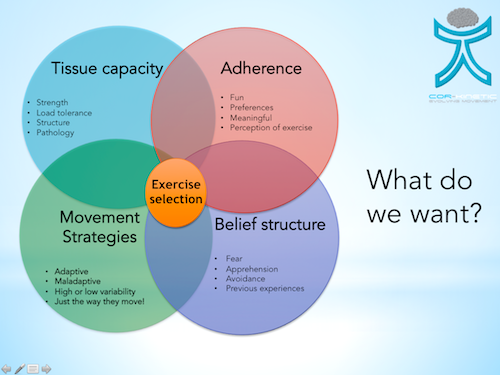
What Do We Want?

Screen Shot 2017 04 10 At 17.33.20

There are many different outcomes that we may want to achieve from our application of exercise and we find we can influence lots of different elements of human function.To make things a bit simpler and more organised we could make some broad categories.

Capacity

This could be tolerance of a specific tissue such as a tendon or muscle although we still have not quite worked out the relationship between pathology and pain here. There may also be clearly defined scenarios where we see the need for specific biomotor qualities, such as strength needing to be addressed postoperatively.

Pain

Pain relief maybe another specific outcome that you want to achieve from your exercise prescription.

It seems there that lots of types of exercise may create analgesic effects. Isometrics are the flavour of the month at the moment, but both strength training and cardio training also have the potential to create analgesic responses.

I am still slightly on the fence about the usefulness of short-term responses for all but I can see a clinical need for some groups of patients.

Belief

As we start to move away from a tissue focused view of exercise and movement, the concept of beliefs around exercise becomes much more important concepts such as fear avoidance and exposure-based therapies are starting to gain traction, and rightly so, especially as their role in actually getting people moving is starting to be appreciated more and more.

We might have to be very SPECIFIC to a movement but that movement is probably very SPECIFIC to the individual as well.

Adherence

It might not matter what the exercise or its aims are if it doesn’t get done in the first place. This is a great example of when non-specific is really quite specific. We may have to be specific in:

  • Location
  • Type of equipment
  • Preferences & enjoyment

to get someone moving again.

Movement

It has been hard to pin down many SPECIFIC movement ‘problems’ that we reliably see as a cause for pain. Our understanding of the mechanisms behind the pain experience are broadening and we see modern concepts such as the decoupling of SPECIFIC movements from pain responses as a plausible reason for using a movement based approach, but again these seem to be quite SPECIFIC to the individual.

Variability that is either too high OR too low might be relevant to pain, maintenance of pain and injury, or not! who knows?

It might be that just MOVING is what many people need!

Being Specific – Where’s Your Data!?

This does not mean that there are NO specifics we should aim for across people but they DO need to be clearly defined.

An example here might be, return to play for ACL rehab. Better outcomes have been shown if patients achieve RTP markers of almost equal, within 10%, of quadriceps strength and also hop performance.

We also see the specific use of eccentric contractions with the prevention of hamstring injuries over concentric strength work. The key here is if you ARE being specific that you have some form of data to back it up.

Remain Vigilant To The Specific Response

All exercise gives individual responses, it’s not just fire and forget.

Lots of exercise research is based around comparing the means of two different groups to look for a statistically significant difference or variation between the two groups. While this type of analysis does point towards a trend for an effect, in reality, it gives us little idea about individual responses to exercise so it is important to monitor someone’s response rather than just expect your reasoning process to have a successful outcome.

An exercise could make someone better, worse, or simply have no difference.

It is important to know that many exercise interventions don’t achieve spectacular results. The actual effect is often around the minimal clinically important difference (MCID). The MCID is the smallest difference that a patient is likely to see as important to them. Although this number varies across studies is generally around 2 points on an 11 point 0-10 VAS scale.

We must always be prepared to adjust the exercise type or dosage based on the SPECIFIC response from the patient.

Summing Up

  • We always need to be SPECIFIC
  • Not always in the same way
  • Always ask “what do we want?” from the exercise
  • Lots of different effects across the BPS spectrum
  • Want to be specific? Have data!
  • Always remain vigilant to the effectiveness of your exercise

Articles Of The Week March 18, 2018

Do you focus on a biomechanical style of treatment, or do you prefer to focus on pain science? Not sure what the difference is, or confused how to integrate both? Well, this post should help out with that. It’s only the first one in a series, but it’s a good way to get started if you’re not sure about those topics.

“Biomechanics Vs Pain Science: Bridging The Clinical Divide” – Curtis Tait

They say exercise is medicine. In clinical studies, it has been shown that regular aerobic exercise is as effective as anti-depressants for reducing symptoms of mild to moderate depression. Unfortunately in our society inactivity is the norm, so exercise isn’t used as much.

“Running From The Pain”  – Scott Douglas

More about exercise! Intense exercise can cause dramatic improvements in heart health, even at older ages.

“Hearts Get ‘Younger’, Even At Middle Age With Exercise” – Patti Neighmond

There are four critical questions we ask ourselves which make us feel like we are connected to our communities. It turns out taking one extra second to be connected with others can actually improve the quality of that presence. 

“How To Change Your Life In One Second Flat” – Katherine Schafler

There is a subheading in this article that is truly amazing. “The best workout isn’t always the most extreme one. The best on is the one you enjoy.” I’d say the same would apply to exercises you recommend to patients for homecare.

“Whatever Happened To Moderate Fitness?” – Colleen Stinchcombe

It’s Time To Start Building Your Tribe

“If you think leadership is only for other people, you’re wrong. We need YOU to lead us” – Seth Godin

We live in a time where information and innovation are at our fingertips.

Yet, within our profession, we still sit steeped in outdated information and a lack of updated education for our students coming out of college.

But there is a reason for that. It’s easier!

It’s easier to teach people to be sheep that follow along, rather than challenge the status quo. It’s easier to go decades without updating curriculum, while still teaching old information with confidence, and failing students for questioning otherwise.

What’s also easier is to just follow rather than question. And there’s nothing wrong with that, it’s human nature. Why would we question what educational institutions and regulatory bodies say?

Well, we have to in order to grow. 

This is where you come in. Your community needs you, and our profession needs you. We need you to embrace the tension between what you were taught and what new information says (it’s literally at your fingertips). 

If you don’t think you can do something like this, you’re wrong. There is a leader in all of us, sometimes we just need to learn how to bring it out.

So with that, here are some examples of therapists doing great things in their communities both locally and professionally to bring about change and make a difference.

Four Therapists Building Their Tribe

Rajam Roose

She was not a professional event organizer and had never taken on the task of organizing a conference while running her massage therapy practice. But, in January of 2014, after organizing a combination CEU course with Barrett Dorko, and Diane Jacobs, a light bulb went off. Rajam would go on to create the “San Diego Pain Summit,” which would officially start in 2015.

Rajam reached out to presenters and would organize them coming to one place to present on pain science, which would, in turn, start to influence our industry (this is where she started building her tribe). Many don’t know that she does everything for the conference herself, from managing the website, organizing speakers, hiring video, negotiating venues, and organizing volunteers (just to name a few of the necessary tasks), which has led her down a road into being more of an educator than strictly a Massage Therapist. Not only has this opportunity led into more business developments, it has also developed quality relationships with therapists from around the world, and gives her a feeling like she is serving our Massage Therapy community by helping therapists change how their patients pain is managed.

All too often many of us sit back because of “imposter syndrome” for fear that we can’t do something, or don’t know enough. So, I have to include this quote from Rajam:

I also have a bit of a rebellious personality. From prior life experiences, I’ve learned that we can do anything we set our minds to. I enjoy shaking up the status quo. For example, most people may be shocked to learn that I have very little formal education. I only have 2 years of high school and 1 year of a college education under my belt. I hope people will read this here, learn what I have and am doing, and be inspired to know they can do anything if they want.

Sarah Haag

Six years ago sitting on a train platform in Milan, Sarah was talking to her friend Sandy Hilton discussing how much better the world would be if healthcare was better, simpler, more efficient, and more scientific. They shared common goals and dreams when it came to patient care, so they started Entropy Physiotherapy.

Part of the goal was to host courses in their clinic where they and other therapists could learn from the best in the world, not just the best who happened to be closest to them when they needed a course. When picking speakers, they chose the ones that would challenge them, make them a little uncomfortable, and start discussions that would make practitioners better.

They wanted course offerings that left you energized from new ideas, collaborations, and developed new relationships. They reached out and started to find those exact kind of instructors, and also took a different approach in dealing with them. As a team, Sarah and Sandy would be very mindful of treating speakers well and not gouging them, or the course participants. While they didn’t have the intention of building a tribe, it has happened in the ensuing years. The people they’ve met at courses and conferences have become their tribe, which is something they’re only too happy to be a part of, not one they feel like they are leading (and they’re having a lot of fun doing it).

Brian Rutledge

“Necessity is the mother of invention” – Plato

After years of co-owning a successful group practice, Brian decided to go out on his own. 

He thought he had all the right skills and all the right plans, but he had no idea what was in store. While solo practice hasn’t exactly been great for his wallet, there have been other opportunities develop.

Having extra time, he has been able to learn about himself, while growing and refining his vision and purpose. This has given Brian the time to start teaching (even though advocating for up-to-date science can be an uphill battle and one that isn’t exactly rewarded), to engage with other professionals, and to pursue other interests. Some of those interests have led into building a community locally and online, as well as creating more educational content, to put on more courses locally for other practitioners.

Those interests have helped shape his practice and resulted in more enjoyment in what he does, a better relationship with patients, and the ability to refine crucial communication skills which have brought about a greater connection with people.

Two years of personal and professional development haven’t been easy, but building his tribe has been priceless.

Jenn Sharman

In October 2017 Jenn teamed up with an old classmate to open a new clinic.

They had a strong desire to create a clinic grounded in evidence-based approaches to treatment and patient care within the biopsychosocial lens while staying within their scope of practice as RMT’s. 

Knowing there was new research detailing advances in pain science for patient care, that wasn’t taught in school, they wanted to discuss these developments with other colleagues. They decided to create a monthly ‘pain science discussion group’ at their clinic. So far the response has been far more enthusiastic than expected (especially since it’s on Friday nights).

So far, three meetings in, the discussions have been on topics like “reconceptualizing pain, enhancing placebo-minimizing nocebo, and shifting from structural pathological to biopsychosocial.” 

Their group has a wide range of people from new grads to seasoned veterans who are all helping in their own way. While this represents an exciting time for manual therapy, it has brought about concerns. If students are not taught up to date information on pain it is doing a disservice to the public, which highlights how we need to come together as a profession to understand current best practices and let go of approaches or theories not supported by scientific evidence.

In creating this group, there is an attempt to share relevant research and get conversations started based on where to look for valid research and information.

This is another spot where I will include a quote:

it’s really exciting to see the level of interest amongst the community of RMTs. Once you get a group of passionate people talking in the same room, new connections and opportunities to create change will grow from there. I’m really excited to be a part of the conversations that need to happen to move our profession forward so that we can provide effective, compassionate and evidence-informed patient care.

Photo by: rawpixel

Now It’s Your Turn

I hope some of those examples will resonate with you as a therapist. 

It doesn’t take a fancy education, huge credentials, or a big financial backing to start making a difference. It just takes some motivation and the desire to create change. 

Part of what needs to be done is changing the effect some of the “modality guru’s” have within the manual therapy professions, they have made their own tribes. But those people are not where we are going to make change. Growth happens when we reach out to those who aren’t committed members of a tribe, but rather those who are at the fringes questioning modalities, old theories, or questioning those gurus. 

Looking at your local community right now, there are a few ways you can start to build your own tribe. Start by reaching out to other practitioners, whether they are Physio’s, Chiro’s, Athletic Therapists, or other Massage Therapists and be willing to start a conversation (just for the love of all that is good, please make sure it’s evidence-based). You will soon find out if they can be part of your tribe. 

Start pulling people in and discussing best practices, business, education, and whatever else will help each person in your tribe grow professionally and personally. 

Be a leader!

Once you have started locally, reach out online. Start fostering relationships with other practitioners, join in conversations, start conversations, watch debate and see what you can learn.  Join some facebook groups that will challenge your thinking, you will soon find out who you can learn from, and who is still stuck in old theories. Just make sure you join in the conversation.

As Jenn Sharman said, “it’s an exciting time to be a manual therapist,” and it’s a lot more exciting when more people are joining in.