Is Movement Therapy Rocket Science?


Pain and movement are pretty complicated, right? In a sense yes. But in another sense no. Pain and movement are not complicated, they are complex, which is a different animal.

Imagine you are Elon Musk trying to send a rocket ship to the moon. What sort of thinking process, analysis, modelling, research, predictions, and methods of control would help solve this problem? How would that process be different from solving the problem of say, raising a child? 

I’m sure you can think of many ways these tasks are different. For example, raising a kid requires diapers. Wait, does it really? Is that paleo? And here’s another thing: a quick google search tells me that astronauts actually wear something called a “maximum absorbency garment” on takeoff. Let’s face it, that’s basically a diaper.

But I’m getting off track here. Even if the need for diapers is not really a legitimate difference between rocket science and child-rearing, there are still many other differences that actually relate to the subject matter of this post. So here are some similar distinctions that help get to the point:

  • Designing a social media platform versus getting millions of people to use it
  • Building a highway versus reducing traffic congestion
  • Removing a brain tumour versus maintaining general health
  • Winning a war versus keeping the peace

What’s the difference?

According to an idea used by systems theorists, the first set of problems are complicated, while the second set is complex. Although these words sound similar, they describe two different systems that need different approaches to create desired change. Complicated systems are usually built from design, and include cars, computers and buildings. Complex systems were not built but evolved, and include living things, ecologies and economic systems.

Health professionals, including those working with movement and pain, often attempt to address complex problems as if they were merely complicated. As explained below, this is very much like the drunk who loses his keys in the alley but looks for them under the lamppost because the light is better there.

Read on for more information on how to tell the difference between these different systems and why it matters. The basic idea is that most problems with movement and pain are probably more complex than complicated. Surprisingly, recognizing this fact will probably simplify your approach to improving them.

Some Definitions

A system is a set of parts that work together to perform a common function. Both complex and complicated systems have many different parts and subparts that are very interrelated so that the behaviour of one part will affect other parts and the system as a whole. But there are crucial differences.

One is that a complex system does not have any means of central control. The orderly behaviour of the system “emerges” from the interaction of all the subparts. For example, a bee colony can accomplish amazingly sophisticated tasks like building a nest, but there is no single bee that knows how to build it. Instead, each bee is just following its own simple algorithm for behaviour. The intelligence that builds the nest lives in the interactions between the bees  – it is far greater than the sum of its parts. We, therefore, say that the hive’s intelligence is “emergent” or “bottom-up”,  as opposed to centralized or top-down.

Architecture without an architect

By contrast, a highway is a complicated project. Unlike a bee’s nest, it is built according to a central plan.

Everything is designed, predicted and controlled by experts at the top of a chain of command. These experts have the ability to gather all the relevant data about the project and order changes in every relevant variable. If something goes wrong, they can diagnose the reason for the dysfunction, and prescribe an appropriate correction. So the problem of building a highway is solved according to a very precise process, whereby proper analysis of all the parts leads to a complete understanding of the whole. (This is basically reductionism.)

Now imagine there’s traffic congestion and we want to reduce it. Can we follow a similar reductionistic, command and control process to solve the problem? No, because traffic levels depend on many factors that are unmeasurable, unpredictable and uncontrollable by any central planner: weather, accidents, and thousands of decisions by individual drivers, which are all made in relation to the anticipated and actual behaviour of other drivers and events.

Traffic congestion is, therefore, a complex problem not a complicated problem. That doesn’t mean you can’t solve it, but you do need a different approach. You can’t control the behaviour of drivers, but you can encourage it to change, maybe by building public transit, making carpool lanes or creating tolls.

The effects of these measures might be somewhat predictable, but there will always be uncertainty. It’s kind of like dealing with a toddler – some things that work with one kid will totally backfire with another. And you can’t force them to behave, but you can guide them in certain directions through changing incentives and environmental constraints.

So what do you think? Is improving movement performance and reducing pain more like building a highway or reducing traffic? More like rocket science or more like parenting?

Here’s a chart with more distinctions to help you decide.


Consider the work you do with your clients in light of these factors.

For example, does it absolutely require many years of training? If you are doing surgery or administering anaesthesia, then yes absolutely. If it’s helping someone lose weight or making someone feel better after a massage, then training certainly helps, but it is not absolutely required (and won’t guarantee success either.)

Here’s another question: Are you able to understand and solve problems by measuring and controlling all the relevant variables? Or, are there many crucial variables that are beyond your knowledge and control?

The Body Is Complex

Most of what happens in biological systems, including the human body is complex. The body is composed of billions of cells, none of which are any smarter than a bacteria. The intelligence which creates motor control, sensation, perception, including the perception of pain, emerges from the relatively idiotic interactions of all these billions of cells. There’s no one in charge. Unlike a car, the system was not built. It grew.

However! Just because the body is complex, that doesn’t mean that all problems related to the body are complex, or even complicated.

For example, a broken bone has a simple cause and a simple solution. Many other complaints that arise quickly in the body might be related to simple or merely complicated problems, such as acute injuries or even repetitive stress injuries. But many other areas of concern for movement therapists are complex.

Biomechanics is complex.

Motor control is complex.

And chronic pain is definitely complex.

Here’s a simple proof: World-class experts in these areas readily confess their ignorance about even the simplest matters:

Given this level of uncertainty, the problems of movement and pain look more like raising a child than rocket science. Expertise is clearly useful, but (given current levels of knowledge) it does not lead to a full understanding and control of the issues, and cannot be expected to significantly outperform good common sense.

That doesn’t mean you can’t make progress reducing chronic pain! Simple common sense interventions work for chronic pain, just as they work to raise a healthy child.

  • Get support from family, friends and healthcare practitioners. Go to a PT. Get a massage.
  • Learn more about pain. Maintain an optimistic outlook and internal sense of control.
  • Experiment or play with different ways to move. Confront your fears.
  • Apply a Goldilocks level of exercise stress to the painful area to encourage adaptation without further injury.
  • Exercise, sleep well, eat well and try to reduce stress.

None of these tactics are the kind of targeted, scalpel-like interventions that make highly predictable changes in complicated systems. They don’t involve the kinds of algorithms, recipes or blueprints sold by movement gurus.

But they work! Especially under the guidance of someone who is skilled in their application. And they are far simpler, cheaper, safer and honest than interventions that treat the body more like a machine than a living thing.
Will Any Old Exercise Help Your Patient?


So the real question should be, how specific should we be with our exercise prescription?(Now this could have turned into an epic blog, but I have decided to keep it brief and readable!)In my opinion, WE SHOULD ALWAYS BE SPECIFIC.

Now that’s a pretty emphatic statement so I should probably add a bit of nuance to that. For some people, the term specific means that we should use a SPECIFIC exercise for a SPECIFIC problem.

The world of therapy is littered with exercises that have been held up as the ‘best’ exercise to fix a certain issue and not achieved that status, think TvA activation exercises for back pain or VMO exercise for knee pain. Being specific in this way does not appear to be warranted with the current evidence base we have.

We could also be specific to some form of physical quality like strength or range of movement.

We see that in many cases when it comes to MSK pain going after a specific physical quality also does not seem to yield better results, there ARE a couple of examples of when being specific is important and I will discuss those later.

I might be bold and stick my neck out and say that non-specific pain (meaning we cannot pinpoint the source), of which we seem to have a bunch of around the body, probably needs a non-specific approach to exercise. This means that we cannot strongly suggest a singular exercise or a type of exercise that focuses on a physical/biomotor quality.

So Why The Need For Specificity?

So, everything I have said so far may seem to point towards there being no real need to be specific.

Does that mean that we can just give someone any old exercise and expect to see a positive result from it?

I don’t think so. Any application of exercise should come with some form of reasoning and we should start with the end in mind. What SPECIFIC effect do we want from our exercise? This will be SPECIFIC to the person and their current issue or goal.

This means that the reasoning approach is always specific but the application may not always be the same. So rather than be SPECIFIC to a type of exercise or presentation we are being SPECIFIC to the PERSON standing in front of us.

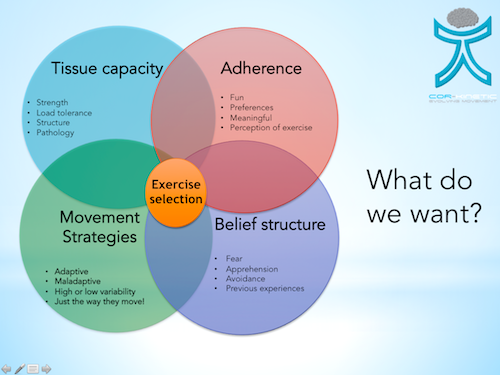
What Do We Want?

Screen Shot 2017 04 10 At 17.33.20

There are many different outcomes that we may want to achieve from our application of exercise and we find we can influence lots of different elements of human function.To make things a bit simpler and more organised we could make some broad categories.

Capacity

This could be tolerance of a specific tissue such as a tendon or muscle although we still have not quite worked out the relationship between pathology and pain here. There may also be clearly defined scenarios where we see the need for specific biomotor qualities, such as strength needing to be addressed postoperatively.

Pain

Pain relief maybe another specific outcome that you want to achieve from your exercise prescription.

It seems there that lots of types of exercise may create analgesic effects. Isometrics are the flavour of the month at the moment, but both strength training and cardio training also have the potential to create analgesic responses.

I am still slightly on the fence about the usefulness of short-term responses for all but I can see a clinical need for some groups of patients.

Belief

As we start to move away from a tissue focused view of exercise and movement, the concept of beliefs around exercise becomes much more important concepts such as fear avoidance and exposure-based therapies are starting to gain traction, and rightly so, especially as their role in actually getting people moving is starting to be appreciated more and more.

We might have to be very SPECIFIC to a movement but that movement is probably very SPECIFIC to the individual as well.

Adherence

It might not matter what the exercise or its aims are if it doesn’t get done in the first place. This is a great example of when non-specific is really quite specific. We may have to be specific in:

  • Location
  • Type of equipment
  • Preferences & enjoyment

to get someone moving again.

Movement

It has been hard to pin down many SPECIFIC movement ‘problems’ that we reliably see as a cause for pain. Our understanding of the mechanisms behind the pain experience are broadening and we see modern concepts such as the decoupling of SPECIFIC movements from pain responses as a plausible reason for using a movement based approach, but again these seem to be quite SPECIFIC to the individual.

Variability that is either too high OR too low might be relevant to pain, maintenance of pain and injury, or not! who knows?

It might be that just MOVING is what many people need!

Being Specific – Where’s Your Data!?

This does not mean that there are NO specifics we should aim for across people but they DO need to be clearly defined.

An example here might be, return to play for ACL rehab. Better outcomes have been shown if patients achieve RTP markers of almost equal, within 10%, of quadriceps strength and also hop performance.

We also see the specific use of eccentric contractions with the prevention of hamstring injuries over concentric strength work. The key here is if you ARE being specific that you have some form of data to back it up.

Remain Vigilant To The Specific Response

All exercise gives individual responses, it’s not just fire and forget.

Lots of exercise research is based around comparing the means of two different groups to look for a statistically significant difference or variation between the two groups. While this type of analysis does point towards a trend for an effect, in reality, it gives us little idea about individual responses to exercise so it is important to monitor someone’s response rather than just expect your reasoning process to have a successful outcome.

An exercise could make someone better, worse, or simply have no difference.

It is important to know that many exercise interventions don’t achieve spectacular results. The actual effect is often around the minimal clinically important difference (MCID). The MCID is the smallest difference that a patient is likely to see as important to them. Although this number varies across studies is generally around 2 points on an 11 point 0-10 VAS scale.

We must always be prepared to adjust the exercise type or dosage based on the SPECIFIC response from the patient.

Summing Up

  • We always need to be SPECIFIC
  • Not always in the same way
  • Always ask “what do we want?” from the exercise
  • Lots of different effects across the BPS spectrum
  • Want to be specific? Have data!
  • Always remain vigilant to the effectiveness of your exercise

Articles Of The Week March 11, 2018

Is yoga effective for managing chronic pain? Maybe, but then again maybe we just need to look at safe, non-threatening movement as a way to cure or manage chronic pain.

“Yoga, Mice, Pain and Your Brain” – Sarah Haag

There are some great points in this article about doing aggressive psoas work on patients, but there’s some things I don’t like about the article. To say that only those trained in visceral work should be doing this kind of work (because there’s not much evidence to say visceral manipulation is effective), is a bit of a stretch. However, I like the overall gist, that only trained professionals should be doing the work, and to be careful, there’s no need to do “aggressive” work.

“Serious Warning – If You Do Any Releases To Your Psoas or Abs, You Must Read This” – Antony Lo

Load management in athletes is an important factor in making athletes available for, and being in the best shape possible for competition. This post reviews three factors related to load management to help your athletes.

“Load Management Is Not About Decreasing Minutes” – Tim Gabbett

I love sleep, so I hate this part of the year where I lose an hour of it putting the clocks forward (why are we still doing this!?). A lack of sleep can lead to a host of health conditions and can affect brain health. Fortunately, massage therapy helps with sleep, so this could be a good article to share with your patients as another reason to get a massage!

“Why Are We So Sleep Deprived And Why Does It Matter?” – The Conversation

I’ve been asked many times if I would ever open up a practice at home and while it’s not for me, I know plenty of therapists who do. This post lays out several things to consider if you are wanting to open a home-based practice.

“Opening A Home Based Massage Business” – Allissa Haines

Articles Of The Week February 18, 2018

I may be partial, but I gotta say I love this post. It might be because I think this has happened to all of us. We have a patient come in who has been told by another practitioner that they will never get better, or they’ve been given some false information. Well, this is an open letter to everyone in our industry to do better.

“An Open Letter To My Patients Previous Therapists” – Sarah Haag

We all treat patients with low back pain. But, what are the appropriate guidelines for treatment? Well, some pretty reliable practitioners teamed up to look at the evidence, and explain the difference in guidelines, implementation, and controversies.

“Low Back Pain, A Ride Through The Guidelines” – Body In Mind

I don’t know about you, but I LOVE sleep. But how much do we really need? Well, that may vary, but it’s important to pay attention to our own individual needs, as well as looking at how to make sleep a priority.

“How Much Sleep Do We Really Need?” – National Sleep Foundation

One of the great things about massage therapy is the many ways we can focus on certain conditions or populations. If you’d like to focus on cancer treatment, this site has some good info. They present different recommendations as far as altering your treatment when someone is going through chemotherapy, and their reasoning seems pretty sound.

“Cold Caps, Frozen Feet, And Massage During Chemotherapy” – Tracy Walton & Associates

Our communication with patients is so important. So how do you present new ideas or research to them when you learn it? How about when it comes to your pain education? It doesn’t have to be complicated (in fact it’s probably a lot better if it isn’t), just explaining that certain areas of their body may be a bit more sensitive, is probably a lot better than a complicated description.

“Pain Science Education” – Lynita White


Articles Of The Week February 11, 2018

Like so many things in our industry, there is lots of confusion around youth strength training. Does it improve health? effect bone growth? is it even appropriate? Some great information in this article covering those questions and many others.

“Youth Strength Training”  – Mario Chavez

Chronic disease is a massive expense on our healthcare system, and yet there doesn’t seem to be much done to prevent it. So how can we start to change things to start making prevention a regular part of our healthcare systems?

“An Ounce Of Prevention Is Worth A Pound Of Cure” – Jarod Hall

Quite often I have patients and colleagues ask where to get good information on pain. Well, Lissanthea Taylor is stepping up with this great resource she is developing. There will be lots of information on pain so that we can give accurate information to others.

“Where’s The Good Information About Pain?” – Lissanthea Taylor

Do you know the difference between Varus and Valgus? This post will help to give you a better understanding of the differences between the two and what can contribute to it. One of the things I like about the article is how the author points out that someone may have this kind of condition, but not experience any pain, so it may not even need treatment.

“Valgus, Varus, Vargus…What Is It?”  – Whitney Lowe

Being in business for yourself is hard work! It seems there is a never-ending list of things that have to get done and we’re constantly hustling to accomplish more. But could we be more successful if we hustled less? Here are four tips on how to do just that.

“How Not To Hustle Your Way To Success: 4 Tips For Aspiring Entrepreneurs” – MeiMei Fox


Three Reasons It Matters Why A Treatment Works

Why exactly does someone feel better after a massage? Or acupuncture? Or foam rolling? Or a chiropractic adjustment, or wearing K-tape, or doing mobility drills, or a hamstring stretch?

There are some good answers to these questions, and the interesting thing I’d like to point out in this post is that quite often, the therapist doesn’t know them. Or even care about them! Or maybe the therapist has heard the good answers, but prefers alternative bad answers that are far less plausible given the current state of relevant science.

Speaking of bad explanations: Foam rolling probably doesn’t work by breaking adhesions or melting fascia. Chiropractic manipulation doesn’t put joints that are “out” back “in.” Deep tissue massage doesn’t get rid of toxins or “muscle knots.” Acupuncture doesn’t access special points or meridians – putting the needles in random places works just as well. Some sham surgeries work just as well the real thing. Motor control exercises often work to reduce pain even though motor control hasn’t changed.

None of this means that the above treatments can’t work to make someone feel better. It just means they don’t work in the manner advertised. And no this doesn’t mean that everything is just placebo (that’s a confusing word without a clear meaning.)

In general, it seems that therapists have a strong bias towards the idea they are fixing “issues in the tissues.”  And they tend to ignore issues in the more complex systems in the body – nervous, immune, autonomic – which are very sensitive to even minor inputs and have a great influence over how we move and feel. Maybe this is because these systems are less visible, or tangible, or just not what practitioners learned about when they were in school.

I was trained as a Rolfer and taught that Rolfing works by changing fascia. So when people got up from the table and said they felt taller, or looser, or had less pain, this was because their fascia had somehow changed for the better.

After doing some research about the deformability of fascia in response to manual pressure, I decided this was not a good explanation for our observations. A better explanation would involve the nervous system, which is constantly adjusting muscle tension, movement patterns, perception, and pain sensitivity in response to new sensory information, including the highly novel sensory information caused by bodywork.

Of course, it’s kind of a bummer to learn that a central premise of your education is incorrect. But the good news is that this doesn’t mean people can’t be helped with your treatment. That is a completely separate issue. So my attitude was – OK, it’s not about the fascia, but that doesn’t mean I can’t help people.

But for many Rolfers, it just has to be about the fascia. And for chiros, it has to be about the subluxation, and for Reiki practitioners, it has to be about energy, and for others, it needs to be about posture, or core strength, or muscle imbalances, or movement patterns.

And of course, many others will say: “I don’t care how the treatment works, I just know that it works does so who cares why?”

Here’s three reasons why it’s important to know why your treatment works.

1. If You Know How Something Works, You Can Make It Work Better

This should be obvious. If you know where the target is, it’s easier to hit the bullseye.

Let’s assume that stretching or massage works to create better range of motion by getting the muscles to relax. (Reasonable enough, right? And supported by research!)

But if you think that it works by forcefully breaking adhesions or physically lengthening tissues you might lose focus on whether your clients are staying relaxed.

When I work on someone I always ask “how does that feel?” Here’s a common response from clients who think it’s all about the fascia: “Don’t worry about me, I have a very high pain tolerance, just do what you have to do.”

And I will think to myself: “Well, I need to know how you feel because that is one of the main targets for this work.” But if my target was breaking up fascia or muscle knots then indeed I wouldn’t care how they felt. And I wouldn’t do as good of a job.

2. Unintended Consequences

Imagine someone with neck pain goes to the chiropractor, is told their neck is “out”, gets cracked to put it back “in”, and then immediately feels much better. What’s the harm if they think that pain relief came from some form of realignment?

Maybe in the short term, there is no harm, but false beliefs have a mischievous way of eventually causing problems in the long term.

Let’s say the neck pain comes back. The client thinks her neck must be “out” again so she needs another crack. So she overlooks other potential solutions like exercise, rest, or gentle movement. If the neck pain continues, she might eventually develop the pathological belief that her neck is fragile and unstable. This can have a nocebo effect – creating further pain and avoidance of healthy movement.

I have seen many clients with similar misconceptions, and this has cost them significant time, money, anxiety, and confusion.

And I’m not just talking about the clients of chiropractors.

I have seen yoga people who are always stretching; Pilates people always stabilizing; corrective exercisers looking for microscopic muscle imbalances; joint mobility fans perpetually mobilizing, as if their joints need a constant bath in synovial fluid, or will start knitting themselves together with some sort of fascial “fuzz” after just a few minutes of stasis. Rust never sleeps!

All these pathological behaviours ultimately stem from false beliefs about why certain therapies have worked for them in the past. These beliefs cluster around the idea that they have corrected “issues in the tissues” as opposed to temporarily adjusting the sensitivity of the nervous system.

The bottom line is that false beliefs, no matter how small, are like viruses – they multiply, get passed to others, mutate to form superbugs, and can eventually cause disease. Don’t spread them, people!

3. The Truth Matters

The truth has inherent value, even when its practical application is not immediately obvious. Knowledge is always powerful – for you, your clients, and the whole community.

We don’t yet know exactly why people have chronic pain and the best ways to treat it.

Even though that knowledge hasn’t been created yet, that doesn’t mean it’s useless to learn more. Every step away from misinformation and confusion is a step in the direction of the truth.

Let’s face it. The truth is good and ignorance sucks. Here’s some quotes from smart people to prove it.

“All evils are caused by lack of knowledge.”

–David Deustch

“I think it’s much more interesting to live not knowing than to have answers which might be wrong.” 

— Richard Feynman

“It ain’t what you don’t know that gets you into trouble. It’s what you know for sure that just ain’t so.”

— Mark Twain

 “The truth will set you free, but first it will piss you off.” 

–Joe Klaas

Many thanks to my readers and members of my social media community who are thinkers, skeptics, and unafraid to follow where the evidence leads.