Have We Ballsed Up The Biopsychosocial Model?

One of the most widely discussed topics in healthcare and especially in pain circles of late is the Bio Psycho Social model conceived by George Engel.  The BioPsychoSocial (BPS) model was developed in reaction to the dominant biomedical viewpoint that involves reducing medicine to specific diseases or pathologies that can be identified and treated and this model forms the backbone of most western healthcare systems.

Engel felt the biomedical model:

“does not include the patient and his attributes as a person, a human being”

But the question is, have we misinterpreted the BioPsychoSocial model?

Are we simply applying it in the same way as the biomedical model it was trying to replace?

It’s People Not Just Pathology!

We know that people’s experiences of pain and pathology differ. The same painful problem may manifest as huge issue for one person disabling them from work and reducing dramatically their quality of life, whilst another person may remain relatively unaffected. This has to be taken into account both in treating the problem but also how the person is TREATED by their healthcare professional, their family and social network and the wider healthcare system.

We can see below from Engel’s view that it is a bi-directional model that involves the layers in which we exist rather than discreet treatment targets as we now see.

Download 4We could perhaps determine this interaction between layers as the wider impact OF the problem rather than just as impacting ON the problem. Rather than seeing the BPS as a direct treatment model where we dissect the three domains to find new pain ‘drivers’ to treat, the BPS perspective should really be seen as a CLINICAL philosophy and guide that can be used for improved patient care.Here is another interpretation from a recent paper ‘How do physiotherapists solicit and explore patients’ concerns in back pain consultations’

“underpinning the bps model is patient-centred care (pcc) which involves incorporating the patient’s perspective as part of the therapeutic process”

One of the issues that are often encountered in healthcare however is that clinicians AND patients want solutions and treatments rather than philosophies and the conversion into a treatment model conforms to the biomedical perspective that dominates healthcare.

Maybe the BPS asks us, as clinicians to better understand our patients and their subjective experience? And it may be better defined as a model of care rather than a model of treatment. Now, this does not mean we cannot involve a BPS thought process IN specific treatment but remember that this is just not really the major focus of the model, certainly as I understand it anyway.

So it is really treating people and their overall existence, not just treating their painful problems. These differing aspects cannot just be separated and simply targeted without an understanding of the person and the context they exist in, doing that for me is the biopsychosocial model in biomedical clothing.

Other commentators such as Leventhal have looked at concepts such as the disease and the illness *HERE*. The disease being the specific issue and the illness being the wider issues surrounding the problem, in my interpretation, this is similar in concept to the BPS. How is this PERSON individually affected by the problem that may even BECOME the problem itself?

Just Treat The Pain?

I can already hear some readers shouting, “Just treat the pain – then you will not have any more problems”

Well, that is the biomedical view in a nutshell!

Firstly we have been attempting to do this for ages, hence why there has been a call for a different model. Often treatments for pain are not successful and people need help in other ways and we treat pathology but pain persists. Perhaps the interaction with healthcare even makes the problem worse!

Can we treat the person and pain? Yes, I believe so. We should not forget this, just realize our limitations at doing so and also avoid pain being the only focus.

The question is do we often attempt to treat the person AND the pain? I don’t think this happens as much as we would care to admit.  Maybe treating people rather than their pain can lead to reductions in pain? Maybe we cannot have an impact on people’s pain but affect suffering, disability, and quality of life? We may not be able to do this in a pain-focused model and why we end up with repetitive surgeries and the opioid epidemic?

People can still have pain and live a positive life; the BPS model is really well placed to help them do so and does life simply return to normal even after pain has reduced for all? I would hazard a guess that for many people their lives are fundamentally changed even AFTER persistent pain has decreased.

BPS Model Of Pain

A pain-oriented BPS model has emerged more recently and two examples of this can be found *here* and *here*. These interpretations should NOT be confused with Engel’s model I feel, and perhaps misses the essence of what he was reaching for. Maybe an issue with the BPS model is its breadth and how far-ranging it is? It is quite easy to place our interpretation anywhere within it.

The pain focused model looks at how Biological Psychological and Social factors can influence pain.

This diagram is a great example with the arrows pointing solely inwards.
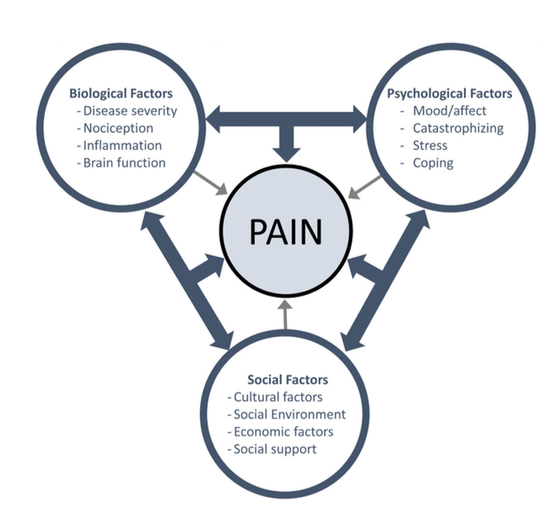
Screen Shot 2019 08 21 At 07.34.26(Figure Fillingim 2017)
The problem here is that it is a return to a biomedical view in which the person is less of a focus and instead the disease (in this case pain) has returned to become the primary focus. Instead of being a comprehensive BI-DIRECTIONAL clinical philosophy, it has in many cases become a unidirectional treatment model.  We also have much more evidence for BPS aspects being associated with pain than we do actual data to support treatment for pain using these BPS aspects.Seeing PsychoSocial factors simply as pain influencing factors is missing the wood for the tree’s I feel. This would be a multifactorial pain treatment model, not the BPS model set out by Engel.This has drawn critique, and rightly so, of the BPS model and its interpretations. A recent paper from Stilwell and Harman can be found here called “An enactive approach – Beyond the BPS model”(Thanks to the authors for the full-text link!). This critique, I feel and highlighted by the authors, is not really of the Engel’s model but instead, the pain focused interpretation that has evolved. We may not need to move beyond the BPS model, more just apply it in its intended way. Let’s try to do that before we think beyond it.Stilwell and Harman go on to say

“Pain is…..a process that emerges or unfolds through a whole person who is inseparable from the world”

but we should also consider the BPS perspective already to consider the whole world and our existence within it and not just its effect on pain!

The very essence of the BPS model was NOT to delve further and further into the microscopic components of biology but instead to also zoom out to encompass the other factors that may be at play in both pain and quality of life.  I have written about this *HERE*. But if we consider most of the discussion, theories, and dominant messages around pain they focus on the reductionist view that Engel was trying to get away from.

As an example please insert any painful problem here ‘XXXXX’. Even the most uni-factorial biological one you can think of… let’s say a fracture.

How does their perception and knowledge, sense-making, around the issue affect them and their behaviors?

How does the injury affect their work and family life?
What are their perceived implications for the future?
How confident are they to return to sport or activity?

How motivated are they to engage in rehab or treatment?

This is considering the PERSON and heir engagement and embodiment in the world not just breaking down pain ‘drivers’ as the trend seems to have become and accusations of people forgetting the bio (eye roll).

Straight Lines & Trichotimies

Some of the criticisms of the BPS pain model focus on the division into three distinct components biological, psychological, and social as well as a perceived linear causality between the associated factors and pain.

My view of Engel’s work is that he objected to a linear causality model. Emergent properties such as pain NEVER have simple linear relationships with causes (whatever they are?). Again this is a misinterpretation and application specifically to pain of the original work. Linear causality is a criticism of previous Cartesian pain models but appears to be alive and well in the BPS.

The term ‘non-linear’ means that small things can give large effects but also large effects in one area may also give rise to no effects in the targeted area.  There are so many interactions occurring that can affect each other that the same treatment may give rise to DIFFERENT positive or NEGATIVE outcomes dependent on the current state of the organism.

We seem to be happier for this to be the case now biomechanically, but less so biopsychosocially. If we are being honest then we have many more associations WITH pain from what is termed BPS factors than actual data from using these factors to treat pain.

The trend of splitting pain into separates categories of Biological, psychological, and social to diagnose and treat is another critique that Stilwell and Hartman highlight in their paper and neatly term a trichotomy. I feel Engel’s point was not that they exist distinctly as pathologies to treat but in their own right but to consider these things within the wider appreciation of the patient’s experience.

Conclusion

  • We should really see the BPS model as a CLINICAL PHILOSOPHY and way of incorporating the patient into healthcare.
  • It is intended to understand patients, their lives, and contexts.
  • The biopsychosocial model COULD be used as a pain treatment model, but this is probably not how it was intended. This may be better termed a multi-dimensional pain treatment model.
  • There is not really much data on outcomes from treatment using a BPS pain model.
  • BPS factors are not simply linear treatment targets.
  • We may need to better apply the BPS model rather than move beyond it.

Articles of the Week – January 3, 2021

A story that was making the news last week was the correlation between grip strength and overall health. While it’s important to remind ourselves of the difference between correlation and causation, perhaps we can use this relationship to help and gauge a client’s health during assessments.

Getting a ‘grip’ on better health – Fliders University


The Achilles tendon is the poster-child of tendon injuries. Here, we talk about the predisposing mechanical factors to Achilles pain and preventative exercises to keep them healthy.

Measures to Strengthen and Prevent Achilles Injuries – Tony Gentilcore


Professionals in our field of work are often overachievers who can’t wait to brush up on the next bit of research, read a book about business, and respond to every opportunity and request. However, as awesome of a practitioner as that makes you, it’s important to mind your own self-care.

Self-care for the Overachiever – Yusra Iftikhar


Here’s one to challenge your brain. We often talk about the importance of variation of movement for optimal health and recovery. However, this strength and conditioning coach has some good rationale on why and when you might want to turn back to specificity and repetition with athletes.

Variation Without Change – Eric Cressey


Two groups of people undergoing surgery – one listens to a blank tape while under anesthetic while the other listens to a tape of positive, therapeutic messages. Read on to find out which group required less pain medication upon waking.

Effect of therapeutic suggestions during general anaesthesia on postoperative pain and opioid use: multicentre randomised controlled trial – Nowak et al.

Starting Over


*While Laura Wrote this back in April, its applicable today as we look to the new year, especially as we see a second wave hitting several places, with new shutdowns in place. 


A couple of months ago, any one of us could have started a sentence with “When this is over,” and chances are, no one except your family or close friends might have known what personal problem you were referring to. Now, everyone knows what it refers to: COVID-19. For many of us, it’s personal on some level. We’ve had a friend or family member or acquaintance who was sick with it, or died from it, or maybe you’ve personally been sick with it.

At this point, no one knows when “it” will be over…” it” meaning the effects on society. There are millions of Americans out of work due to shutdowns of “non-essential” businesses. There are shortages in grocery stores…every day on my social media, I am still seeing people who can’t find a roll of toilet paper. This is Easter Sunday, and millions of Americans who would otherwise be at church are at home watching a service on television or streaming service on the Internet.  Some churches are holding parking lot services where the congregants remain in their cars.

I’ve had a lot of private messages from massage therapists asking my opinion on when we’ll be back to work. The short answer is, I don’t know. Nobody knows. I live in NC, and the governor ordered things shut down until April 30. I personally believe it will be extended beyond that, and even if it isn’t, I will probably wait several weeks beyond the date that it is lifted to go back to work. I’m the suspicious type, as well as one who errs on the side of caution, and I fear a “back to work” decision from the government that is based on economics instead of actual safety.

We tend to think in terms of ourselves and our own occupation and our own lives. There may be no intention of being selfish or self-centered, but that’s the way things are. In reality, there are going to be a lot of businesses, of every type, that do not survive this shutdown. Your favorite restaurant, coffeehouse, or bar may be forced out of business. Your neighborhood florist, art gallery, or gym that is privately owned and not part of a big chain may be gone. While some landlords are giving rent relief, others are not. Some business owners simply cannot pay rent for several months when they don’t have money flowing into the business to cover that cost. In fairness, some landlords count on their rent money to make ends meet themselves.

For many massage therapists (and others), once the shutdown is over, this will be like starting all over at square one. While many may have faithful clients that can’t wait to come back, we have to consider that many of our self-employed clients or those who work in businesses deemed non-essential, may be in the same boat we’re in: unemployment checks are not coming in yet, but the bills keep piling up.  A lot of people may have to choose between getting a massage or trying to catch up on their bills.

For those who are self-employed, and ICs (many of whom are misclassified, but that’s another story altogether), this situation may cause you to rethink your employment circumstances. Those who are employees have had a much easier time signing up for unemployment. While the federal government has announced the intention to extend unemployment payments to self-employed and ICs, most state unemployment websites have been waiting on instructions from the feds to get that started. NC’s website states that it is expected to be in place by April 25 for self-employed and ICs to file. If you don’t have a cash cushion, that’s a big financial strain for those who are waiting.

Anytime you choose to be self-employed, you’re taking personal risks. If you’re using independent contractors in your business, they (and you, if you have them misclassified) are also taking a personal risk. Ask yourself if you could live for 6 months without money coming in. If the answer is no, rethink your decision about your work circumstances. Go over your budget and see where you can cut expenses in order to save money. Maybe that means doing without stopping for coffee on the way to work every morning or doing without eating out. Or giving up your addiction to new shoes, or carefully tracking the mindless spending most of us do. I recently saw a meme pointing out that spending 27.35 per day adds up to $10,000 in one year. Using an app like EveryDollar can help you see where your money is actually going.

Many people are just one paycheck away from total disaster. I’ve been there myself in years gone by. This isn’t meant to be negative; it’s meant to be a reality check. We don’t know how long this is going to last, but it’s already evident that many people are in big trouble.  It’s a good idea, when the world returns to some semblance of normalcy, to treat this as an opportunity to start over with a plan to be better prepared, so the next emergency doesn’t knock you flat.

It’s also a fact that at the end of our lives, none of us are going to say “I wish I had worked more.” We’ll be wishing we had taken more time to stop and smell the roses, spent more time appreciating our families, had more quality time with our spouse, or learned to play the flute or paint or whatever you think you never have time for. If you have that time now, just do it. While you’re adding up your problems, don’t forget to add up your blessings.

In closing, I express my gratitude to all the medical personnel who are on the front lines, and the essential workers who are enabling us to still go to the grocery store, the gas station, and wherever else we NEED to go. I’ve found out in the past couple of months that I don’t need to go near as many places as I thought I did. Bless all who are sick and suffering and all those who have lost loved ones.  Bless you, all, and may you remain safe and well.

Articles of the Week – December 20, 2020

A study this past year suggests that heightened pain sensitivity may be a genetic mutation in those of us who possess neanderthal DNA. We can’t exactly do anything about a client’s genes, but that’s an interesting tidbit for you to know!

Neanderthal gene linked to increased pain sensitivity – Hugo Zeberg


“Habits are a safe harbour in stressful times.” Great sage advice that is referenced in this article about creating and maintaining healthy exercise habits in a time where stress and anxiety are running high.

Exercise Habits: Build Them When It’s Good – Justin Kompf


A study that examines chronic pain trends within a large occupational workforce from which you’ll likely recognize all of the concepts that predispose certain subsets of workers to pain. This gives us a great overview of how to explain employee health and manage prevention when, for instance, helping to create health initiatives within companies.

Cross-sectional study of prevalence, characterization and impact of chronic pain disorders in workers – N. Kerckhove et al.


A fascinating article regarding the affect of someone’s language can affect pain, particularly in bilinguals.

How language, cultural identity can affect pain – University of Miami


We all learned the basic physiology of muscle hypertrophy in school. However, it’s easy to lose track of these concepts in practice and, before you know it, all clients are doing ten reps of all exercises to no specific tempo. The Barbell Physio provides a great review to help us fine-tune our rehab methods.

The Mechanism of Muscle Hypertrophy – The Barbell Physio

How Beliefs And Communication Can Influence Pain

I was listening to a podcast today where the host was talking about successful entrepreneurs.

Since we’re all entrepreneurs I couldn’t help but notice how the information applied to us as therapists.

While the host wasn’t directing the information at healthcare professionals, the main point he was talking about was being good coaches. His biggest point was that being a good entrepreneur meant being a good coach and communicator.

This is especially true in our profession.

The way we communicate and “coach” our patients can have a profound effect on the results we get with them. Both in a negative and a positive way.

The words we use can have both a positive and negative effect, which sometimes can last for years, depending on how it’s delivered.

As we have been preaching about the evidence-informed practice and implementation of the BPS framework for some time, we felt it important (and it was also requested) to look at how the words we use affect patient outcomes.

Fortunately, Darlow et al. has done a number of papers on this so we can draw from some of the research that has been done!

For now, we’ll look at how not only our beliefs and communication but also our patient’s beliefs can affect outcomes.

Patient Beliefs About Their Back

When we look at the BPS framework of pain it can sometimes be difficult to separate what the differences are between psychological and social influencers that could be causing a patient’s pain.

This first paper(1) lays it out quite nicely and shows that psychological influencers include; fear-avoidance beliefs, catastrophization, self-efficacy beliefs, depression, emotional stress, and outcome expectations. Now, this can certainly be a lot to take in if it were someone’s first visit to come and see you, so don’t think you have to get it all figured out on the first visit.

When they looked at much of the data collected in this paper, they further broke down the information into five main themes.

  1. The vulnerability of the back
  2. Special nature of back pain
  3. Prognosis of back pain
  4. Activity and back pain
  5. Influences upon beliefs

Vulnerability Of The Back

Not surprisingly most of the people in this study(1) equated their back issues to physical injury, damage, or dysfunction.

While most were not sure what exactly was damaged they also believed it was possible to hurt their back without being aware they were causing any damage, they also believed that an increase in pain meant more damage, while a decrease in pain equaled recovery.

The interesting part is that while most participants didn’t understand what caused the pain or “injury”, they also came to the conclusion that somehow their back was vulnerable, or designed poorly due to a variety of factors that included genetics, previous injury, or misuse.

There was also a belief where activities that included bending, twisting, and sitting were dangerous things that could cause further injury or pain. In reality, how many times a day do we do these things which are quite safe activities!?

In addition to all these beliefs, many of the patients tended to catastrophize about the possible explanations about the cause.

The Special Nature Of Back Pain

This is another area that brought about some surprising results (at least for me).

People believed that pain was a function of the back and in order to protect itself, it was forcing the person to stop any activity. There were even beliefs associated with the back being its own entity that could achieve its own goals which a person had absolutely no control over.

While this hindered simple things like walking, it also became a threat to people’s financial security as they did not think they would be able to work at their secular jobs.

An interesting consideration was that back pain was difficult to understand without personal experience, however, it was acknowledged that their psychological well-being was affected making people feel old, depressed, and irritable even to the point of impacting their relationships with other people.

The Prognosis Of Back Pain

While the previous sections demonstrated getting a prognosis was important to patients there are some things that proved worrisome for patients.

Some things that stood out were the back’s ability to heal, timeframes, and the quality of healing. This was influenced due to thoughts of vulnerability, not sure if the back could heal, and also because of seeing how back pain affected those with chronic back pain. Most thought due to the type of injury they had, or because of not doing the right things their own back was not going to heal.

The paper(1) concentrated on those three topics, but in just looking at the beliefs around that, is it any wonder people end up developing chronic pain when their belief systems are basically telling them there’s no way they can get better?

Client, Clinician, and Community

To continue on the topic of back pain and beliefs Darlow(2) looked at three different entities that influence our beliefs about back pain, the client, clinician, and community.

We know that psychological factors play a role in all pain but do we really understand why? Because if we did, we could more positively change patient’s beliefs and decrease things like catastrophization, for better outcomes.

As mentioned earlier there are different themes which influence how a patient perceives their back pain. Things like genetics, previous injury, and worries about movement reinjuring the area and are seen as dangerous. So a person can weigh out the risk vs. benefit of not only engaging in activity, but also seeking out care.

As pointed out in this paper (2) almost half of those experiencing back pain don’t seek out care, but for those who do, they see more than one healthcare professional. The things that do cause people to seek care are things like high levels of disability, pain, and maladaptive beliefs like catastrophization.

Now, this is where we can play either a positive role…or sadly, a negative one.

This is because the beliefs of the therapist can influence the beliefs of the patient. Remember, those who are seeking care are typically experiencing disability, pain, catastrophization, so they want more information from a trusted source…YOU!

If we are providing a strictly biomechanical explanation, this can seem threatening as most of those explanations involve things like muscle strain, discs out, hip rotated, the rib is out, etc. In turn when these kinds of explanations are given, if the person feels pain in the area weeks, months, or years down the road, they equate the pain to that biomechanical explanation they were previously given. I’m sure we’ve all seen this in practice when someone comes in and automatically equates the pain they’re experiencing to that “same old injury” that has been going on for years.

Since we know it is likely they are seeking care from multiple professionals, if they are getting different explanations, this can result in not only frustration but increased uncertainty about their capacity to get better.

Interestingly, while very well-meaning professionals give instructions on proper lifting or moving techniques, this can be understood as a need to protect the back creating hyper-vigilance about movement.

However (as we have preached so many times on this blog) providing reassurance, validating a patient, showing that movement is safe, can empower a person not only now, but in the future.

When they looked at community in the study (2) some things that stood out were how messages stemming from places like schools, workplaces, media, and the internet had an influence on people’s beliefs. These actually influenced the amount of support given by friends, family members, and even colleagues. As it turns out, a spouse’s beliefs about pain can actually influence the amount of support or care they give to their significant other.

Now, if your beliefs about pain can actually influence the amount of care you give to someone you love, imagine how this is influenced in the workplace!?

In my past life (before becoming an RMT) I was an industrial first aid attendant in a sawmill, I would see this first hand (although I didn’t understand it at the time). When people were injured at work (keep in mind this was a very bravado-filled environment) people were called wimps (and a host of other names I dare not repeat on this blog), or it was commonly believed they were just trying to get an insurance claim.

If a person is facing this in the workplace, and say their spouse isn’t overly supportive, combined with bills piling up due to the added stress of not working, imagine how this influences not only a person’s beliefs around pain but also the amount of pain they’re in.

The spouse can also have a directly negative effect by emphasizing what the injured person can and cannot do. They can become overbearing in trying to do too much for the person, or by doing too little, again, this comes down to their beliefs.

Part of the issue is that so many of these beliefs don’t match what the current evidence says.(2)

A great example of how this can be changed is the pain revolution cycle tour put on by noigroup. Every year they do a cycling tour to different communities in Australia where opioid usage is high. They visit these communities and put on education events about pain and have seen significant reductions in opioid usage through their education and changing people’s beliefs. 

So, imagine what we could do with each of our patients by just providing a little education!?

We’ve heard so many times practitioners saying things like “I don’t need research, my work speaks for itself, I get results”. One small part of the issue with statements like this is that many times a practitioner has been practicing for years and hasn’t updated themselves, or their beliefs, so are still saying things that are way out of date. While they are very well-meaning (and yes probably have some good results) they are still instilling beliefs like “my pelvis is rotated, rib is out, bad back due to genetics etc. etc.” which as we have seen is actually harmful to a person. We have a golden opportunity to provide education to patients that will change this narrative and alter their belief system in a very helpful way. (2) If we can confidently sit in front of someone and provide reassurance that they aren’t broken and concentrate more on education that will be interpreted positively by not only the patient, but their significant others will bring about far more lasting benefit. However, the only way we can gain the confidence to do this, is by reading current research and staying on top of new information and resources like the ones we’ve cited here. Because really, while you owe this to your patients, you also owe it to yourselves.

If you’d like to learn more about how to incorporate these kinds of things in your practice, we have an upcoming course on the low back, hips, and pelvis we are offering via zoom in February where we will be discussing many of these strategies as well as therapeutic exercise that you can check out by clicking HERE

References

  1. Darlow B, Dean S, Perry M, Mathieson F, Baxter GD, Dowell A. Easy to harm, hard to heal: patient views about the back. Spine. 2015 Jun 1;40(11):842-50.
  2. Darlow B. Beliefs about back pain: the confluence of client, clinician and community. International Journal of Osteopathic Medicine. 2016 Jun 1;20:53-61.


Articles of the Week – December 6, 2020

There are a few different issues that you could probably use to summarize the struggles that we saw in 2020, and inequality is one of them. Read into some of the shocking things that you may not have known about prejudice in even the medical field.

Chronic Pain and Inequality – Paul Ingraham


Since Jane Fonda coined this term, “No pain no gain” has stuck with us in the fitness world. Conversely, it almost is demonized by many in the healthcare realm. What does the research really say about pain during exercise?

Is No Pain No Gain True? – Tommy Mandala


Another good reminder that self-compassion and self-love greatly increases the ability to cope with pain and illness, assisting our continued involvement in the valued aspects of our lives.

Self-compassion in chronic pain sufferers linked to a better capacity to continue engaging in valued activities – Eric W. Dolan


Non-operative ACL care will sound like a completely foreign concept to many of us. However, more and more research has been emerging that may make you pause and consider the power of conservative care in certain circumstances.

Non-operative ACL Management | What You Need To Know – Scott Buxton


Positivity is often hard for our patients to find amid their pain and other life struggles. This article highlights the importance on capitalizing on positive moments and helping clients celebrate the little victories in their lives and during their recovery.

Make Your Patients’ Good News Even Better with This One Simple Action – Larry Benz