• Home
  • About
  • Articles
  • Courses
    • Live Courses
    • Online Courses
  • Store
  • Contact
  • Course Login
  • Search
  • Menu Menu
  • Facebook
  • Twitter
  • LinkedIn
  • Instagram
Course Login

Looking at Pain From Different “Levels”

April 14, 2020/in Article, Massage, Massage Clinic, Massage Therapist, Massage Therapy, Pain/by Todd Hargrove


Pain can be a complex phenomenon, meaning that many different factors might contribute to pain, and that these factors can be interwoven in a way that makes it very hard to separate one from the other, either for purposes of explaining pain or intervening to treat it in some way.

This is a major theme of my recent book Playing With Movement, where I argue that complexity science has many concepts that are useful in understanding movement and pain.

One of these concepts is that complex systems are often nested. That means the system as a whole is composed of smaller subsystems, which are also composed of smaller subsystems and so forth.
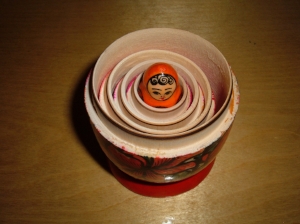
 

Example of pain complexity

Where is the pain?

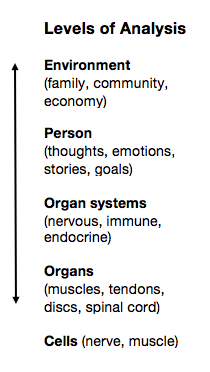
For example, people are made up of organ systems (like the nervous system or musculoskeletal system), which are in turn composed of organs (like the brain and spinal cord, muscles, and tendons), which are composed of cells (like nerve cells and muscle cells) and so forth. Further, people are parts of larger systems like families and communities and economies. This is interesting because each nested system provides a different level from which we can attempt to explain and treat pain.
Here’s a diagram to illustrate:
Screen Shot 2018-05-11 at 7.17.42 PM.png

At the “lower” levels, you can analyze the health status of cells and organs like muscles, tendons, discs or nerves. For example, maybe your foot hurts because of a stress fracture. This is where you can find “issues in the tissues”, which is where traditional pain treatment has focused most of its attention. This is often called the “biomedical approach” or the “bio” part of the biopsychosocial model. You find the structure that is damaged and work to repair it.

At the “higher” levels of analysis, such as the person or the environment, you are looking at more complex phenomena – the role of thoughts, emotions, or social relationships. These are the “psychosocial” issues that are known to have very important effects on chronic pain.

Problems in these areas are often relatively subtle, more about dysregulation or imbalance than something being broken or injured. These issues are also invisible if you look for them at a lower level. For example, you can’t see catastrophising by assessing a foot – you need to talk to a person.

Fields Of Study

There are many different formal disciplines you could study to get a better understanding at each level. Note that they are very different from one another, and very few people will have significant knowledge at more than one level.

Screen Shot 2018-05-11 at 7.19.35 PM.png

At the lower levels, you could study biomechanics, exercise physiology or neurodynamics. Each would give you a better understanding of how physical structures in the body respond to stress – either by breaking down and getting injured or adapting to get stronger.

You could move up a level to study the behavior of a larger system like the nervous system, immune system or endocrine system. This would help you see that pain functions like an alarm. The nervous, immune and endocrine systems help set the sensitivity of the alarm, and determine the kinds of events that cause it to go off. “Pain science” is mostly education in the basic physiology of these systems as they relate to pain. 

We can move up another level to the “person”, where we are studying the role of cognitions and emotions in pain. This is the realm of psychology, the relevance of which should be obvious – pain is a psychological event.

Psychological concepts can be very useful in understanding why movement and physical activity help with pain. For example, cognitive behavioral therapy can explain how exercise might extinguish fears or expectancies that contribute to pain. In many cases, this perspective is more helpful in choosing an exercise program than one focused on “lower-level” concerns about muscle groups, reps, and sets.   

You could move yet higher to study the role of social and economic systems. Many social critics argue that the real pathologies causing a wide variety of chronic diseases – including drug addiction, anxiety, depression, and even chronic pain – live more at the level of society than the individual. For example, low socioeconomic status is a big predictor of chronic pain. Most readers of this blog are not active in trying to solve problems at this level but are quite aware that they have a big impact on clinical outcomes.

Comparing The Different Levels

The terms “high level” and “low level” don’t reflect any value judgment. They merely indicate different perspectives: one is taking a “micro” view of relatively small and simple things like tendons or muscles, and the other is taking a “macro” or big picture look at larger complex things like nervous systems and emotions.

In general, if you’re moving down levels in your effort to explain some problem, you could call that “reductionist.” And if you’re moving up, that might be called a more “holistic” or “systems thinking” approach.
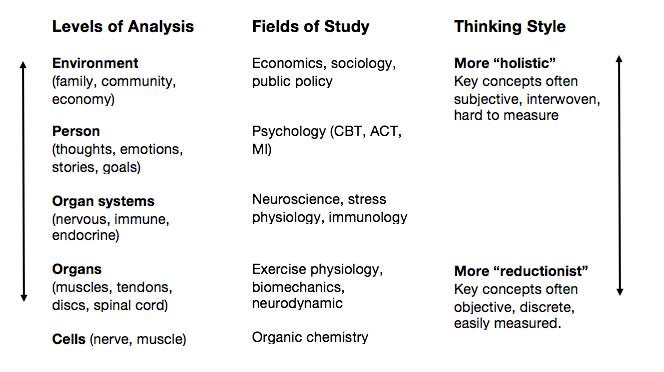
Screen Shot 2018-05-11 at 7.37.06 PM.png
Again, there is not necessarily any right or wrong here – the right level depends on the context.  Some problems with pain, especially those related to acute injuries, benefit from a lower-level approach – strengthen this, stretch that, do X sets of Y reps for Z weeks and then you will be fixed. Other pain problems can never really be “fixed” and may be hard to manage even with a whole team of psychotherapists, social workers, and attorneys.
Although each end of the spectrum has its costs and benefits, there is no doubt that until very recently, manual and movement therapists have spent way too much time at the lower levels, looking for issues in the tissues with their microscopes, while ignoring some very real big picture human issues sitting right in front of them. If the “pain science revolution” means anything, it is trying to improve basic literacy at the higher levels. “Playing with movement” means exploring a problem from as many different levels and perspectives as possible. To put it simply, finding physical activities that are challenging, meaningful and variable will go along way toward engaging us on almost any level that matters.

Todd Hargrove

Todd Hargrove is a Certified Feldenkrais Practitioner and a Certified Rolfer living and practicing in Seattle. He became interested in movement and pain twenty years ago, when as a lawyer, he was trying to treat his own chronic pain and win more squash matches. He got some great results, and eventually changed careers to help others make similar improvements. In 2008 he started writing a blog at bettermovement.org to share knowledge with a wider audience. His writing seeks to explain why pain science and neuroscience is relevant to manual and exercise therapists. He recently published a book called “A Guide to Better Movement: The Science and Practice of Moving with More Skill and Less Pain”.

  • Author
  • Recent Posts
Todd Hargrove
Follow Him
Todd Hargrove
Todd Hargrove is a Certified Feldenkrais Practitioner and a Certified Rolfer living and practicing in Seattle. He became interested in movement and pain twenty years ago, when as a lawyer, he was trying to treat his own chronic pain and win more squash matches. He got some great results, and eventually changed careers to help others make similar improvements. In 2008 he started writing a blog at bettermovement.org to share knowledge with a wider audience. His writing seeks to explain why pain science and neuroscience is relevant to manual and exercise therapists. He recently published a book called “A Guide to Better Movement: The Science and Practice of Moving with More Skill and Less Pain”.
Todd Hargrove
Follow Him
Latest posts by Todd Hargrove (see all)
  • Exercise Induced Analgesia - November 2, 2021
  • Does The Brain Think? - August 17, 2021
  • Why Some Movements are Incredibly Fun - June 7, 2021
Tags: Massage, Massage Clinic, Massage Therapist, Massage Therapy, Pain Science
Share this entry
  • Share on Twitter
https://themtdc.com/wp-content/uploads/Massage-Therapist-pain-levels.png 687 1037 Todd Hargrove http://themtdc.com/wp-content/uploads/logo.svg Todd Hargrove2020-04-14 07:12:202026-04-22 20:30:06Looking at Pain From Different “Levels”
You might also like
Predictive Coding: Why Expectation Matters For Movement And Pain
Models Of Pain And Movement
https://flic.kr/p/9Q4xUkUsing Massage Therapy For PTSD Treatment
Would You Pay For That?
Articles Of The Week July 21, 2019
Best manual therapy articles of the week for December 6, 2020Articles of the Week – December 6, 2020
Why Massage Is Like Chicken Sexing
Articles Of The Week September 30, 2018

Categories

  • Article
  • Business
  • Cardiopulmonary Resuscitation
  • Continuing Education
  • CPR
  • Emergencies
  • First Aid
  • First Responder
  • Massage
  • Massage Clinic
  • Massage Therapist
  • Massage Therapy
  • Mental Health
  • Myofascial Release
  • Nutrition
  • Pain
  • Pain Science
  • podcast
  • Posture
  • PTSD
  • Social Media
  • Sport Massage
  • Success
  • Therapeutic Exercise
  • Uncategorized

Join and stay up-to-date!

Email Marketing by AWeber

Have a solution to a problem within our industry? We want to hear about it!

Learn More

© 2020 – 2026  James Johnston RMT • All Rights Reserved

Todd Hargrove

Todd Hargrove is a Certified Feldenkrais Practitioner and a Certified Rolfer living and practicing in Seattle. He became interested in movement and pain twenty years ago, when as a lawyer, he was trying to treat his own chronic pain and win more squash matches. He got some great results, and eventually changed careers to help others make similar improvements. In 2008 he started writing a blog at bettermovement.org to share knowledge with a wider audience. His writing seeks to explain why pain science and neuroscience is relevant to manual and exercise therapists. He recently published a book called “A Guide to Better Movement: The Science and Practice of Moving with More Skill and Less Pain”.

  • Author
  • Recent Posts
Todd Hargrove
Follow Him
Todd Hargrove
Todd Hargrove is a Certified Feldenkrais Practitioner and a Certified Rolfer living and practicing in Seattle. He became interested in movement and pain twenty years ago, when as a lawyer, he was trying to treat his own chronic pain and win more squash matches. He got some great results, and eventually changed careers to help others make similar improvements. In 2008 he started writing a blog at bettermovement.org to share knowledge with a wider audience. His writing seeks to explain why pain science and neuroscience is relevant to manual and exercise therapists. He recently published a book called “A Guide to Better Movement: The Science and Practice of Moving with More Skill and Less Pain”.
Todd Hargrove
Follow Him
Latest posts by Todd Hargrove (see all)
  • Exercise Induced Analgesia - November 2, 2021
  • Does The Brain Think? - August 17, 2021
  • Why Some Movements are Incredibly Fun - June 7, 2021
Scroll to top

This site uses cookies. By continuing to browse the site, you are agreeing to our use of cookies.

OK

Cookie and Privacy Settings


How we use cookies

We may request cookies to be set on your device. We use cookies to let us know when you visit our websites, how you interact with us, to enrich your user experience, and to customize your relationship with our website.

Click on the different category headings to find out more. You can also change some of your preferences. Note that blocking some types of cookies may impact your experience on our websites and the services we are able to offer.

Essential Website Cookies

These cookies are strictly necessary to provide you with services available through our website and to use some of its features.

Because these cookies are strictly necessary to deliver the website, refusing them will have impact how our site functions. You always can block or delete cookies by changing your browser settings and force blocking all cookies on this website. But this will always prompt you to accept/refuse cookies when revisiting our site.

We fully respect if you want to refuse cookies but to avoid asking you again and again kindly allow us to store a cookie for that. You are free to opt out any time or opt in for other cookies to get a better experience. If you refuse cookies we will remove all set cookies in our domain.

We provide you with a list of stored cookies on your computer in our domain so you can check what we stored. Due to security reasons we are not able to show or modify cookies from other domains. You can check these in your browser security settings.

Other external services

We also use different external services like Google Webfonts, Google Maps, and external Video providers. Since these providers may collect personal data like your IP address we allow you to block them here. Please be aware that this might heavily reduce the functionality and appearance of our site. Changes will take effect once you reload the page.

Google Webfont Settings:

Google Map Settings:

Google reCaptcha Settings:

Vimeo and Youtube video embeds:

Privacy Policy

You can read about our cookies and privacy settings in detail on our Privacy Policy Page.

Privacy Policy
Accept settingsHide notification only

Clinical Pain Science For The Low Back, Pelvis And Hips

This course will be presented over a zoom meeting.  Details will be sent after you register.

Clinical Pain Science For The Low Back, Pelvis And Hips Remote