Acute Quadricep Contusion Management For Massage Therapists
He was a little slow getting up.
An opposing player tripped him, he fell to his knees and slid into the boards.
I was following the rest of the play and the student working with me pointed out he was hurt.
Looking down at the end of the bench, he was standing and shifting his weight back and forth from leg to leg and was bearing weight on the leg no problem. The whistle blew, so he went out for a quick skate to test it while there was a stop in play.
When he came back to the bench he was wincing and gave me a look that said he wanted some help.
As we walked into the dressing room, he had a bit of a limp.
Once he sat down, I started taking his gear off and there wasn’t much of an issue pain wise.
There was some tenderness just above the knee cap and his range of motion was pretty good, a bit of pain with muscle testing and some minor swelling in the area. We pulled him from the game and had him ice the quadriceps.
After the game he came into the treatment room and asked what he should do that night? Since we had a game the next night, I advised him to ice the quad, elevate it and take some ibuprofen.
Then the discussion started.
The student I was working with thought it was better to get inflammation to the area rather than prevent it.
After we discussed it, we still decided to go with ice and anti-inflammatories.
Treatment for Acute Quadriceps Contusion
There has been so much debate over this for the last while, it’s no wonder there was some confusion for treatment protocol.
I think Paul Ingraham explained it better than I could with his article titled “The Great Ice vs Heat Confusion Debacle”.
We use ice as a treatment application to reduce pain with acute injuries as well as reduce inflammation. While there is much debate on whether to reduce inflammation, the body has a tendency to over do it, so in the acute stages (in order to manage pain and mobility) ice is a good thing.
As with any other injury, you want to make sure you do a thorough assessment to determine its severity.
If you’re working on the sidelines in sport, your assessment happens immediately on impact or collision that causes the contusion.
Running through a quick checklist in your head can help:
- Was the collision severe enough to cause a fracture?
- Can the player bear weight?
- Did they need help to get off the ice or playing surface?
- If they can bear weight, are they walking with a limp?
- Are they able to bend the knee?
Once you get them into your treatment room, or away from play, your more concise assessment can start.
In the case of a Quad contusion, they are divided into three grades:
- Grade I (mild)
- Mild swelling and pain and able to walk without a limp.
- Passive movement beyond 90° may cause pain.
- A muscle test for knee extension may cause minimal discomfort.
- Grade II (moderate)
- Walks with a limp.
- Can bend the knee between 45°-90°.
- Swelling prevents full knee flexion.
- Grade III (severe)
- Progressive bleeding and swelling occur within 24 hours.
- Swelling won’t allow knee flexion past 45°.
- Flexing the quads is also painful or not possible.
- They will need to see a doctor.
The easiest way to do this is just by having the person lay prone on your treatment table (if possible) and you’re essentially going to perform an Ely’s test.
Once they are face down on the table just passively flex the knee (within pain tolerance) as much as possible to see what grade you get. Anything past 90° is mild, anything less than 90° is moderate to severe, the person should not bear weight and should be given crutches.
In order to treat a mild contusion an application of ice while the knee is braced in full flexion (this can be done using a large tensor bandage), puts a stretch on the muscle and helps maintain range of motion but the bracing should not be done for extended periods of time because it can weaken the tissues. One study showed that bracing for 24 hours immediately after injury (in addition to stretching and strengthening exercises after brace removal) had people back to full athletic function in 3.5 days.
For the first day or two continue with ice and anti-inflammatories to keep the swelling down. Use passive and active range of motion to keep the surrounding joints moving as well as preventing tissue changes.
With any hip or thigh injury, if the person can’t bear weight (grade II or III) they should be sent for more advanced medical care.
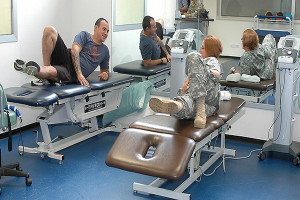
Photo by: The US Army
Return To Play For Massage Therapists
Once past that initial 24-48 hours and swelling has started to go down you can look at getting your athlete involved in their sport again.
Massage Therapy treatments can start in addition to functional exercises. As long as the athlete can do the functional movements associated with their sport, pass all functional tests, and range of motion is within 10° of the other leg, they should be good to go.
In the case of a Grade I, this could be the next day, Grades II-III will take longer and if the athlete has been sent for more advanced medical care, their return to play should be coordinated with feedback from the doctor.
There are a couple of complications that should be ruled out with Grade II-III (possible compartment syndrome and myositis ossificans) and this requires a doctor’s care.
It will be rare to see an acute quadricep contusion in a clinical setting, but if you are interested in or are already working in sport, there is the potential to see this all the time. While there are many guidelines that can be used, good clinical reasoning on your part will be the best guideline for whether an athlete can return to play again. The player treated in this story was back on the ice and in the game the next night. Using some ice and anti-inflammatories helped manage his pain when he got home that night, so that he could get a decent sleep. The next day, the swelling had gone down, he was functioning well and we put a bit of extra padding in place for protection. Athletes are a bit of a different breed compared to the general population in cases like this, they will do whatever they can to get back in the game and sometimes to their own detriment. In his most recent book Ron MacLean tells a story about Trent McCleary, a former NHL player who repeatedly used his body to block shots which meant constant swollen and bruised ankles and knees, and the odd charley horse that took him out of a game or two. But he didn’t like to get out of the way because he thought that was putting himself ahead of the team. Besides, he was getting good at managing contusions with ice and flexing.


- Episode #29 Dealing With Burnout - May 25, 2026
- Episode #28 With Great Educational Power, Comes Great Educational Responsibility - May 25, 2026
- Episode #27 Myofascial Release And CLB, What Does The Evidence Say? - May 25, 2026