Posts

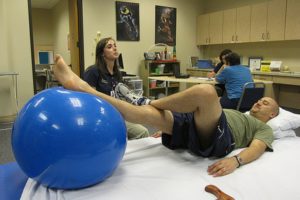
Should Massage Therapists Stretch Athletes Pre-Performance?

Hey, can you stretch me out a little before the game?

Well, no but we can after the game, it’s best to not stretch before the game but I can help you with your warm up.

Teachers had told me that doing any kind of stretching on athletes pre-event can actually mess up their stride and make things worse (if you’re stretching out the lower body).

Recent research has shown that stretching doesn’t really do what we thought it did and has been argued that it may be a feel good thing as opposed to a therapeutic intervention.

So what about when your athletes want you to stretch them out, especially pre-event?

What Actually Happens During A Stretch

As new research develops we have come to learn that stretches aren’t actually lengthening a muscle, but rather it is the nervous system reacting to the tension placed on the muscle that causes the change.

I always thought that doing a stretch actually elongated a muscle but upon further reading, have come to understand things a little differently.

When we do a stretch and reach that point of feeling tension in the muscle, the GTO (Golgi Tendon Organ) monitors what’s happening and reports back to the central nervous system which then affect’s the muscles response to a stretch.

The nervous system feels the tension and then regulates how far it will allow the stretch to go.

While I used to believe that we were actually lengthening muscle fiber, I’ve come to learn it’s all up to the nervous system.

So then, if I stretch an athlete out before competition, am I actually messing up their stride?

Static Stretching

Static stretches are probably the most commonly used stretch, especially among amateur athletes and weekend warriors.

It’s the type where you place tension on the muscle for 10-30 seconds without much movement involved.

When it comes to athletes and their performance a few studies have shown whether this is helpful to do before competition.

One study  compared 12 college baseball players having stretching done as part of a warm up before throwing pitches. The results showed that doing static stretches as part of the warmup made no difference whatsoever.(1)

Another study done on 16 NCAA track athletes over four weeks showed that static stretching before doing 20 m sprints actually added time to their sprint, showing that stretching had a negative impact on performance. (2)

In an effort to mix things up, thirty teenage athletes were tested on doing dynamic exercise combined with static stretching as a pre-event routine. They were tested on vertical jump, medicine ball toss, 10 yard sprint and an agility shuttle run. The test showed that it might be more beneficial to combine the dynamic exercise with the static stretch in athletes performing power activities.(3)

It’s interesting to see that between the three studies there is a combination of upper body and lower body tests as well as a difference in muscle groups being tested.

Also, the tests were done on very different activities but all came back with either no effect or a negative effect.

So maybe my sport massage teacher was right!?

Not so fast.

Photo by: Ryan McGuire

Photo by: Ryan McGuire

Dynamic Stretching

Dynamic stretching is when there is movement and resistance applied during the stretch.

Commonly known as PNF (proprioceptive neuromuscular facilitation) which has a few other titles under it like:

  • Contract Relax
  • Antagonist Contraction
  • Hold Relax with Agonist Contraction

Essentially you passively stretch the patient, then they contract the muscle against your resistance for a short count and you’re able to passively move the limb or joint into a greater range of motion after they resist.

This is where things change up a little bit with your athletes.

A study on 12 track athletes (yes I know these are small numbers) who train for explosive power, showed that dynamic stretching of the hamstrings increased jump height, yet decreased after static         stretching.(4)

It doesn’t just have an effect on explosive power either.

A study was done to see how it would effect balance, agility and reaction times on the upper limbs. 31 female high school athletes were tested by doing 3 min jogging, then either dynamic stretching, static stretching or rest. Again dynamic stretching won. (5)

Two more studies show that dynamic stretches are a benefit.

One was on female basketball players and their bicep brachii muscle, which recommended dynamic stretches for explosive maximal exercise. (6) The other showed that dynamic stretches for 20 seconds prior to a vertical jump improved not only height, but hip and knee range of motion. (7)

So apparently not all stretching is created equal.

However, the question is why?

There was a study done where heart rate and electromyography (EMG) data were collected and it showed via the EMG that a fast dynamic stretch is linked to greater nervous system activation and prepares an athlete better. (8)

It always goes back to the nervous system.

However now that I have written this post I also have a caveat to the whole thing. After years of working in hockey, one thing I know for sure is: athletes know what they like. They also know their bodies and performance routines better than your average weekend warrior. Before every game or competition athletes like routine, don’t mess it up. If they regularly have you stretch them before a game and want it, then explain why a dynamic stretch is better and ease them into it if they’re not used to it. Also important is to know your sport. Most of the studies listed in this post were very specific for certain movement. Warming up Usian Bolt before a 400m sprint is vastly different than taking care of Sidney Crosby. A sprinter has under 10 seconds to perform, whereas you can help a hockey player warm up, then he goes out for a 10 minute pre-game skate and warm up before the actual game. Your warm up is not going to have the same effect in two drastically different sports. Either way, try to educate and don’t screw with their routine, they really don’t like that.


References:

  1. Haag S, Wright G, Gillette C, Greany J. Effects of acute static stretching of the throwing shoulder on pitching performance of national collegiate athletic association division III baseball players. Journal Of Strength And Conditioning Research / National Strength & Conditioning Association [serial on the Internet]. (2010, Feb), [cited July 18, 2016]; 24(2): 452-457. Available from: MEDLINE with Full Text.
  2. Nelson A, Driscoll N, Landin D, Young M, Schexnayder I. Acute effects of passive muscle stretching on sprint performance. Journal Of Sports Sciences [serial on the Internet]. (2005, May), [cited July 18, 2016]; 23(5): 449-454. Available from: MEDLINE with Full Text.
  3. Faigenbaum A, Kang J, McFarland J, Bloom J, Magnatta J, Hoffman J, et al. Acute Effects of Different Warm-Up Protocols on Anaerobic Performance in Teenage Athletes. Pediatric Exercise Science [serial on the Internet]. (2006, Mar), [cited July 18, 2016]; 18(1): 64. Available from: SPORTDiscus with Full Text.
  4. MEERITS T, BACCHIERI S, PÄÄSUKE M, ERELINE J, CICCHELLA A, GAPEYEVA H. ACUTE EFFECT OF STATIC AND DYNAMIC STRETCHING ON TONE AND ELASTICITY OF HAMSTRING MUSCLES AND ON VERTICAL JUMP PERFORMANCE IN TRACK-AND-FIELD ATHLETES. Acta Kinesiologiae Universitatis Tartuensis [serial on the Internet]. (2014, May), [cited July 18, 2016]; 2048-59. Available from: SPORTDiscus with Full Text.
  5. Chatzopoulos D, Galazoulas C, Patikas D, Kotzamanidis C. Acute Effects of Static and Dynamic Stretching on Balance, Agility, Reaction Time and Movement Time. Journal Of Sports Science & Medicine [serial on the Internet]. (2014, June), [cited July 18, 2016]; 13(2): 403-409. Available from: SPORTDiscus with Full Text
  6. VEEVO M, ERELINE J, RISO E, GAPEYEVA H, PÄÄSUKE M. THE ACUTE EFFECTS OF WARM-UP, STATIC AND DYNAMIC STRETCHING EXERCISES ON BICEPS BRACHII MUSCLE FUNCTION IN FEMALE BASKETBALL PLAYERS. Acta Kinesiologiae Universitatis Tartuensis [serial on the Internet]. (2012, Dec), [cited July 18, 2016]; 1839-46. Available from: SPORTDiscus with Full Text.
  7. Murphy J, Nagle E, Robertson R, McCrory J. Effect of Single Set Dynamic and Static Stretching Exercise on Jump Height in College Age Recreational Athletes. International Journal Of Exercise Science [serial on the Internet]. (2010, Oct), [cited July 18, 2016]; 3(4): 214-224. Available from: SPORTDiscus with Full Text.
  8. Fletcher I. The effect of different dynamic stretch velocities on jump performance. European Journal Of Applied Physiology [serial on the Internet]. (2010, June), [cited July 18, 2016]; 109(3): 491-498. Available from: MEDLINE with Full Text.

Tips For Writing Amazing Massage Therapy Blog Posts

The first one took me hours.

I mean loooong hours to write.

I hired a professional writer I know to help me get into this whole writing thing, read books on it and even debated taking some classes.

My professional writer friend gave a great piece of advice when he looked at me and said:

“Jamie, writing is like a muscle, you have to use it and develop it to make it strong”.

Blog articles still took me hours to write, I wanted them to be perfect (but honestly not one of them ever has been).

However as time goes on things got a little easier, sort of like a new workout program. At first you’re sore all week, then a month later you’re getting a bit of a high after each workout and the pain goes away. But just like that workout, it’s usually better if you have someone coaching you and helping you.

So here are some methods to help you start getting some blog posts out for your clinic.

Getting Started With Massage Blogging

Before you get going, make sure you are setup to be distraction free and in a comfortable space.

Choose whatever you like best, computer or pen to paper. If it’s pen to paper you prefer, get yourself a really nice smooth writing pen to make it as enjoyable as possible.

If it’s keyboard you prefer, do your best to stay disconnected from the internet so you’re not tempted to constantly check Facebook, twitter or play angry birds.

I always like to have a really good cup of coffee and put some music on.

I know some people like to put on some hip-hop or reggae, but for me it’s George Strait.

Okay, now that you’re set let’s get going.

Telling Your Story

While blogging is a great way to educate your patients, the real thing you want to do is entertain them.

Tell them a story, tell them your story.

If you’ve been following this blog for a while, I try to start every post off with a story as it is a great way to intrigue a reader (and hopefully keep them reading),

A good example is the post I wrote about dealing with someone who has had a stroke. I started off the post talking about a real life situation where I helped a friend of mine who suffered a stroke. It’s effective because it gets the reader involved and adds more weight to the post than me just simply saying: this is what you will see.

“It was around 1am Monday morning, when I realized there was an issue.

That night, something seemed different but nobody else really noticed. Standing with his arms crossed almost supporting one arm with the other, our conversation seemed confused as he constantly gazed at the floor.

As we walked to the First Aid shack for a coffee, I asked how he was feeling:

“not good”

How was the weekend?

“I don’t remember, apparently I didn’t show up to work on Friday”

Did you leave the house to go to work that day?

“I remember dropping the kids off at school Friday morning, but that’s really the last thing I remember”

As we kept talking, his slurred speech became more noticeable. When he relaxed, those crossed arms became one crossed arm and one seemingly limp arm. Looking into the eyes and face of this normally strong, athletic man there was something missing. His left side was almost motionless, wilted.

Can you lift your arms above your head for me?

The right arm went up, left one didn’t move.

Can you kick your legs out for me?

The right one kicked out, left one stayed put.

We need to get you to the hospital.”

Seeing how this person moved and was reacting to our conversation paints a better, more realistic story than me just explaining what the symptoms of a stroke are.

So if you were doing this as a post for your clinic, using a real life experience of how getting a massage has helped you in the past, or how you have helped someone else with a particular condition. It will make your reader engage and think “yeah that’s exactly how I feel”, now you’ve hooked a potential or current patient who recognizes you as the professional and the Massage Therapist who can help them.

Always try to lead with a good story.

The Disney Method For Massage Therapists

One of the toughest things about writing is how hard we are on ourselves.

If you’ve ever tried to write anything there is a constant voice in your head saying:

“that was terrible”

“no one is going to read this”

“you’re like the Adam Sandler of serious writing” (okay maybe that one is just me, but you get the point).

This happens to everyone when they start trying to write, it’s our internal editor and it’s harder on us than anyone who reads our writing.

The hardest thing to do is turn off that internal editor, but to start that’s what you have to do, you can edit after you’ve actually written something down.

The Disney Method is how Walt Disney used to come up with ideas and he made it a three phase process.

It consists of:

  1. The Creative Phase (or dreamer phase)
  2. The Realist Phase
  3. The Critical Phase

Once you start to practice this, it can make the whole process of writing a blog a lot less daunting and time consuming.

1. The Creative Phase

Pick a topic, it doesn’t have to be fancy, pick something about massage therapy you’re passionate about and know a lot about, it’s a good place to start.

Just start writing.

Write with reckless abandon, like there is no chance anyone is ever going to read this.

Turn off that internal editor and just let whatever thoughts are in your head pour on the page or the keyboard, whatever your choice is for writing.

Be the most creative you can be, don’t worry about spelling, grammar, mistakes or anything and for god’s sake don’t hit the delete key. Use whatever tone comes natural to you because at this point it doesn’t matter, just let it pour out.

In the example I gave about the person having the stroke, when I sat down to write that, it was full of swear words (I kinda have a mouth like a sailor) because I remember that night and couldn’t believe my friend and mentor was in that condition.

It was a rough and I mean rough draft.

But that’s fine, you can clean up anything you write in the next phase, but you have to get that first draft out.

2. The Realist Phase

In the realist phase you want to make sure your story flows.

You’re going to go through and edit that rough draft with very broad strokes to make sure your story makes sense. Don’t worry so much about grammar and spelling at this point, just see if sentences need to be changed to give the story some real body.

Does a sentence work better a few paragraphs up or down?

Does a paragraph need to be moved?

Just shape your story to make sure it flows in a logical sequence and put the big pieces together so it makes sense to your reader.

In the stroke article, the story was the introduction, then the body of the post was video that gave instructions on how to deal with a stroke in your clinic. Go through your post and make sure the story ties in to what you can do for your potential patient with whatever topic you picked.

Now  your potential patients are starting to put together how you can help them and why they should be coming to you for treatment.

3. The Critical Phase

Now it’s time to rip things up.

Go through and get ruthless with your editing.

Sentence by sentence trim what isn’t needed. Line by line slash what isn’t needed.

Take out any and every word that isn’t needed.

See if you can take as many words as possible out of each sentence without changing it’s meaning or tone.

When people are reading blogs they skim through them, it’s rare they get read word for word (seriously, you aren’t reading these posts word for word!?).

Go through and take out the word “that” wherever possible along with phrases like “in other words”. And don’t ever say things like “in my opinion”, we know it’s your opinion, you’re writing it.

You get to be creative in the first phase, but now is when you need to be critical (but don’t be super hard on yourself, remember writing is a muscle).

This is also a good place to go through and add any research you think is applicable that you have done for the post. It’s always good to add some kind of research into a post to give it legitimacy, especially if you’re writing for patients, it will reinforce you are the professional.

When adding your research to a post, you don’t have to use specific referencing styles, you can just add hyperlinks in the appropriate text of your article.

It’s a blog, not a research paper.

Photo by: fancycrave1

Photo by: fancycrave1

Coming To Conclusions

Now that you’ve gone through and edited things and the post is looking great, you’ll need to come up with some sort of conclusion.

A conclusion is a great way to wrap up the post and highlight the main points.

The conclusion is also a great way to leave an impression on your reader. Always try to leave them with a smile on their face, it will make them want to come back for more. This is how I wrapped up that post on dealing with strokes:

Later that morning I went to the hospital to check on him. As I walked in the room he looked at me and shouted to the nurse:

“Hey nurse there’s the little jerk that sent me in here” (they had him on some pretty good stuff)

“You should thank that little jerk, he saved your life”

I’ll be honest, that took some editing because the language he used was a lot stronger than “little jerk”, but you get the idea. While it can be tough getting into blogging for your massage business on a regular basis, if you start making it a practice it will get easier. If you try writing and you get stumped, take a break and go do something else, go for a walk, play angry birds for 15 minutes, just get a break. It’s amazing how much your ideas and writing can change with even a 10 minute break. Also, don’t be too hard on yourself if the first one takes you a bit of time. Set a timer for 20 minute time intervals. Use each interval to go through the Disney method to be the creative, the realist and the critic. See how your article looks after each time interval and continually build it up until you’re happy with it. Feel free to share your posts in the comments below when you try it. Hopefully before too long we’ll be able to get a guest post on theMTDC from you.

Why YOU Should Blog For Your Massage Therapy Business

Sometimes I just sit here staring at the screen, trying to write.

It’s tough.

Blogging is tough.

In fact it may be the hardest thing I’ve ever done. The first time I hit “publish” it scared the bejeezus out of me and still scares me a bit to this day.

However as they always say, if it was easy, everyone would be doing it.

The thing is, everyone should be doing it and using blogging as a tool to promote and advertise your massage practice. We live in a generation where information is currency and it’s valuable currency.

As I said, blogging is tough but it CAN be done.

Most of you reading this right now are probably thinking “you just finished saying it’s hard and plus, I’m not a writer!”

Well, guess what? None of us are writers. 

Very few people who started a blog sat and thought to themselves “yeah I’m a damn good writer, this is what I should do”.

Most people who got into blogging had something they were passionate about and decided it was time to start a discussion on their passion. 

But there are some other reasons why you should start blogging, especially about your massage practice.

Marketing Your Massage Therapy Practice

Any time you decide to market your practice you should be looking at the ROI (return on investment).

There are a few platforms now where you can set up a free site to start your blog (wordpress, wix, weebly to name a few). Down the road you may want to invest money into a site and developer but the free ones can at least get you started.

So really your biggest investment is time.

Here are some stats from Writtent’s 45 Reasons to Blog that might convince you to get started:

  • Small businesses that blog get 126% more lead growth than small businesses that do not blog. (Source: ThinkCreative)
  • Companies that blog have 55% more website visitors (Source: HubSpot)
  • B2C companies that blog get 88% more leads per month than companies that don’t (Source: HubSpot)
  • 71% of survey respondents say blogs affect their purchasing decisions (Source: HubSpot)
  • 60% of consumers feel more positive about a company after reading custom content on its site. (Source: CMI)
  • 78% of chief marketing officers think custom content is the future of marketing. (Source: Hanley-Wood Business Media)
  • Brand engagement rises by 28% when consumers are exposed to both professional content and user-generated product video. (Source: comScore)
  • 90% of consumers find custom content useful,  78% believe that companies behind content are interested in building good relationships. (Source: TMG Custom Media)

Looking at that list, the big ones that stand out to me are that blogs affect purchasing decisions, consumers feel more positive about a company after reading their content and consumers believe that companies behind content are interested in building good relationships. 

Think about what those three things alone can do for your massage therapy practice.

Now google other Massage Therapists in your area and see who is actively blogging. Go ahead, I’ll wait.

That’s right, barely anyone is doing it because it’s hard, or some have a couple of posts from 2013 and then gave up.

So imagine that if you started doing this consistently and your blog started having the above affects in your local area. All of a sudden, they’re purchasing from you, feel more positive about your company and want to build a relationship with you. 

There is no other marketing scheme that is going to do that. Yellow pages, billboards, bus stops, signage, none of these things actually contribute to building a strong relationship with a potential or current patient, it’s just noise.

Establishing Yourself As A Massage Therapy Expert

Whether you’re a new grad or been in business for sometime, you need to establish yourself as an expert in your community.

It takes a bit of a mind shift to start thinking like this, since most of us are pretty humble people. However you need to get over the imposter syndrome and start putting yourself out there (here’s some tips on getting over imposter syndrome).

Pick whatever aspect of massage therapy you know the best and start writing about it. Do research on the topic, pick your favourite aspects about the topic and know them inside and out. 

For instance, let’s say you like doing pregnancy and infant massage. Come up with a list of every issue you can possibly think of dealing with pregnancy and write a story associated with that, and how massage therapy can help.

When people in your city or town who are pregnant start doing searches for local healthcare providers, they are going to come across your blog. As long as they can relate to your stories, they will come seeking you over any other therapist in town because you have just answered a majority of their questions and gained their trust. 

In my case, I was pretty confident I knew more about first aid than your average Massage Therapist. I also knew I had a ton of stories I could use to convey my message and relate it to therapists on how to handle medical emergencies in their clinic.

So that’s what I started writing about.

Now I’m actually traveling around teaching first aid courses to other practitioners.

The reality is, there is at least one topic you know and you probably know it better than most other therapists.

Start with that.

Becoming a regular blogger also makes you stay on top of your game. When you’re writing and researching topics regularly, that imposter syndrome will start to fade and you will start to feel like you are becoming an expert. 

You never know what other Massage Therapists may end up learning from you as well in this whole process.

You just need one topic you’re passionate about to start, then you can start to branch out into other topics as your confidence builds.

Photo by: geralt

Photo by: geralt

Differentiating Yourself

This is another important aspect of what blogging can do for you and your business.

It makes you different.

When someone is doing a search for a therapist, there are no end to the options. Blogging can help make you the BEST option.

Say you work in a clinic with several other therapists. A potential patient goes to the website to book in and sees all of your profiles, there has to be something that makes them want to book in with YOU.

Blogging on a regular basis gives you this opportunity and it is just that, an opportunity.

It gives you the opportunity for your target patients to become not only engaged with you, but to keep wanting to come back to you. If you set things up properly and use social media and email subscription services properly, you will be able to stay at the top of your patients mind.

There is no other marketing effort you can make that will do that. 

It provides the real opportunity for you to build a following, to build your patient base.

For those of you who are clinic owners and are thinking you don’t want your people doing this, you should be encouraging this.

In fact I’d be encouraging everyone in your clinic to write one blog post per month for your clinic, plus writing one for their own personal sites. 

If you’re worried that if one of your practitioners is blogging and could “steal” patients away if they moved, you have to change your thinking. If a patient really likes a therapist, they’re probably going to move with them anyway. If you try and restrict the patient from knowing where the practitioner is, they will do their own work to find out.

It took me two years to finally launch this blog. It wasn’t that I didn’t want to do the work, it’s that I was afraid to start putting myself out there. So far some people have called me out on things I’ve written because they didn’t agree, but it hasn’t happened near as much as I thought it would. There’s nothing wrong with other people having a differing opinion than yours, in fact it’s a good thing. It will help differentiate you. While blogging is a lot of work, the rewards from doing one are immeasurable, especially if you’re using it as a marketing technique for your massage therapy business. You’ll be surprised at the opportunities that start coming your way. Don’t just try to sell, try to inform your potential and current patients, trust me they’ll thank you for it. If blogging is something you’ve been considering but haven’t started, get over your limiting beliefs and jump in. Just be consistent and you’ll start to find your voice. And who knows, maybe soon I’ll be taking a course you’re putting on!

The Complexity Of Biomechanics

I really enjoy studying biomechanics.

I find it totally fascinating to learn, for example, that a certain muscle is very well suited to stabilize a joint, but not to move it through a large range of motion; or that it is active in one movement but not another; or that it becomes atrophied in people with chronic pain.

This kind of detective work is very cool and I always look forward to applying it to help one of my clients.

But that is where things get frustrating, because with biomechanics, as with so many other subjects, the more you learn, the more you realize you don’t know as much as you would like to know.

And sometimes you don’t know enough for your treatment protocols to make any sense.

The following are a few random observations which remind me that manual therapists such as myself need to stay humble about the extent of our biomechanical knowledge.

Joints Interactions Are Complex 

I recently picked up a very intensely biomechanical book called Human Locomotion by Thomas Michaud.

Very cool book!

And humbling.

This book is about four hundred pages of detailed biomechanics analysis, most of which you need about two advanced degrees to understand and apply.

One takeaway that I received from browsing through this book is that different people have different bony shapes, the differences are hard to detect and these differences have important biomechanical consequences.

For example, the book is literally filled with passages like the following:

The subtalar joint motion may be limited by bony restrictions that block pronation and/or supination. The most common bony restriction that limits supination is the tri-articulated subtalar joint. This anomaly occurs in approximately 36% of the population and produces a restriction that prevents continued subtalar joint supination when the anterolateral facets of the calcaneus contacts the anterolateral facet of the talus.

….

Another example of a bony restriction that limits the range of subtalar joint supination is the rudimentary talocalcaneal bridge. … This bony anomaly, which is very difficult to identify with conventional x-ray techniques, acts as an osseous block that maintains the heel in an everted position.

The author provides numerous examples of how understanding these differences may be important in devising an intervention to improve gait.

For example, a person with one type of foot might benefit from forefoot striking, while another would be better off heel striking.

Another interesting takeaway from this book is that expert opinion about even simple biomechanics can be completely overturned by new technologies that provide better measurements.

For example, recent 3-D imaging techniques to determine the effects of orthotics on gait revealed findings that were totally surprising to orthotics experts, including that it is far harder to prevent pronation with an orthotic than was previously thought.

Muscles Are (surprisingly) Complex 

We all know the function of a multi-joint structure like the foot is complex, but even the simple actions of a muscle can be very hard to determine.

I have recently come across at least three examples of how common assumptions about muscle function have been challenged by research.

The Psoas

We are still learning about the basic function of the psoas, and debate continues, even amongst the foremost experts in the world. But there is growing evidence that it functions more as a spinal stabilizer and hip stabilizer than a hip flexor, and that it works to create posterior pelvic tilt as opposed to anterior tilt during standing.

This information clearly calls into question the biomechanical rationale of “releasing” the psoas to help with back pain supposedly caused by anterior pelvic tilt or hyperlordosis.

The Upper Trapezius

Research by Bogduk argues that the upper trap serves more to stabilize and retract the scapula than to elevate it and upwardly rotate it.

This calls into question the biomechanical rationale of many treatments of upper cross syndrome.

The Supraspinatus

We are all taught that the supraspinatus initiates abduction of the shoulder, but new research indicates that it does not activate any earlier than the deltoid.

Perhaps this has implications for the biomechanical rationale underlying treatments for shoulder impingement.

The point here is not so much to argue in favor of any of the new interpretations offered in the above research, but to simply note that some very basic biomechanical issues have not yet been settled, and that many treatment protocols may be proceeding on a faulty base of unsupported assumptions.

Complexity Makes Prediction Difficult In The Presence Of Error

One of the simplest models that drives a great many treatments in manual therapy is based on the lower cross syndrome.

For example, a client comes in with lower back pain, and assessment reveals that the client’s pelvis is anteriorly tilted and the lumbar spine is hyperlordotic.

The therapist decides that the psoas is “short” and needs to be lengthened or released.

Now this is about as simple as any biomechanically based treatment gets in manual therapy, but let’s look at how many things would need to be true for this story to make sense. There are many links in the chain of reasoning, and regular readers will immediately notice that almost all of them are flawed.

First, there is very little reason to believe that low back pain is caused by excess lumbar lordosis or anterior pelvic tilt, because most studies find very little correlation between these variables.

Second, given considerable individual anatomical variation in vertebral shape, sacral base angle and bony landmarks on the pelvis, we have reason to question someone’s ability to assess that a particular client is standing in anterior tilt or hyperlordosis, as opposed to a posture that is neutral for their particular structure.

Third, as we just learned about the psoas, it might play no role in increasing anterior pelvic tilt in standing, and in fact might even perform the opposite function.

Fourth, there is little reason to believe that manual therapy could lengthen a short psoas.

So the chain of reasoning does not hold up in any of its links, much less all of them. And this is one of the simplest biomechanical models that we see, one that is taught to novices.

More sophisticated biomechanical models, that people may study for years, often have even more links in the chain of reasoning, creating even more places to go wrong.

For example, overactivity of muscle A in the pelvis inhibits the activity of muscle B, which moves joint C into flexion, which causes joint D to compensate by moving into extension, which eventually brings us to . . . the lateral pterygoid!

Each successive link in the chain makes it far more likely for error to be introduced and errors are particularly problematic in a complex system. One of the characteristics of a complex system is that you cannot predict its behavior unless you have perfect knowledge of all the variables and how they interact.

Even very small errors in measurement of the initial conditions of the system will lead to huge errors in prediction after a little time passes.

Therefore, to the extent that the body’s interactions are complex, which they often are, it is unlikely that we can predict how changes in one area will affect a distant area.

We might be confident that one will affect the other, but exactly how might be very hard to determine.

Photo by: Unsplash

Photo by: Unsplash

Conclusion

I am not saying that we are hopelessly ignorant about biomechanics or that they are always too complex to understand and apply at a practical level.

Far from it.

There are obviously many situations where we can be confident in our biomechanical analysis (I just haven’t listed any here!).

What I am saying is that we need to be aware of how fragile biomechanical models are to mismeasurement and incorrect information.

If your intervention is based on a pretty complicated biomechanical analysis, and you don’t have rock solid knowledge of all the relevant variables in the system and how they interact, you probably aren’t affecting mechanics in the way you think you are.

Avoid Becoming A Bully Massage Therapist

He pulled me to the side and I was immediately uncomfortable.

It used to happen all the time. One of my friends dad when I was growing up was a bully.

He was REALLY old school and believed that he was always right. It didn’t matter if he was blatantly wrong.

The worst part was when he would force his opinion on you and expect you to respect whatever his opinion was. He would regularly use intimidating factors to push his way around, especially if you ever had the nerve to question him.

Then the day came that I had enough. 

When he pulled me aside that day, we were at a graduation party in a different town and he didn’t like the environment and the way other people were conducting themselves.

The reality is he just didn’t understand their culture so that made it wrong in his eyes.

However, he was going to enforce his opinion and demand this group of people change their behaviour and do what he thought was appropriate. The worst part was, he wanted me to go tell them to change, he didn’t want to do it himself.

I got my back up and wanted to go toe to toe with him (except he was way bigger and I don’t know how to fight). When I told him I wouldn’t have anything to do with it, he got angry and I mean really angry. He got in my face and looked at me saying “I’m a parent, not you, what I say goes”.

I had to put my foot down and tell him he could do whatever he wanted, but I would have no part of it.

A Balance Of Power

In this case there was a major imbalance of power.

This guy thought he had the right to impose his opinion on not only me, but every other person who was at this graduation party.

The problem is, he was blatantly wrong.

According to bullyingstatistics.com these type of people use their strength or position to harm, control and manipulate others, especially when those others have a difficult time defending themselves.

Do we consider this when we are dealing with our patients? Is there a balance of power there?

According to the College of Physical Therapists of BC “There is an inherent power imbalance in favour of the physical therapist, because the physical therapist has a disproportionate amount of knowledge compared to the patient, and the patient relies upon the therapist for care”

When we have a patient on our table we have to be careful of our communication and whether we are expressing opinions or fact. The two could be easily misinterpreted.

We must not impose our opinions on our patients.

It’s not only wrong, it’s against our ethics as Massage Therapists and healthcare professionals.

We see a variety of patients every day who walk into our clinics, some of us see a new person everyday, especially when we are trying to build our practice. Regardless of your background each one of the people who come to see you have a different background or come from a different culture that you may or may not be familiar with.

Whether we disagree with their lifestyle, religion, sexual orientation or anything else, we are medical professionals that must treat each person the same regardless of our opinion.

This also applies when speaking to them about other healthcare practitioners. We have to choose our words carefully. 

We have all wanted to look at a patient and say “well your doctor is an idiot” but again this would be expressing an opinion, which could be potentially damaging to not only our relationship with the patient, but the relationship they have with other practitioners.

Remember the patient relies on us for care, not our opinion. 

Applying Research

Staying up to date on research can be a difficult road to navigate.

Quite often it is going to challenge some long standing beliefs we’ve had, which can also change the way we treat and our relationship with a patient. 

However it is part of our responsibility as healthcare professionals.

I saw a quote on Facebook the other day where someone said they had lost the passion for their practice because research has proven a technique they loved wrong. This could be debilitating for some, especially when we are talking about some long standing beliefs.

It is important to understand that the technique hasn’t necessarily lost its effectiveness, but our explanation of what is happening has to change. If our understanding has changed and we don’t relay the information to our patient this could be considered a form of harm.

Our patients look to us to stay informed and assume that we are doing everything in our power to provide quality care.

With so much information readily available to us nowadays we should be able to find a few ways to incorporate research into our practice for the benefit of our patients.

Whether it’s via Facebook groups, blogs or just searching for research online we should be making this part of our regular practice.

Take some time and check out a couple of blogs and websites. A few that I like are painscience.com, the international journal of therapeutic massage and bodywork, pubmed.com and rmtedu.com which all have some great information on various areas of research and evidence based resources.

Photo by: Foundry

Photo by: Foundry

Communication Outside The Treatment Room

“If I wasn’t standing there, they would have had my daughter booked in once a week for the next two months!”

When I hear things like the statement above I think a little piece of me dies inside.

There is a drastic difference between a treatment plan and fear mongering.

Telling patients that they must come in for extended periods of time, without even knowing how a person will react to your treatment is a bullying tactic and it has to stop.

So does using terms like “well I only have one spot left, so you better take it before it’s gone”.

I get it, we all want a full practice but trying to tell someone you know how their body will be reacting two months down the road isn’t a treatment plan, it’s ego.

A proper treatment plan involves continual assessment and re-assessment to gauge progress.

As we move towards a patient centered healthcare system, these choices will more and more be the patients decision. Laying out a sound treatment plan and then incorporating the patient as part of the decision is how we will gain more respect in our medical community. 

A patient should never feel pressured in making their healthcare decisions. We have to remember, even though it may not seem like it, there is a balance of power between us and our patients. We have responsibilities not only with our treatment but also in the way we communicate. Using any kind of communication where a patient feels pressured to book back in is an abuse of that power differential. As we strive to be more a part of mainstream healthcare all of these factors come in to play. Staying on top of relevant research can be intimidating but it improves not only our relationship with patients but also with other healthcare practitioners. It is our duty to stay informed and keep our patients informed so they can make the best decision for their healthcare. Just make sure you’re never in a position where a patient has to put their foot down with you.

Using Movement To Teach Resilience, Not Fragility

Movement is a very important component in the treatment of painful problems. 

It makes sense that if someone has a movement problem that movement will be key to their recovery. 

Pain is very effective at taking things like movement away from us. And it often leads to a search for “good” movements to be encouraged and “bad” movements to be avoided. 

It can seem sensible, especially when the pain seemed to originate with a particular movement or activity, and many a well-meaning provider is all too happy to help a person identify them. But let me tell you that one of my biggest frustrations is when I get people who have become scared of movements and actively avoid them because they’ve been told to!

 “My PT said that my lumbar degenerative disc disease is probably related to all of the bending that I’ve done in my life. So, now I avoid bending whenever I can.” 

This, folks, is avoidant behavior, one of the biggest indicators of poor prognosis, that was ENCOURAGED by something a person was told. 

We can do better than this. Much better!

Movement Is Education. Teach Resilience, Not Fragility.

It can be tempting to separate the things we do into divisions such as manual therapy, education, exercise, motor control movements, etc.

Certainly there are plenty of examples out there of “making sure to include education into your treatment.”

I would submit that you can’t avoid educating your patient even if you try.

Everything that we do informs the patient in some way or another. Even the timing and body language used when we take notes or make eye contact informs the patient about what we consider to be important about their case.

“He looked concerned and started taking notes when I mentioned my old auto accident. That must be important!”

Our tests, screens and the way we react to the findings provides education. When we apply our hands to the patient we are educating them about their condition.

“He looked at my spine and when he pushed on it I noticed stiffness.”

Movement is no different.

When we discourage certain movements we are sending a message that those movements are a threat and may create harm. When we encourage other movements, we are providing education as to what may be “good” or “helpful.”

Sometimes this may be appropriate but we must be careful because, if on one hand we tell the patient that “pain is an output of the brain” and that their problem is not explained by an orthopedic “issue in the tissue” but then on the other hand dispense movements based on tissue strain principles then we are sending a mixed message.

Or, worse we may be sending a consistent message of threat that implies fragility.

Be careful of passing on themes of fragility through movement programs.

Use movement as a way to demonstrate resilience, build confidence, and regain lost territory of function.

People Don’t Look For Explanations, They Look For Confirmation

If we are going to educate and communicate with people effectively we need to have some understanding of behavior.

One of the most important aspects of human behavior that we must always keep in mind is called confirmation bias.

It is the tendency to look for things that support the position that we already hold and we ALL do it.

What this means for us is that people 1) tend to come in with some idea of the problem already and 2) are looking for confirmation of this idea.

This is scary for us because it means that these messages of fragility may be getting passed on without our even knowing it! You may have no intention of passing on the “poor posture” message, but they may find validation in something you’ve said or done anyway!

Beyond this is another related behavior known as the backfire effect.

If you try to talk someone out of a position that they already hold it is very likely that it will only cause them to entrench in the very belief you are trying to discourage.

This means that if you were to make the effort to tell your patient the many reasons why their pain likely has nothing to do with their posture, there is a very good chance that this will only make them even more confident in their notion of the poor posture problem!

C’mon now! What are we to do?! We need to take a third road.

One form of learning that is currently thought to be one of the more powerful mechanisms behind the success of exposure based approaches is that of inhibitory learning (here and here).

Think of someone who has a fear of being bitten by a dog.

They may think that if they sat in the same room as a dog for 10 minutes that their chances of being bitten would be 100%. So, if they sat in a room for 10 minutes and weren’t bitten, this finding would be surprising.

Evidence indicates the outcomes that drive lasting change are those that are unexpected.

It appears that the more surprising the result, the bigger the effect. When a person is confronted with a surprising result, they no longer look for a confirmation but instead look for an explanation. This is good timing to apply verbal education.

We can easily apply this principle to movement.

When they can demonstrate to themselves resilience they did not expect, the surprising result offers an opportunity to refute the notion of fragility.

Reassurance Is One Of Our Most Powerful Allies

“To live a year without a memorable bout of back pain is abnormal” ~Nortin Hadler MD

Why is this so important?

What is often implied in our approaches, either implicitly or explicitly, is that pain is never normal.

This is just not true. Pain happens and has a role.

The average person will experience a memorable bout of back pain every 1-2 years (here, here, here, and here).

When we imply that the presence of pain is by default abnormal we may validate the presence of threat implying that something is wrong. Pain appears to be based on the perception of bodily threat. So, in that case, when our treatments work it is likely through a process of convincing that the threat has been removed or resolved.

In certain cases, like fractures and lacerations, that is certainly appropriate.

However, in the absence of a true threat, we should be careful about potentially validating the abnormality of pain.

Encouraging the avoidance of certain movements can drive fear and confirm that scary things exist along that continuum of movement.

This gives us a valuable role in re-assurance.

What is typical and expected? What would we see if this were something more concerning?

Photo by: Roger Mommaerts

Photo by: Roger Mommaerts

Consider Yourself In The Role Of Contextual Architect

I have long considered that my primary role as a physical therapist is to set up scenarios in which people can come to certain conclusions.

We are architects of the context in which change occurs, at best (here). We are not responsible for the change itself, only the patient can bring change.

This is why I am no fan of the descriptors of “healers” and “fixers.”

We can set up and progress “experiments” which can refute fragility and encourage resilience. We can use movement in the form of exposures to first disconfirm the limitation and then use graded activities in varying contexts to consolidate and strengthen the disconfirmation.

It becomes a form of confidence building.

So, be mindful of the messages being sent by your interactions. Be aware that your patient is looking for any signs to confirm their worst fears, even if you are not purposefully sending that message.

Use your understanding to set up experiments in which they can demonstrate to themselves a surprising resilience.

When it occurs be ready for the opportunity to explain it. But…

Be Mindful Of The “Safety Signal”

Returning to the dog bite fear scenario, there are a few different ways that we could set up the experiment so as to bring about the surprising outcome.

But, not all options are equally good.

For example, we could put the dog on a chain. Or we could give the person a shield or a taser or something to use to defend themselves. We could stand there with them providing assurance that if the dog were to attack we would stop it.

These are examples of what are known as “safety signals.”

The safety or lack of the feared result is credited to something other than themselves: the chain, the defense, or the helper person. While these things may serve to give the person a sense of safety, it may not be a sense of safety that they will feel they brought about for themselves.

So it is not likely to last because it only serves to confirm that the threat was real in the first place.

The best outcome is when they feel as though they’ve successfully navigated the predicament of their own accord. The best outcome is when they feel that they have the resilience to be in the presence of the dog themselves.

In the case of movement treatments, we need to be mindful of this as well.

Did they feel that they navigated the steps successfully, or did they they do it because of the tape they were wearing protected them?

Were they able to successfully work in their garden or was it just because someone had “fixed their alignment.”

Again, look for opportunities to portray themes of resilience, not fragility and vulnerability.

Practice

Practice becomes a time when repetition gives reinforcement. Gradually increasing loads build confidence. Differing contexts and scenarios provides consolidation. And regaining of lost valued functions provides motivation.