Posts

Chain Of Command In Sports Massage

When I first started in the fire service, I didn’t fully understand why we had chiefs, captains and lieutenants, this thing we call “chain of command”.

All I knew was there were people telling me what to do and I’d better listen.

As I progressed it became more clear why this was necessary and how it applied to what we were doing.

I never gave it much thought outside of the fire service but have now come to understand how “chain of command” is applicable and necessary in sports and working with teams as a Massage Therapist.

While it can be a bit tough to understand (and some may find it insulting) there is a purpose and very good reason behind having chain of command in place. It is also important to understand how to work within it if you are going to be successful working with teams.

You may not always agree with how this type of organization works but if you want to work effectively and be part of the team, you have to work in accordance with the team principles.

Here’s why and how to do it.

Principles Behind This Organization Style

If you’re already working with teams you might be familiar with this, but if not it’s important to understand the structure.

Businesses, organizations and emergency services all operate under this kind of functional system in order to operate more efficiently and to work within it, you have to understand not only your role, but also the terminology behind it.

Here is some of the terminology, it may not be used extensively when working with a sport team, but the basics are the backbone of the way most organizations have things set up:

  • Chain Of Command
    • The formal line of authority, responsibility and communication.
  • Unity Of Command
    • A principle that each employee reports directly to one supervisor moving up the chain, ultimately all report to the main person in charge.
  • Span Of Control
    • The principle that establishes the maximum number of people or functions that any one supervisor can control, it’s typically three to seven but five is considered optimum.
  • Division Of Labour
    • This is the process of dividing larger jobs into small jobs to make them more manageable and efficient.

Below is how an organizational chart could look for a large team (obviously I picked hockey).

*This is just an example, not necessarily how any one team is set up.
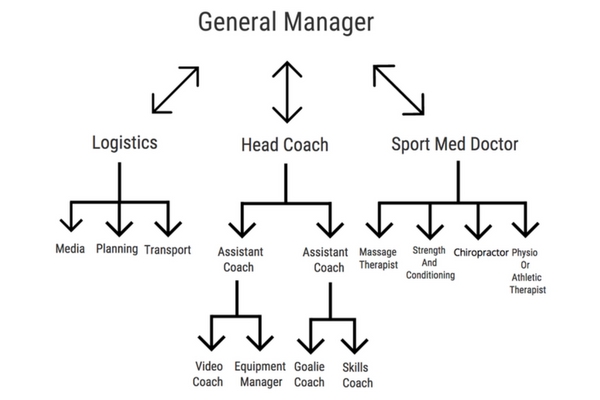
 

Sport Massage Chain of Command


As you can see, the General Manager would ultimately be in charge with Logistics, Head Coach and Sport Med Doctor all reporting directly to him/her.

They would each then oversee their own group who would report to them.

In our case, the Sport Med Doctor would oversee the healthcare of the athletes with Massage, Strength, Chiro and AT all reporting directly to them, they would then convey the necessary information the the General Manager.

Remember, the above is just an example. It may be set up where the Massage Therapist reports to the Physio, who reports to the Doctor.

These lines of communication are essential in the function of any organization, since each person can only effectively manage five people (according to span of control).

Having things organized this way also gives the organization room to expand (or decrease) if necessary. For instance, the General Manager can add assistant GM’s as the organization expands giving them new branches of responsibilities and groups operating under them.

Understanding how you fit into these lines is essential, not only to your success, but to the teams success as well.

Know Your Role Jabroni!

Okay, so you’re not a jabroni, but it’s a good headline to get the point across.

If you’re selected to work in this kind of team environment, knowing your role is crucial.

The team probably even has a job description prepared for each person on the medical team, outlining each persons specific role. Not all the roles will be specifically medical.

Depending on your past relationship with a team or whether you’re brand new can define what your role will be, or how you can function within the role they define and the scope that is laid out for you.

Initially you may have a very minor role. The A.T, Physio or Sport Doctor may be the ones who do all of the assessment and refer athletes to you only when they deem necessary.

Don’t take this as a slight against you if this is how things start out!

The team may have things designed that way because of insurance concerns, or because of past experiences which are totally beyond your control. Don’t forget, there is a broad spectrum of massage therapy certifications out there in addition to the broad spectrum of experience these other healthcare professionals in working with Massage Therapists.

The job description given to you may have you assisting equipment managers, helping with video, filling water bottles, or just cleaning up the dressing room.

Again, it’s not a slight against you or the profession, it’s just a role the team needs filled, so they might get you to help out by filling that role.

Now, the rest is up to you.

Personalities play a massive role in team sports. When you’re starting out be happy to fill whatever role it is they have designated for you. Leave the ego at the door. As you start to work more regularly with the team, your role can expand, it’s all about building that relationship (where have I heard that before?). As the trust builds between you and the other healthcare professionals in the group, so will your role and what you can do. It’s all part of being a team, not all jobs on the team are going to revolve around you doing soft tissue work on athletes. Nor is all the work for the other healthcare professionals going to solely revolve around healthcare for the athletes, it’s about pulling together for the greater good of the team. Like it or not there is still a hierarchy, these other therapists have more education than we do and may assume that we report to them, even though the team chain of command doesn’t display that. Back to those personalities, while some people will bring their ego and put it on display, that usually gets weeded out. You may just have to change your approach in dealing with people for the greater good of the team. If someones ego is getting in the way, it may be something you have to work around temporarily, but trust me it will be temporary.


 

Basic Communication Improvements For Massage Therapists

I always tell my students “when you get into the real world… you may be the best technical massage therapist but without great communication and listening skills you may not have the most successful practice”.

I remember when I was in Massage Therapy College, immersed in anatomy, physiology and manual skills (sometimes known as the hard skills) then once a week, we would go to a class where we worked on self-reflection, communication and listening skills (the so-called soft skills).

I know many of my classmates thought this class was a waste of time and completely irrelevant to the education they were now immersed in.

Me on the other hand, I love this stuff.

Over the years I have spent many hours in training and working on crisis lines, communication, conflict resolution courses and even peer counseling.

My passion for communication and listening came from, like many of us, a pretty tough childhood and teen years. When I was 12 years old a friend of mine took his own life.

Now (and to some extent then) in retrospect and had I known how, I may have been able to stop this tragedy. This event shaped my passion for listening and communication.

But this work requires a lifelong commitment with constant work and no matter how skilled you are, you may still miss things. This became all too real to me this January when at 4 am, my phone rang, it was news that another person close to me had taken their own life.

In retrospect, I could see the signs, but they were quite subtle. This is one of the reasons I am an advocate for communication and listening.

Now not all situations will be this intense but as healthcare professionals, we need to have superior skills in the areas of communication and listening and this is why I am writing blog posts on communication, starting with the basics.

Building Rapport With Massage Therapy Patients

One of those make it or break it skills for all Massage Therapists.

If a patient does not feel comfortable with you in the first 20 seconds it may hinder your ability to really help them.

Some of the things you can do to help build rapport are:

  • When you first meet the person look them in the eye.
  • Call them by name (sometimes it’s best to ask an elderly person permission to call them by their first name.)
  • I normally shake the person’s hand.
  • I always check if they need to use the washroom before we get started.
  • Invite them into the room.

Remember most of the communication is not the words, in fact more than 50% of communication happens in the body language and much is also connected to the tone or rhythm of the voice.

  • Be on time, nothing destroys rapport more than always being late.
  • Watch their face, do they look calm?
  • When you go to shake their hand do they pull away or do they move towards you?
  • Is their voice quiet and timid?
  • When you make eye contact do they hold your contact or look away?

The best way to build initial rapport is to meet them where they are.

Don’t hold eye contact too long if they are showing signs of being uncomfortable, give them space if they pull away and meet their tone and rhythm of voice with yours.

The Interview

Set up your treatment area so it’s calming but professional.

Remember the power differential, if you sit and talk to your patient (at eye level) it is less threatening and can make the person feel more comfortable in your presence.

Utilize the space between you and the patient, if you are too far away you will seem distant and uncaring, being too close might make the person feel defensive, I find 4 feet seems to be a good distance.

Take notes during the interview and special tests but do not allow your note taking to interfere with you being present with your patient.

  • Be professional at all times.
  • Be present at all times during the interview.
  • Use clear communication.
  • Avoid using slang and overusing of technical terms (or educate the patient so they understand).
  • When a patient says something important, paraphrase (repeat back what they said to you) so they know they have been heard.
  • Clarify what they have said so you understand what they meant.
  • Get a detailed history around their general health, details of the current issue and any pain related questions or physical limitations due to the condition.
  • Ask them what their goal for the treatment is.
  • Finally ask the patient what they would like you to address today (every so often I have a patient come in and describe many health concerns, then, when I ask, they request work on an unrelated problem).

The interview is your opportunity to recognize any contraindications that your patient may have, create a hypothesis for the condition you believe is affecting your patient and consider the level of special testing to either confirm or rule out your clinical reasoning around your patient’s complaint.

The Assessment

We as Massage Therapists are very well trained in assessment using range of motion, manual muscle testing and other various special tests to confirm or rule out conditions.

We have to remember that every patient is unique and just because the last three people had back pain due to trigger points in the gluts, it does not mean your next patient has the same issue.

A good assessment can narrow down the cause of the issue, help speed up recovery time and most importantly get our patients get back to their normal activities.

  • Consider a test that could confirm and a test that could rule out the condition you suspect.
  • Remember to ask permission before placing your hands on the patient.
  • Explain your special testing before you do it.
  • What you are testing for?
  • What a positive result will feel like?
  • Always test the unaffected side first.
  • Be honest with what you find.
  • Remember as a massage therapist it is not within our scope of practice to diagnose a condition, although we can state that the patient is presenting signs and symptoms consistent with a condition

A thorough assessment will help create confidence from your patients, reduce recovery times and help the profession by creating consistency in massage therapy treatments.

Photo by: StartupStockPhotos

Photo by: StartupStockPhotos

Create Your Treatment Plan

Now that you have the history and have done assessments, the next step is to create a treatment plan.

For this treatment, then for subsequent treatments and the home care exercises (stretching and strengthening) hydrotherapy and any changes to activities of daily living.

When you give patients a solid treatment plan they are more likely to trust you, follow the plan and recover more quickly.

This is where research and experience comes very handy, if you understand the condition and the length of time the patient has been affected by it you can start formulate a plan.

When my patients come in with an acute issue I normally start them off with one treatment per week for four weeks then we reassess and back off from there but this always depends on the condition.

  • Discuss the techniques you will be using and why.
  • Discuss the areas of the body you would like to work with and why you recommend working with these areas.
  • Discuss a pain scale or intensity scale.
  • Discuss the possible side effects or complications of the treatment.
  • Discuss the level of dress.
  • Get consent to treat.

I always check in and regain consent when I am about to work with a more sensitive area like the gluts, lateral rotators, abdomen or the adductors (especially with new patients).

We are also required to monitor the intensity of treatment with the patient, so I always check in to ensure the treatment is not too intense (I am 240 pounds and have very strong hands), some patients may not tell you it’s too much unless you ask.

Before you leave the room to allow the patient privacy to dress down and get on the table, remember to discuss the level of dress and how to get on the table between the sheets with their face in the headpiece.

Don’t assume they understand the routine.

I have heard stories of more than one RMT returning to the room only to find the patient naked on top of the blanket.

Knock on the door before you re-enter the room, this way you can be sure the person had enough time to get on the table.

There is a debate in the world of massage if we should talk during the treatment or not.

I always say the difference between getting a massage and getting a massage therapy treatment is the fact that we educate the patient. After I know a patient and if they prefer I will talk a lot less during a treatment. Remember to keep your conversation within your scope of practice. Many of my students have asked me why I should be concerned about what I say or how I say it in my practice. We have to take into consideration the dynamic of the session and balance of power in a treatment. The patient (in many circumstances) is naked or nearly naked on the table (covered by sheets and a blanket) we, as the therapist, are pretty much towering above them speaking down to them. The patient (depending on the treatment) may be in a very relaxed or semiconscious state and these facts could possibly put the patient in a little too open state and cause them to believe what we say without question. At the end of the treatment,  give everyone some form of home care and ask permission to send a follow up email with pictures, videos and details of the stretching and strengthening exercises.

How Does Foam Rolling Work?

Foam rolling is very popular.

Athletic trainers use it as a part of the warm-up. Physical therapists use it as part of their treatment strategy, often to improve extensibility of “short” tissues.

There is very limited evidence about what benefit, if any, foam rolling confers.

But there are a few studies showing it leads to short term increases in range of motion that are not accompanied by strength loss (this is interesting because stretching interventions tend to show increased range of motion that are associated with a loss of strength and power).

The purpose of this article is not to question whether foam rolling is effective for anything.

I’m willing to assume it works in some way for some people. It is hard for me to believe that so many intelligent trainers such as Mike Boyle would be singing its praises unless it was good for something. So I’ll give it the benefit of the doubt for purposes of this article.

The question for this post is the following: if foam rolling can actually reduce pain or improve mobility, what is the mechanism?

I do not find the common explanations very convincing.

But there is one (less commonly heard) explanation which I really like. Here’s my critical analysis of the different theories for why foam rolling works, including my favorite one.

1. Does Foam Rolling “Improve Tissue Quality”?

This is one we hear quite frequently, usually without any specifics as to which “qualities” are at issue.

I think some people imagine that foam rolling can smooth out bumps in their tissues like a rolling pin over pizza dough.

To be fair, this explanation is usually intended for lay people and not scientists, so we can cut some slack about the lack of specifics. Perhaps the qualities to be improved involve the presence of fascial adhesions or trigger points.

I’ll address those claims specifically below.

2. Does Foam Rolling Lengthen Or “Melt” Fascia? 

For some reason people just tend to assume that foam rolling works by changing the fascia.

I honestly have no idea why.

A foam roller puts pressure on all the other tissues in the body, and they all communicate with the CNS, which controls how we move and feel. Isn’t the CNS the most obvious place to look for changes after foam rolling?

No, it always has to be the fascia.

But fascia is tough stuff.

Sure it has some interesting adaptive properties, but at the end of the day its purpose is to form a solid structure for the body. Is it really plausible that we can significantly change our structure just by leaning on a foam roller a little bit?

We must be made of stronger stuff than that.

If fascia started to break down, or elongate, or “melt” every time it felt a little sustained pressure, we would be pretty fragile creatures. Every time we sat on a rock our posterior chain would lengthen.

So for me the idea that foam rolling lengthens or melts some important structural stuff in our body does not pass the common sense test, and more importantly, the research does not support this idea either.

There are a few research studies (here and here) which try to determine the degree of pressure necessary to cause permanent deformation in mature human connective tissue.

The upshot is that if you want permanent change, you better be prepared (as Paul Ingraham notes) to “get medieval.”

Steam roller maybe, foam roller, no.

It’s not going to happen in any of the places where the roller is most commonly applied, which are usually the strongest parts of the body – the ITB band, lumbar fascia, plantar fascia, etc.

 3. Does Foam Rolling Break Up Fascial Adhesions?  

Maybe a foam roller can’t lengthen the IT band, which is stronger than steel, but could it break up some little fascial adhesions that prevent sliding between different muscle groups?

One of the studies I referenced above show that manual pressure might be enough to deform nasal fascia.

Now I don’t see many people foam rolling their nose, but maybe there are tiny little adhesions between large muscles groups that are as weak and deformable as nasal fascia. Again this seems highly speculative to me.

How do we know where these adhesions are, or what angle will help break them?

A foam roller is a blunt non specific instrument that delivers force in a diffuse manner into the tissue.

Smash!

Part of the job of fascia is to diffuse force, so it would be hard to target a specific point here. Also, the angle of pressure is always straight in. The foam roller would have limited ability to provide the kind of precise oblique force that might be able to slide one layer of tissue with respect to the other.

Another problem I have with the idea that foam rolling breaks up fascial adhesions is that the effects are often temporary.

People do some foam rolling, they feel better for a while, and then tomorrow or even later that same day, they feel the need to roll the same area again. If the mechanism of effect is breaking fascial adhesions, then why do we need to repeat the process? Did the fascia knit itself back together again?

The temporary nature of the results strongly suggests a nervous system mediated mechanism for efficacy, not a structural one.

3.  Does Foam Rolling Get Rid Of Trigger Points?

Many foam rolling proponents explain that proper procedure involves finding a “trigger point” and staying on that point for a while.

Is foam rolling a way to treat trigger points?

It should be noted that the term trigger point means different things to different people. For some it just means a sore spot, but for others it refers to a specific pathology.

The technical definition involves several elements such as a hyperirritable nodule within a palpably taut band that elicits a twitching response to snapping palpation. Trigger points are thought to be caused by some sort of metabolic crisis in the muscle cells which causes chemical irritation in the local area and for some unknown reason refer pain to other areas when pressed.

Trigger points are controversial to say the least.

There is substantial debate as to whether they even exist. Whether they can be reliably identified is another debate. And whether they can be effectively treated is another.

There are many recommended treatments – stretching, post-isometric relaxation, sticking needles into them, pressing on them, etc. I definitely don’t have the time or anything approaching the knowledge to address all these debates.

But given all these uncertainties, I’m disinclined to believe that foam rolling works by getting rid of a trigger point. There are just too many unanswered questions here.

The experts in trigger point therapy will tell you that not every sore spot is a trigger point, that not all trigger points are clinically relevant, and that their identification and treatment takes practice and expertise.

So I don’t think shotgun fascia smashing with a foam roller is a plausible trigger point treatment (assuming they exist and can be treated with pressure.)

4. Does Foam Rolling Work By Proprioceptive Stimulation?

I often hear claims that foam rolling works by proprioceptive enhancement – stimulating mechanoreceptors in the muscles and/or fascia, such as golgi tendon organs, or muscle spindle fibers, or ruffinis, or pacinis, or Pacinos or DeNiros.

This could have some beneficial effect of encouraging relaxation of muscular or fascial tone, or causing the brain to reorganize its sensory or movement maps in the local area. I think this is a very plausible explanation and definitely on the right track.

But I doubt it is the main mechanism which explains why people like to foam roll.

If stimulating these mechanoreceptors explains the claimed benefits of foam rolling, then why wouldn’t you just stretch and move around, and get probably even more stimulation to these organs, but within the context of functional movements?

Can the foam roller, which doesn’t really provide that much movement or stretch to the target muscle or fascia, provide more proprioceptive stimulation then functional movements like the squat, lunge or reach?

I think not.

Perhaps what foam rolling has to offer over movement is novel proprioceptive stimulation. I think novelty is great and of huge potential benefit. It helps get the brain’s attention, which is what you need to do if you want the brain to change. But here’s something else that you need to do.

You need to provide the brain with information that is relevant to something that the brain cares about.

The brain cares about how to move your body through functional patterns such as squats, lunges and hip hinges.

How is the information derived from foam rolling relevant to these tasks?

The brain is not interested in information just because it’s novel. The information must also help it solve movement problems. Why would the nervous system be interested in how it feels to have a lacrosse ball jammed into your butt?

5. Does Foam Rolling Work By Diffuse Noxious Inhibitory Control?

This is my favorite explanation.

And this is probably the mechanism with which readers will have the least familiarity.

Here’s a description of what it is, how it works, and why I think it’s the major reason for the potential efficacy of foam rolling (and many other forms of manual therapy).

Diffuse noxious inhibitory control (DNIC) is one of several varieties of “descending modulation”, by which the brain adjusts the “volume” on nociception (danger signals which originate in the body).

DNIC means that the brain inhibits nociceptive signals from traveling up the spinal cord to the brain. DNIC is reliably triggered by a sustained nociceptive input, such as immersing your hand in cold water.

The inhibition is diffuse – it suppresses nociception not just from the local area, but distant areas as well.

In other words, if your leg hurts, and you stick your hand in icewater for a while, the resulting DNIC will cause both the hand and the leg to hurt less.

This dynamic of fighting pain in one area by creating it in another likely explains the success of many therapies, and is sometimes called counterirritation. The effect is temporary of course.

How powerful is the effect of DNIC?

Very powerful.

When a soldier loses a limb in battle, he will often feel no pain so long as the emergency persists, and DNIC is a major reason.

David Butler refers to DNIC as the “drug cabinet in the brain.” Here’s a video where he explains this idea in a little more detail, including the fact that some of the drugs in the brain are stronger than morphine.


Pain expert Lorimer Moseley views descending modulation and DNIC as a way for the brain to “second-guess” the periphery about the threat posed by a particular stimulus.

For example, if the periphery is communicating information suggesting there is a large amount of mechanical threat in a particular area, the brain, which has access to a wealth of additional information about what is actually going on in the periphery, may decide that the problem is not so serious, and therefore inhibit the transmission of nociceptive signals to the brain.

There is significant research showing that many chronic pain conditions such as fibromyalgia, irritable bowel syndrome, and TMJ are characterized by relative failure of the DNIC mechanism.

The effectiveness of DNIC in suppressing pain is highly dependent on the expectation that the counterirritant will have an analgesic affect.

In this interesting study, researchers immersed the hands of participants in cold water, shocked them with an electric blast to the sural nerve, and then measured the level of nociceptive activity in the spine, as well as the self-reported pain level.

Importantly, the participants were divided into two groups.

The first group, called the “analgesia group”, was told that the cold water immersion would reduce the amount of pain they felt from the shock.

The other group, called the “hyperalgesia group” was told the opposite – that the cold water immersion would make the pain in the leg worse.The analgesia group experienced 77% less pain, and less spinal cord nociceptive activity than the hyperalgesia group, who experienced almost no reductions in pain or spinal cord nociceptive activity.

In other words, expectation of relief was a huge factor in determining whether DNIC worked.

Now let’s put this all together.

DNIC is a powerful but temporary way to reduce pain in one area by creating pain in another. It depends on a decision by the brain to ignore danger signals from the body.

Expectation of benefit from the irritating stimulus plays a strong role.

There are several aspects of foam rolling that are very consistent with the hypothesis that its main benefit is achieved by creating DNIC. Rule number one in foam rolling is to find a sore spot and stay on it for some time. 

You need to create some pain.

Of course, the pain is often a “good pain”, which is exactly the type of feeling that would correlate with the brain’s conclusion that the irritation is somehow beneficial – which is what gets DNIC going.

Foam rolling often creates pain relief, not just in the area of pressure, but in other areas as well. People also tend to feel more freedom of motion, which could easily be explained by suppression of nociceptive activity, which tends to create muscle guarding, stiffness, and compensatory patterns of movement.

Further, the results of foam rolling are often temporary and need to be repeated (and often repeated harder the next time – are people becoming addicted to the drug cabinet in the brain?), this suggests a CNS mediated mechanism.

So here is the story I tell about foam rolling.

You put a foam roller into your butt and create some significant nociceptive signalling.

The brain receives it and says something like: “OK, the butt is telling me that there is some danger down there right now. But I happen to know that this is a therapeutic situation because my trainer said so. So, let’s send some drugs down the spinal cord to block all this talk about danger. And, we’ll make this feel like a “good” pain, not an injury.”

The drugs reduce pain and thereby improve movement temporarily.

Make sense?

Practical Implications On Foam Rolling

Now some people will read this and say “well who cares about how it works, all I care about is that it works.”

And in some sense that is fine, but this lack of curiosity ignores the potential improvements one might make to a therapeutic regime by understanding the real mechanism of effect.

If foam rolling really works by nothing other than DNIC, then perhaps it would be easier to get the same effect by just pinching yourself or putting your hand in ice water. Or maybe this would mess with expectations, which we know are important to get the effect.

Here’s another interesting question that arises from the consideration that foam rolling may work purely on the basis of DNIC.

If the results are only temporary, can there be any progressive benefit?

I think the answer is: it depends.

Pain relief and improved movement open a window of opportunity that one might climb through. If you are feeling better only for an hour, this provides enough time to train movements that would not normally be accessible, learn new skills, develop new capacities, and reduce the perceived threat associated with certain movements.

This could have permanent benefit.

But of course if you just sit on the couch, the benefits would probably be temporary.

Here’s another question I have in regard to foam rolling. If the major reason it works is release of the drug cabinet in the brain, then can one become addicted?

I have no real evidence of this, but I swear I’ve seen a disturbing pattern. Someone gets relief from a foam roller, and then graduates to the lacrosse ball, and then to the wooden ball, until they are bruising themselves with steel in an effort to get that fix!

Avoiding this type of situation is one reason it’s a good idea to know why something works.

A Passion For The Biopsychosocial Approach

When asked, Jamie suggested I write about what I’m passionate about, and that was all?

I am passionate about improving the massage therapy profession because I feel that we have a tremendous opportunity to help those who are suffering.

I am passionate about the need for healthcare professionals to adopt a biopsychosocial approach to their clinical reasoning and critical thinking, informed by research and scientific principles.

It has taken me years of post-secondary education and consumption of research to begin to grasp some of the topics I will now discuss. I am not expecting everyone to have the time or interest in pursuing all of these, but I hope something piques your interest.

I will be dividing topics into the core components of the biopsychosocial approach.

Biology

Are you intrigued by the inner workings of our cells and organs?

Do you want to understand how notes on a piece of paper become beautiful music played with intricate fingers movements that seem to ‘know where to go’ while played by memory?

Are you curious about the way diseases and disorders produce physiological changes in our bodies?

Biological Topics to Explore:

  • Biology
  • Chemistry
  • Physics

These core foundational sciences make up much of the first few years of any scientific education. I think some MTs miss out on this a bit. This is why certain MTs still tout things like ‘toxins’ building-up during exercise and needing to be released by massage.

Let me be more specific with some of my selected topics below.

Neurogenesis

  • The birth of new neurons, and what conditions stimulate this in particular areas of the brain

Neuroplasticity

  • The ability for neural synapses to strengthen, weaken, or be created and under what circumstances this may occur

Epigenetics  

  • The ability for our genetic code, DNA, to flip specific sections on or off, shifting the production of new proteins, including ion channels

Psychology

Are you interested in how we humans think, feel, and believe,  and the tremendous effect this has on our daily behaviours, for better or worse?

Where do our beliefs come from, and how do they change?

How can our attitudes affect our behaviors, including positive health activities?

These are just a few examples of scientific questions explored in psychology.

Why is psychology important to manual therapists?

About 8% of adults will experience major depression at some point.

Roughly 5% of the population experiences mild to severe impairment caused by anxiety.

About 20% of the adult population in Canada will experience a mental illness in their lifetime.

We now understand that a complex interplay of genetic, biological, personality and environmental factors cause mental illnesses.

Research is also demonstrating a strong association between anxiety, depression, and pain. How many of your clients come to see you about pain? How many of these mention symptoms that could be considered depression or anxiety?

I am not suggesting that we treat depression or anxiety,  just as we learn about medications, but do not prescribe, learning about these topics can help our clients.

Still not convinced of the importance?

Let me ask you, what are the most consistent therapeutic outcomes of massage, based on research?

How many of you have an answer to this question in the form or research?

Should this not be something we can answer with research, as healthcare professionals?

According to Moyer (a recent speaker at the RMTBC’s 2016 conference), Rounds, and Hannum (2004), the answer is a reduction in anxiety and depression. The results of this meta-analysis found the treatment effects to be similar to psychotherapy.

I strongly recommend reading this paper.

Psychology Topics to Study

  • Pain science
  • Depression
  • Anxiety
  • Self-reflection
  • Self-awareness

Social

Are you interested in how we interact with humans as humans?

How are my words interpreted and understood by clients?

What effect do our behaviors and actions have on clients?

Social Topics to Investigate

Multicultural Clinical Competence

  • Can you admit to being racist, or live in a racist country?
  • Are you aware of the physiological responses that occur when white people encounter unfamiliar minority cultural members?
  • Have you stopped to think how your worldview might be different from your clients?

Therapeutic Alliance

  • Have you thought about how the rapport you have with clients affects outcomes?
  • Do you listen to your clients’ narratives and attempt to meet them where they are, or do you jump to tell them about what you think is ‘right’ and will ‘help them best?
  • Are you the expert, and they need to learn from you to get better?

Contextual Factors (or Placebo Effect)

  • Have you thought about how your physical clinical setting may impact the therapeutic outcomes of your treatments? They do.
  • Do you think the unique properties of the modality you use are the primary driving factor in your therapeutic outcomes? They are not.

Research is finding amazing results when looking into contextual factors. From the size of the pill to the colour of your skin and the type of words you use, contextual factors affect therapeutic outcomes.

How To Learn?

Use resources available through professional organizations.

There is also google scholar for papers, and a few websites promoting the freedom to access scientific information concept by putting up every article they can obtain. There are amazing groups posting research articles and having wonderful scientific discussions on Facebook.

Free courses can be found throughout the internet with minimal time requirements needed.

Quality and Type of Research:

  • Research and resources range in quality, and it is important that we always critically analyze and questions papers and their outcomes.

Research Methodology Topics for Examination:

  • Quantitative and Qualitative Research
  • Confounding Variables
  • Statistical analysis
  • Internal Validity
  • External Validity

Do not just focus on single studies, explore trends in research. Different researchers, in different journals, and different labs across multiple continents. This is the beauty of science, as we ‘crowd-source’ collection knowledge gets refined over time. Two types of research reveal trends and summarize the findings of many papers.

The Systematic Review:

  • The collection and critical exploration of multiple studies and papers looking at topics with a bird’s eye-view

The Meta-Analysis:

  • A type of systematic review that collects qualitative and quantitative study data from many different sources into refined conclusions with better statistical power.

The paper cited by Moyer, Rounds, and Hannum (2004) is an example of a meta-analysis. These researchers combined the statistical data from multiple studies, factoring in all sorts of potential confounding factors, using all sorts of complication statistical analysis to determine overall effect sizes (the amount of positive change produced by the treatment in question).

What is the purpose?

Listed above is a wide spectrum of scientific concepts, ranging from a little bit of clinical applicability to very little. What they do, however, is guide our clinical reasoning and critical thinking skills. Education helps defend ourselves and clients from all the pseudoscience out there.

Photo by: Unsplash

Photo by: Unsplash

Modalities and Techniques

Some readers may have noticed not one mention of any sort of physical modality or technique.

This was intentional.

Regardless of the type of hands-on technique you use, all the factors mentioned above come into play. Regardless of what ‘modalities’ are claimed to do, they all must be taken into account with the context of the therapeutic environment with a living organism (with thoughts, feelings, values, and needs). If we do not consider the whole person, any technique or modality will be incomplete and less effective.

One will improve and grow through reading, learning, and striving to be the most evidence-informed clinician possible. Relying on clinical experience alone for learning is asking for confirmation bias, self-serving bias, and hindsight bias (among many others) to cloud our judgement and obstruct us from evidence-informed clinical reasoning and critical thinking.

Read, watch videos, and listen to podcasts. The medium of learning is less important than the quality of the material and the push for constant progress and education as ethically responsible healthcare providers.

Explaining S.I.J. Issues Without Using “Rotation” Or “Innominate”

One of the most frequently asked questions I get at Modern Manual Therapy courses is, “How do you explain SIJ dysfunction without using rotation, out of place, etc?

Many clinicians, both novice and experienced are gravitating toward Pain Science Education, but cannot seem to fully commit. This is something you really can’t dabble with. Click here to see 5 Outdated Clincial Explanations and Why You Should Not Use Them.

If you use a modern explanation for neck pain, why can you not do the same for the SIJ? Here are steps that Lorimer Moseley suggests that I use to Stop Thought Viruses

  • Challenge a concept
  • Provide an alternative concept
  • Provide evidence for a new concept

In this case you can use a video or education like in this #GetPT1st SIJ video

After you get them thinking, ask them something like:

  • How much force do you think your PT/Chiro uses?
  • Is it less than what is required to move the pelvic and tail bones after all other skin/muscles, etc are removed?
  • How long does a full body massage last?
  • Do you think the hour long or more input from a massage lasts longer than a few quick impulses?

The important message here is that without education on self assessment and treatment, regardless of the mechanism (if they’re not buying the neurophysiologic aspect), is that treatment must be reinforced with home movements/education to get lasting effects. The evidence for a new concept may be doing alternative treatments, or self treatments like a repeated loading strategy that enables them to self treat without any passive modality or manual therapy. Even if you have to use a manual therapy treatment, always relate it back to self treatment accomplishing the same effect (reducing alarm in the brain – good input = good output).

One of my final questions is:

If I could show you a way to both assess and treat yourself, so that in many cases, you would not need either myself or any other clinician, would you want to learn that?
Most answer yes, and by then, regardless of the mechanism, most will choose saving $$ and empowerment, probably in that order.

Using Evidence Based Practice To Avoid Fear Tactics

Sometimes I just have to shake my head.

I’m sure we’ve all heard the same kind of things in our clinics when patients go to other practitioners.

“I have compressed discs in my spine, I’m out 14 degrees here, 12 degrees here and 8 degrees here”

Yeah, I probably have all that too, but I’m not in any pain. 

“I went to this other therapist, and they said I’d probably never get better”

Well that’s not true.

Then there’s my favourite (I wish there was a sarcasm font).

“Well the muscle pain you’re having stems from something that happened when you were a child, it’s going to be really hard to get rid of it”

I’m sorry about whatever it is that happened, but that is going to take some counseling to help, you should talk to your doctor about a referral to a mental health professional to get the appropriate care.

Sometimes I wanna phone up these other practitioners and ask what the hell they are doing saying things like that to a patient but apparently I’m supposed to be professional or something. 

Instilling Beliefs In Patients

As therapists we play a role in which we can be either effective or detrimental.

There is a strong correlation where what we say to a patient has a huge impact on their improvement or just instilling fear that makes them have to keep coming back in for more therapy.

Unfortunately instilling fear in patients with the language we use has become more of a marketing gimmick than using our words to help a patient. 

This is called the “Fear Avoidance Model”.

The fear avoidance model shows that patients can develop pain as a result of fear and avoidance behaviour. Typically it is referring to a patients fear of movement as it might cause pain.

However studies have shown how this model can be developed in other ways.

If a patient can’t make sense of the pain (which is part of our job to explain to them), have some societal beliefs associated with past experience or have a diagnosis of something that can’t be fixed are all things that can be associated with this fear avoidance model. 

If a patient comes in for treatment and already has some of these underlying issues, we have the opportunity to either correct or reinforce what is going on with them. 

We can have a strong influence on those patients beliefs and in turn can influence those beliefs in a positive (or negative) way.

If we decide (and it is a decision on our part) to use negative language like “tissue damage, out of alignment, or structural problems” we can change a patients beliefs for many years to come. One study showed that it can even lead to feelings of increased vigilance, guilt and worry.

The same study showed that if we take an approach of providing reassurance, which increased confidence we could positively influence a patients movement and activity.

So, imagine if just the way you communicated with your patients, made them want to adhere to their home care and gave greater outcomes overall in their treatment?

Photo by: PublicDomainPictures

Photo by: PublicDomainPictures

Improving Communication For Better Outcomes

So where do we go from here?

We are always going to have other therapists and practitioners who use scare methods like I mentioned at the beginning.

I’m pretty sure a little piece of me dies inside whenever a patient tells me about these things they’ve been told. 

In the case of the patient saying they have compressed discs and are out of alignment, well I’m pretty sure if they x-ray’d me they would find the same thing however I’m not in any pain. In fact Todd Hargrove wrote a great article on the topic that we have used on this site, which you can read here and is a good reference to show a patient when they are worried about imaging and disc issues.

The way we communicate has to involve positive reinforcement, with good explanations of what is going on with the patient.

Being able to describe to them that pain is just the nervous system reacting, not tissue damage, is a hell of a lot better than reinforcing some old beliefs or scare tactics.

There is a new model of rehab being developed that outlines four elements that could lead to better outcomes:

  1. Knowing the person and building a supportive relationship
  2. Effective education and information exchange
  3. Goal setting and action planning
  4. Fostering positive, realistic, cognitive and self framing.

Those four steps represent a golden opportunity for us as Massage Therapists. 

All four steps are well within our scope of practice and we quite frankly have the opportunity to reinforce those steps more than any other practitioner due to the time we get to spend with patients. Because we get to spend so much time with our patients our ability to build that supportive relationship is paramount to what we do.

Even being able to read the mood of our patient who we have built that relationship with can make a difference in the outcomes of their therapy.

As much as the terms “evidence based”, or “research based practice” gets thrown around (I know some of you don’t like it), there is sound justification to making this a part of your practice. Research is actually showing us the importance of how we communicate with our patients. There is even studies that show how contextual factors like a therapist and patients features can contribute to outcomes. Now I know there is no way you can do anything about your features, but you can do something about all the other things we discussed. Staying up to date on new research, working on communication skills and not being afraid to “forget” some of the things we used to know goes a long way to establishing ourselves as the more trusted source of therapy in our communities. Being able to educate a patient when they come in, helps to build that supportive relationship and puts you at the forefront of their healthcare as a professional. Help your patients to set goals aligned with their home care by making them positive and realistic. Our biggest job is always going to be education. Educating our patients and explaining what is happening to them is a key factor in getting them back to their activities of daily living. Unfortunately as other practitioners use fear to market their practice, they make our jobs just a little bit tougher.