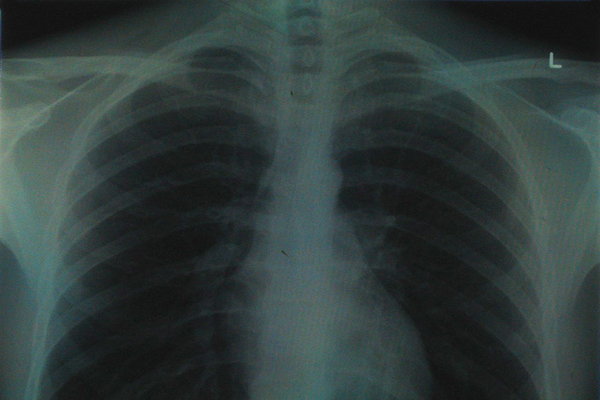
How Massage Therapists Can Treat The Thorax Part 1
In this Part 1 section for the Thorax, I hope to serve you by discussing my general thoughts and perspective on the Anterior Thorax. Part 2 will be a discussion on the assessment and treatment of the anterior thorax.
Please remember that ALL structures in our bodies are connected, from the largest organ to the smallest arteriol.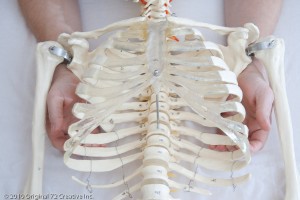
Everything is dependent on each other. When a part is removed or becomes dysfunctional, the rest of the system is affected in some form or fashion.
Fascia, skin, vasculature, nerves, lymphatics, interstitial fluid…they all span the complete existence of who we are and we are never apart from them. Even though I have divided these discussions into sections, we, as a whole, are not.
Currently, I feel that the assessment and treatment of the anterior thorax is an area of education and instruction that is far from acceptable. I feel the same for the abdomen & pelvis. I estimate that the majority of manual therapist spend the majority of their careers touching the dorsal thorax and rarely the ventral side. If you are a therapist that treats the anterior thorax on a regular basis, then I commend you.
We are all greatly affected by negative events that occur in our lives. My perspective is that when these negative events occur, our physiology attempts to revert to the foetal position. You can see the postural changes that occur in someone when they are being verbally abused/bullied at work, school, home etc…
Stress accomplishes this perfectly. In today’s society, there is such a prevalence of Essential Hypertension, the anterior thorax is an area that is sorely in need of treatment.
Knowing the detailed anatomy of the thorax is necessary. Your education for this area will consist of study of the vital organs, vasculature, osseoss articulations, fascia, musculature etc… and their interactions with each other. This study takes time, focus, patients and a continued interest.
Gil Hedley’s Dissection DVD series is an AMAZING volume to learn from. I watch them on a regular basis and always see something I missed from the previous time.
The payoffs for focus in the area are the compliments that you will receive from your patients for helping to improve their quality of life, helping them to move from dysfunction to function.
Massage Therapists, Gain Informed Consent
Typically, in my practice, techniques in this area are “clothes on” techniques. I treat through the clothing, educating my patient along the way, describing what I’ve found & what may potentially be contributing to their complaints. Patients must be informed so as to make an informed choice about receiving treatment.
I am always clear and precise. 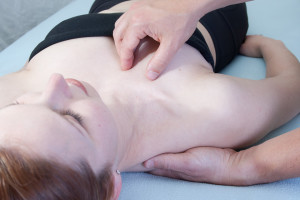
An informed patient who recognizes that you have an interest in improving their quality of life and who feels that you have the confidence to treat effectively in this area, will give you permission to work here.
Please do not fear the potential of touching anatomy (breasts) that shouldn’t be touched. The breast tissue is quite extensive in some women and in order to gain access to the structures we intend on making changes to, some breast tissue will be touched.
With clear intent, knowledge, and confidence in your skills, an informed patient will feel comfortable and confident having you treat in this area.
If you have any doubts or fears for this work, then practice on a family member, wife, girlfriend, someone whom you can make mistakes with, who will provide you the necessary feedback needed.
I always practiced on my female colleagues any time I am learning a new technique that is performed in a sensitive area. Their feedback is invaluable and has allowed me to help my patients. I am truly grateful!
“The quieter the mind, the stiller the hands, the less movement we make, the more we are able to perceive involuntary movement.”
– James Jealous, DO
Why Massage Therapists Shouldn’t Just Palpate, Also Sense
In the beginning, you must be calm and slow your thoughts in order to develop a “perceptual touch.”
This is an alert observational awareness for the functions, dysfunctions and actions that are occurring within the physiology. The thorax is a busy place and you honestly need to “watch the world go by” for a few minutes to have a sense of what’s going on.
This is the beginning of developing “Listening Skills.” Develop your “allknowingseeingthinkingfeeling” hands.
Once, you’ve have an outsiders look in, then you must start to ask questions with your inner voice and your hands. I know it sounds completely unscientific, and it is, but we are not completely made of substances that can always be explained by science. If you do not believe me than I challenge you to join a dissection class and dissect a thought or a memory.
Back to asking questions; the little voice in side your head will answer back through your patients tissues into your hands. This is your patient subconscious. Biodynamic Craniosacral/Osteopaths have an amazing ability to tune into this “conversation.” Listening in this way will change your skill set.
Ask for information with your hands. What pulls you in is what’s needing help, what pushes you away, does so for a number of reasons. It doesn’t require treatment, or something else is in need of treatment first.
Everyone is different with different injuries, conditions and the sequence of what gets treated in what order is different. This sequence not only changes from patient to patient, but from each treatment with the same patient.
The more you can “tune in” to what the specific sequence is for a patient, the faster you can determine a course of treatment, or make decisions as to what will be treated today and what is on the agenda for the next treatment. Of course we need to stay flexible in our planning as inevitably patients complaints/concerns do change.
Remember, we need to be calm and focused enough to listen and understand the information we are receiving to follow the order of treatment, rather than having a predetermined concept of what the tissues need. Forcing tissue will get you nowhere.
Remember:
“Small changes can result in disproportionately large effects!”
One of the most wonderful processes to watch/feel is thoracic respiration. It’s such a simply detailed process that is ignored as a treatment assistant by many. It should be used to our advantage with every technique and treatment.
My Challenge To Massage Therapists
Sit quietly with a willing, informed participant lying supine on your treatment table.
Seated at the head of your treatment table with your patient lying with their clothes on, place one hand gently but firmly on the sternum.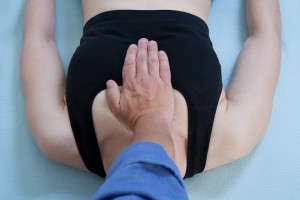
Your fingers are relaxed, close together, the wholeness of your hand/palm is in full contact with the sternum. You may chose to have the other hand placed along the vertebral column directly at the same level as your hand on the sternum, or you may just choose to monitor the sternum hand on it’s own.
Calm your mind & your hands. Become focused on the functions of the physiology and movements that you are in direct contact with. If thoughts about your life come in to your mind, push them out and refocus. The more you practice this preciseness of focus, the less those life thoughts will enter.
Do not make any attempts to “correct” what you find. You are feeling how the physiology needs to function in it’s current state to allow the current quality of life for the patient. Just sit and “window shop!”
As Rolin Becker DO wrote, “ Be a water bug on the surface of the water.”
Sit in this quiet place, almost in a meditative state for 15 -30 minutes. It may seem like a long time to sit there “doing nothing”, but it will go quicker than you anticipate. You are now listening to what your patients body physiology is speaking to you.
The body physiology never lies, it always tells you exactly what is needed, where, when for how long, and to what tissues.
I the next section on the thorax, I hope to provide perspective on assessment and treatment for the thorax.
As always, I hope that I have been able to serve you in some way with this information, be it a completely new perspective into your patients, be it some new thoughts about how to approach a treatment or provide you with a review and acknowledgement that what you are doing, as far as I’m concerned, is having an amazingly positive impact in improving the quality of life for your patients.

Robert Graduated from CCMH in 1994.
He is recognized as a national instructor across Canada instructing Ligamentous Articular Strain Technique. He has a passion for inspiring manual therapists to perform to their highest ability and to providing high quality educational programs to the profession.
From 2001–2008 Robert instructed Orthopedics and Neurological Examination departments at the West Coast College of Massage Therapy (WCCMT).
Robert can be contacted at www.lastsite.ca

He is recognized as a national instructor across Canada instructing Ligamentous Articular Strain Technique. He has a passion for inspiring manual therapists to perform to their highest ability and to providing high quality educational programs to the profession.
From 2001–2008 Robert instructed Orthopedics and Neurological Examination departments at the West Coast College of Massage Therapy (WCCMT).
Robert can be contacted at www.lastsite.ca
- 5 Habits To Have To Have Before Disconnecting For The Weekend - October 9, 2017
- 5 Habits To Start Your Work Week! - February 13, 2017
- “World-Class” Communication In Your Massage Therapy Clinic - May 23, 2016