Posts

The Massage Therapist Guide To Clinic Management Software

This was an opportune time to make the switch.

Over the past 8 years, our clinic has gone from paper and pencil scheduling, through two different software based management systems, and now we’re switching to a platform that supports online booking and electronic medical records.

Each time we change systems, it involves researching options, exporting and reconfiguring all our data, and then re-training the staff on a new software.

Every few years our needs in a clinic management software seem to change or grow, and unfortunately our past softwares haven’t grown with our needs.

With the high demand from the public for online booking, even though we have full-time reception, this was something we couldn’t ignore any longer.

The other factor that played into our need for change, was that with more therapists and multiple disciplines their files take up A LOT of room in the clinic. They are taking up so much room that we are now archiving files after two years.

Needless to say, a more storage-efficient method was needed.

6 Important Features For Massage Therapy Clinic Management Software

When what you love doing for your career involves working with patients to become pain free, you don’t want to spend all your time with dealing with scheduling, billing, and lots of “front end” duties at the office.

We now live in a time where there’s an app for everything. It feels like overnight we went from not having any choices, to having too many choices in selecting the software to run our clinic.

Being involved in a large interdisciplinary clinic, I’ve recently underwent the arduous task of finding a new clinical management software (CMS) that needed to check more boxes than I have fingers. Since I have finally come to a decision for my clinic, I’m here to share what I learned. My choice will not be your choice, because my boxes are not your boxes, but here is what I learned.

First step is to figure out what you want out of a CMS, which is tricky when you don’t know what they offer or have the capabilities of. So here are the important features I decided to highlight:

  1. Online Booking – even if you have a full-time receptionist, online booking has now become a very important feature that patients look for in order to access their therapist.
  2. Electronic Charting – If you have a large number of therapists and limited number of square feet to devote to file storage, then this is a great option for you.
  3. Integrated Billing – This makes sure that checking out your patient is a smooth and quick process, and with the different reporting options, makes a big difference when it’s time to do your books.
  4. Integrated Wait List – If you are like some Massage Therapists I know, who have a 1-month waiting list, it can be frustrating when you get a cancellation with too little notice to fill it.
  5. Remote Schedule Availability – Having the ability to check your schedule from home is a great asset, especially when patients can book in with you when they wake up at midnight with a kinked neck.
  6. Cost – When it comes down to it, cost always plays a factor, especially when it comes to your business.

4 Online Scheduling Programs Reviewed

I investigated several applications, but I found that only four of the ones I looked at had the right combination of features to warrant getting shared.

There are lots of choices out there, so I could have easily missed some that you may really enjoy.

These options happen to all be cloud-based, which means they are not installed on your hard drive like a typical software program, but hosted online and you log into them via your internet browser. Here they are:

 1.    Jane App – www.janeapp.com

Jane App has a very clean presentation and seems to hit the best on all the features listed above, and many more features not listed.

It’s a Canadian company based in Vancouver, and they make an honest effort to really do things properly; such as hosting your data in Canadian servers in multiple provinces where they are very safe.

If you are running a clinic with only one type of therapist (such as RMTs), they have a feature where you can incorporate into the intake form a “Survey Monkey” style questionnaire for  health history, and inputs it automatically into their patient file for you. Jane App also lets you custom build your template for charting, using both scanned diagrams (or using a stylus to draw on), lists, and general text charting.

Their website is by far the easiest to really understand what you get and what you don’t compared to the other options. My only complaint with Jane is that it’s the most expensive of the options, especially when you have a larger clinic.

Unless you need all those great features, it might not be worth the expense.

2.    Cliniko www.cliniko.com

Cliniko, much like Jane, has a very clean presentation to it and also does well on the features above.

There were little details with how well some of those features function that made them not the best, but overall still great.

They are working on incorporating electronic charting, the ability to use a stylus to draw, scribble, and write in the chart, but it is not set up yet.

They are an international company, which was great as they have help staff that work 24/7. If you have a large clinic with many types of practitioners and lots of needs, Jane & Cliniko seem like the only choice that starts checking boxes after the fundamental needs.

3.    Body Soul www.bodysoulonline.com

Body Soul’s website is hard to find any really definitive answers on without asking for help, which makes me think their software lacks the same forethought.

Their online booking feature seems not as streamlined as Jane & Cliniko, and lacks the waitlist feature.

They are however a local company from British Columbia, and even though they don’t allow the use of a stylus in the charting function, they have done a clean job of streamlining it. They even have a dictation feature for your charts!

Their price was very reasonable, if you’re a single Massage Therapist; otherwise it’s double the cost per practitioner.

 4.    Mind Body – www.mindbodyonline.com

Mind Body seems like it is designed for a yoga studio first, then adapted for a health clinic.

This is the one software that doesn’t include the Electronic charting and as it was with body soul, it lacks a waiting list. It is very focused on social media and lets you even tailor an app to the branding of your business, and have patients book in for a treatment from within Facebook.

The overall design is not as clean as Jane or Cliniko. Mind Body was the only application in addition to Jane that has a feature to customize your practitioners’ access; everyone gets a unique login and password so they can access what they need, but not everything that you can.

The cost is really hard to argue with too; you can get one of their bigger packages for under $100/month.

I’ve included a handy chart to show you which program has what feature, and in some cases a rank out of 5 on how well they did. These ratings are based on the information I was able to pull from the website and from answers I received from helpful staff, I have not used any of these programs in my clinical setting yet.

If it wasn’t obvious in my review, we chose Jane for our clinic.

Key FeaturesJaneappClinikoBody SoulMind Body
Janeapp.comcliniko.combodysoulonline.commindbodyonline.com
Cost$$$$$$$$$$
Electronic Medical Records544N/A
Integrated Billing5543
Online booking5433
Remote Schedule AvailabilityYesYesYesYes
Wait List FunctionYesYesNo No

The cost for each app has a slightly different structure, so it’s hard to lay it out for you easily here. Your best bet is to visit the websites and calculate your cost based on your clinic size and needs.

Based on what your needs are, you will probably choose different options, from myself and from each others. Most of these apps have functions that would work for your clinic, but based on our needs, Jane App was the solution. It was a challenging decision between Cliniko and Jane App, but in the end the extra details associated with Jane App didn’t equate to a large enough price difference to deter us from using it. Another reassuring fact that help us make this decision is that many large clinics that I respect and trust use Jane App. Our plan is to start using Jane App in the new year, fingers crossed it all goes well. Stay tuned for the 6-month follow-up. 

I’m also just really excited to get to do my charting on a snazzy iPad!


Subpoena’d As An Expert Massage Therapy Witness

I have been fearing this day since I graduated college.

The envelope looked different than any other mail I’d ever gotten.

I opened up the registered letter and there it was, a cheque for $20 and a subpoena.

It read:

“TAKE NOTICE that you are required to attend and testify as a witness in the place, date, and time set out below. You are also required to bring with you all documents in your possession or control relating to the matters in question in this proceeding.”

What was I going to do?

I don’t want to go to court and testify!

At the end of the letter it clearly states:

“if a person, contrary to these Supreme Court Civil Rules and without lawful excuse, refuses or neglects to obey a subpoena or to attend at the time and place appointed for his or her examination, is guilty of contempt of court and subject to the court’s power to punish contempt of court.”

Looks like I have no choice.

I am not looking forward to this.

Compensation For Being A Massage Expert Witness

I really wasn’t sure what to do.

It was quite insulting that a lawyer would send a cheque for $20 (the requisite witness fee) to force you to be a professional witness in an insurance claim that was being fought in order to achieve a settlement for the claimant and themselves.

Not only would I have to take time off work and lose pay, but there is also prep work to be done.

Before I called the lawyer in question, I figured I would talk to our provincial association for some advice first.

The association had some good advice as far as what should be charged in cases like this.

  • Testimony in court $700 per half day
  • Court prep time $93/hour
  • Production of records $100 or $.50 per page.

I had no idea if I was just supposed to demand this or if it was assumed. I was told just talk to the lawyer and explain what was recommended to me.

Calling their office, the lawyers assistant answered.

I laid out what I thought compensation should be.

She responded and said, “okay you can bill us for the $93/hour, but no judge is going to pay you $700, that’s the kind of money they give brain surgeons”.

As we chatted about what would happen, I told her this scared the crap out of me.

Her response set me at ease: “Don’t worry about it, it’s not like TV. You’re a good person, as long as you don’t rob a bank in the meantime you have nothing to worry about. All you have to do is just show up and be honest, they’re not going to try and trip you up.”

Now it’s time to prep.

https://flic.kr/p/9mNxFH

Photo by: Medill DC

Prepping A Massage Therapist For Court

The lawyer had me come in to the office for an hour to prep.

We went through all my notes to make sure he could understand them and of course to see what I could remember.

Scouring over the notes, he asked for explanations on what he was reading. Deciphering what different orthopedic tests meant and what I was testing for. Looking for explanations on why there were missed appointments, why would I work on one area one day and a different area on another.

Some of those treatments were three years ago!

Then it was time to tell me what to expect and what was expected of any Massage Therapist called in as a witness.

Just be honest. If you don’t remember something just be straight up about it.

While the opposing lawyer is working for the insurance company and wants to win, they will not cross examine you like you see on TV. They will ask you questions more to try and discredit the patient, not you as a therapist. Just be honest with them.

If you’re asked a question, you answer the judge. While it may be either lawyer asking, you look at and direct all answers to the judge.

Dress appropriately, wear a suit.

Show up early and look for directions as to which room the case will be argued in.

While you are scheduled to be there, you may not be called. It will depend on how the case goes. If the case is settled before hand, you’ll be informed that you don’t need to show up that day and although the case could go on all week, you will only be called for the scheduled day and time that we ask for.

We discussed compensation.

He confirmed that $700/ half day was more than would be given, he did agree that $100/hour for time spent was appropriate as long as I was fine with that.

Two days before the case went to court, they settled. I was fortunate to not have to go. Although I will admit there was some disappointment, I ended up really wanting to see what it was like. Overall it didn’t end up being as scary an experience as I thought (even though I didn’t have to go to court) and as the lawyer and I talked I thought he was fair. He paid the $100/hour for the hour I spent with him and for the hour to get any extra paperwork together, in addition to the bill I had given them months earlier for sending them my charts.

The experience also made me realize that my charting should be better than it was. The lawyer wasn’t totally sure if he’d be able to use them. Some treatment notes were more detailed than others and not all of them were specific enough. Make sure that if you’re ever working with patients who are involved with insurance companies that your note taking is top notch. This is another way for us to prove not only our worth as Massage Therapists, but also our professionalism as one.

Massage Therapy For Children With Developmental Disabilities


“I am also a believer in an integrated treatment approach to autism” – Temple Grandin

”Don’t think that there’s a different, better child “hiding” behind the autism. This is your child. Love the child in front of you. Encourage his strengths, celebrate his quirks and improve his weaknesses, the way you would with any child. You may have to work harder on some of this, but that’s the goal. – Claire Scovell LaZebnik


I was nervous and unsure.

There was no one to talk to who had experience working with a child with developmental disabilities..

Although I had already met him, how was I going to handle this?

I knew what I wanted to achieve, but could I actually attain any of the goals for my patient that I had set?

Due to my past experience I felt fine working with this child, but no one had ever mentioned or taught me to manage a Massage Therapy case like this.

When I talked to my teachers, they never heard of anyone doing anything like this, and I never realized how much work or how much learning it would take to pull this off.

It was hard to find any good research on the topic, so I had to figure out a lot on my own.

All the goals I set had to be broken down into tiny steps accomplishing little goals in the grand scheme hoping things would add up to the greater good for my patient.

This was a huge learning experience and I hope what I learned can make a difference for kids with developmental disabilities and other Massage Therapists who want to help them.

Massage Objectives With Developmental Disabilities

Before pursuing a career as a registered massage therapist, I worked as a community support worker/ care assistant in a group home setting with people who had developmental disabilities.

I worked with people of all ages that had mild to severe developmental disabilities.

Giving medications and providing support for our clients was all we could do to assist them, however I felt more could be done to improve quality of life.

I found it difficult the only way I could help kids with developmental disabilities was through medical intervention and emotional support.

Although those interventions did help, I felt more could be done to improve the lives of these kids.

I wanted to do a case study to determine the effects of Massage Therapy for these people in need, particularly a developing child who was nonverbal with autism spectrum disorder and global developmental delay.

Developmental disabilities are common in children and occur in all racial and socioeconomic groups.

Some developmental disabilities may include: Attention Deficit Disorder (ADD), Autism Spectrum Disorder, Cerebral Palsy, Downs Syndrome, intellectual disorders, hearing loss, vision impairment, learning disabilities, and other development delay.

Children with developmental disabilities may experience impairments in social interaction, communication, speech and language, general physical development, behavior, learning, cognitive skills, motor control, coordination, balance, and emotional stability.

I found in my case study that Massage Therapy benefits children with developmental disabilities by improving their physical and emotional well being while they are still developing.

My objective was to determine if the effectiveness of Massage Therapy could improve their focus, behaviour and motor function.

Massage Therapy, A Case Study

My participant was a nine year old male with a diagnosis of Autism Spectrum disorder, Pervasive Development Delay (PDD), Moderate Intellectual Disability, asthma, seizure disorder, and an educational designation of physical disability or chronic health impairment (PDCVH).

He also experiences challenges with focus, aggression, and functional movements as a part of his diagnosis and would elicit a rigid rocking behaviour when he became anxious.

When I first met this patient, it turned out in the past he had been turned down by other RMTs when his guardian sought treatment for him. I was nervous at first to take on this case as I was only a Massage student, but put those feelings behind and decided to take it on as the well being of this child meant way more to me than staying within my comfort level.

I performed this case study over the course of three months and was broken into fifteen treatments, seventy minutes in duration, which were divided into three phases:

Treatments consisted of manual modalities to the lower extremities and back such as:

  • relaxation techniques including general swedish massage
  • rocking
  • full limb vibrations to trick the nervous system (helping to relax muscle contractions)
  • deep pressure stroking
  • myofascial release techniques
  • joint mobilizations
  • passive range of motion

Measurement tools included:

  • postural assessment
  • gait analysis
  • orthopedic tests
  • range of motion (ROM) for the motor function aspect of the study  
  • focus tests and qualitative feedback from the patients guardian for the focus and behavior aspect

The results from the study concluded that the patients focus and behaviour had improved, became more social with other children, less aggressive at times of frustration, less anxious, and his balance, motor function, gait and posture had improved.

The patient also completely stopped the rigid rocking behaviour and was able to follow direction when asked to perform simple tasks.

In just three months, a young child’s quality of life had significantly improved.

This proved that more can be done for these people to help improve their lives.

It just takes health care professionals like RMTs to take a risk and work beyond their comfort levels to improve the health and wellness of people of all ages at all stages of physical and mental development.

So what are some rules I created for working with children with developmental disabilities?

Establish Trust With Your Massage Therapy Patient

When working on children with developmental disabilities (or any client really) it is important to establish trust and better yet, a therapeutic relationship.

In our typical practice, we meet a client and establish a trusting therapeutic relationship on the first appointment. If that trust is met, they will typically rebook and come back for a following treatment.

In this case, it wasn’t that simple.

I had to work slowly at introducing massage and creating that therapeutic relationship. Before starting the treatments, I met the patient and his parent guardian. I interviewed the parent about triggers, behaviours, things that he enjoys, and tips on communication.

When the treatments finally took place, it was important to introduce everything slowly.

The first treatment was conducted on the floor, while the patient cuddled with his guardian. I slowly introduced touch to the legs and feet. By the next treatment we were able to introduce the table using support from his parent.

As the treatments progressed I slowly introduced massage to different areas of the body.

To put things in perspective, finally after a year and a half of treatment, I am able to work on his arms and hands without him pulling back showing there is now enough trust to let go.

Keeping a constant routine was also important.

I found that if he missed an appointment one week, we would lose progress in comfort with receiving massage. If we made any changes to duration, treatment techniques, or the number of treatments per week/month, it had to be done slowly and only changing one thing at a time to decrease the chance of  effecting progress.

Keeping a routine and working slowly will allow the client to maintain trust in you as a therapist.

https://flic.kr/p/95h8v9

Photo by: hepingting

Gaining A Thorough Massage Health History For Developmental Disorders

It was important to have the full picture on the patients health history, not only for treatment safety but also to fully understand why the patient presented as he did and how I could create a care plan that would be effective.

In order to understand the full picture I collected documents from other health care professionals about his condition and did some research. I also did an extensive interview with his guardian to gather more in depth information on the child’s condition as well as information and tips on how to work with the child.

It is our duty as RMTs to take an in depth health history to ensure the safety of any patient.

Medications, current (and past) medical condition, emotional or behavioural status, assistive devices, activities of daily living, and other therapies a patient is taking part in are all examples of things you should know to create a safe and effective treatment plan for them.

These things are not just important for working with a special population but for every patient you see in your practice.

Massage Treatment And Developmental Disabilities

As mentioned before, ease into treatment.

Slowly introduce touch and ease into longer duration treatments. When it comes to technique choice, I began with general techniques and experimented with techniques until I found what worked.

Once massage was comfortably accepted by him, I was able to use more specific techniques.

Pay attention to the little things.

Starting on the treatment table may be too much too soon. You can start out treatments with a patient in a chair (or wheel chair) or on the floor on a mat or blanket.

Massage may also not be accepted by the patient right away, you may also need to spend the first couple of treatments getting to know the patent.

Utilizing  tools may help the patient feel less anxious, for example they may have a special toy they enjoy. When introducing massage for the first time, having certain objects act as a distraction may help significantly. Using toys, music, books, and sensory stimulation objects may help greatly.

I found that a thermaphore worked excellent as tool to help calm the patient.

Include Your Patient.

Note their mood.

Are they tired or playful?

This may affect how the treatment goes. During the case study, if he was acting playful, I would create a treatment that would suit his mood.

For example, one technique that he enjoyed was a bilateral leg pull.

When he was in a playful mood, I would make the technique more playful by exaggerating that he was growing tall like a tree during the pulling component then shrinking small during the compression portion.

This typically resulted in excitement and laughter. I would also typically use more stimulatory techniques like shaking and jostling when these playful moods were present.

Creating Home Care And Remedial Exercise For Developmental Disabilities

Be creative and realistic.

Utilize the patients hobbies and interests to ensure that the patient will enjoy doing their home care. Another factor to keep in mind is their home life. Quite often home life is very busy so you have to make sure to create a home care plan that will actually be obtainable by the family or care workers.

With this in mind, make sure that the home care you give is therapeutic and effective.

Be patient!!

Improvement may happen very quickly or very slowly. To get the results during my study, it took quite a bit of time and things slowly progressed. When I first began my treatments, the patient didn’t feel comfortable on the table so it was done on the floor. During this treatment, he moved around the whole time. Finally after a few treatments, the next step of progress was having the lower limb remain still for 3 minutes! By treatment 10, the patient actually fell asleep and remained still on the table for the whole hour long treatment.  Results may seem minor, but really are a big deal! The whole point of this Massage Therapy case presentation was to help improve focus, behaviour and motor function. I managed to use Massage Therapy to obtain these goals and truly believe that Massage Therapy would benefit other children dealing with these difficulties.

Because kids are so adaptable to change, there is greater benefit in using Massage Therapy to help them. After treating him for a year and a half this has developed into a rewarding experience that I never thought I would have. For all of us involved we have seen a huge difference in his development, behaviour and body awareness. Remember to be patient, and don’t forget why you became a RMT… to help improve the quality of life to the people who need it!

If you would like to read Chelsea’s full Case Presentation, you can download the word document here. 

A Summit On Massage Therapy


When I got the invitation I didn’t know what to expect.

I was even more surprised that I was the only one in the clinic who got one.

When I phoned the association to find out what it was about, I was told:

“We are hosting a summit where there will be a roundtable discussion on what needs to change and what can be done to improve the profession. There will be several other RMT’s and members of the public participating.”

Okay, I’m in.

I walked into the room on Saturday morning and started to see faces I had only ever met online.

More and more people started to look familiar.

I’ll admit, I was a little star struck.

There were between 40-50 people in the room. We were told that the invite was because those in attendance were considered to be thought leaders in the province.

There were no ego’s in the room and everyone was there for one purpose.

Improving the profession.

Massage Therapy In Patient Centered Care

The BC Ministry of Health is setting new priorities for our health system by setting eight new priorities.

While I understand that if you don’t live in British Columbia, it doesn’t really matter to you there are still take-aways from this that can apply to the profession everywhere.

  1. Provide patient-centered care.
  2. Implement targeted and effective primary prevention and health promotion through a co-ordinated delivery system.
  3. Implement a provincial system of primary and community care built around inter-professional teams and functions.
  4. Strengthen the interface between primary and specialist care and treatment.
  5. Provide timely access to quality diagnostics.
  6. Drive evidence-informed access to clinically effective and cost-effective pharmaceuticals.
  7. Examine the role and functioning of the acute care system, focused on driving inter-professional teams and functions with better linkages to community health care.
  8. Increase access to an appropriate continuum of residential care services.

I don’t think anyone can argue, these are great priorities (especially the portions that are in bold) and we as Massage Therapists should be involved.

However the sad truth is that we are not.

When we looked at the BC labour market for therapists and talked about the Provincial Priority Health Professions, this is what the list looks like:

  • Audiologist
  • Medical Laboratory Technologist
  • Medical Radiation Technologist
  • Occupational Therapist
  • Physical Therapist
  • Physician-General/Specialist
  • Registered Nurse
  • Registered Nurse-Specialty
  • Speech Language Pathologist
  • Ultrasonographer

We didn’t even make the list as a Priority Health Profession.

When you look at the National Occupation Classification we are under “Major Group 32 Technical occupations in health” and within that grouping are classified as “323 Other technical occupations in health care.” Within that group we are listed along with Opticians, Practitioners of natural healing, Licensed practical nurses, Paramedical occupations and Other technical occupations in therapy and assessment.

Under Major Group 31 Professional occupations in health (except nursing) is the realm and classification given to Occupational Therapists, Physiotherapists, Chiropractors and are called “Therapy and assessment professionals”

RMT’s and Physiotherapists in the BC labour market both are in demand, but RMT’s are listed as having “Some Post Secondary” education and  Physiotherapists are listed as having a “Masters Degree”.

The group we are in has significantly less education than we do and with some of those occupations the schooling can be done online. Really!?

In order for us to be recognized as a priority health profession some things need to change.

We need to establish our legitimacy as a profession.

Level of education has been an issue since I became a Massage Therapist and I’m sure it started long before. If we want to be recognized and given increased legitimacy we need to start looking at improvements to our education.

One of the big issues is price of education. For a Physiotherapist or an Occupational Therapist the average tuition is only $13,000 but we know to become a RMT it’s around $30,000.

All because their programs are offered through public universities instead of private schools.

There is a significant decrease in the amount of physical therapists and occupational therapists in the province that are able to fill necessary jobs within the public sector. Most are working in private practice, which creates a substantial need in the public sector working within the health authority.

So where can we start to help fill that gap and be involved?

First off the government needs to fully understand what we do. They are projecting our annual salaries to be in the range of $11,000 – $33,000 a year.

With their stats of 3,200 RMT’s where only 26% are working full time (a total of 832 full time RMT’s in the province?) I think we’d all venture to say those stats aren’t accurate.

Here are the stats from RMTBC on a survey that was done regarding income 

It’s time to start lobbying government to educate them on what an RMT does. Show them what our current education consists of and also how effective Massage can be for the patients in hospitals or extended care facilities.

The encouraging side is there are some places where Massage Therapy is being offered in the public sector.

We heard from Liza Dion.

She is a Massage Therapist at the Mayo Clinic. She told us about how surgeons wanted Massage Therapy performed for their cardiac surgery patients. They ran randomized control studies and proved Massage Therapy was effective in helping these patients.

They now have regular Massage Therapy happening in the hospital and is a primary part of the care given. However it’s not just in cardiac patients, they have also done studies with Colorectal surgery, Thoracic surgery, Breast surgery and Cardiology patients. It has even gotten to the point that they have a hospital based Massage Therapy course that is offered twice a year for Massage Therapists to come in and learn how to offer care in the hospital.

Liza also mentioned that she regularly has to educate new nurses and other practitioners in the hospital about what Massage Therapy does.

What if these other practitioners already knew what we did because we all went to university together? At least started out in the same programs and then decided which avenue we were going to pursue.

If we want to join these other therapies in the public sector work, we should also join them in the public sector schools.

https://flic.kr/p/qL2wPW

Photo by: NEC

Massage Therapy Education, Professionalism, Practice Support and Resources

As part of the summit we were divided into groups to discuss these topics.

I was fortunate to be part of the Education group.

As expected, there was a lot of discussion and passion on the topic.

Everyone there believed more education was crucial to our advancement as a profession. The common belief (as discussed earlier) was that a bachelor’s or master’s degree in massage was the direction we should start looking at.

I’m sure there are just as many people against the idea as there are people for it, but think about what this could do for us.

We have never been able to say that we specialize in something. I’m sure there are a number of therapists out there that focus their practice into something specific or some particular modality. Having more education is one way to lift this type of boundary on the profession. As we start to set up Professional Practice Groups here in the province, why shouldn’t we be able to say that we specialize in something or some area of interest?

Expanded scope of practice. I get frustrated that we are not allowed to use modalities like IMS, Shock Wave, Ultrasound or any other electrical stimulation. I know that in other provinces Massage Therapists are fully licensed and allowed to use these types of modalities. I think it’s time to make these options standard practice in regulated provinces.

Part of the problem with this goes back to lobbying government and making them aware that this should be within our scope (even though I think it already should be). Having a bachelor program in place, would help take away any doubt on their part.

As someone who loves working in sport, I believe there are many things we could do with our curriculum that would support students who have this interest. I spent last year working with some Athletic Therapy students and there are things we could learn from their program.

Those students come out of school with a few different certifications. Since it is a bachelor degree program, they come out with a list of exercise certifications on top of the AT certification. Right now we could start incorporating a CPT (Certified Personal Trainer) certification into the program. It would give students a much better grasp of exercise prescription for their patients and also give them an extra avenue of making money once done school.

For those that are interested they could have a combination Personal Training and Massage Therapy practice. It would also give those students interested in working with athletes or sports teams a better chance of getting involved.

There were so many other topics that were brought up in that discussion, but I’m writing this from memory so I can’t remember it all.

However when each group came back and talked again, every group mentioned that education had come up as a priority.

The Future Of Massage Therapy In Mainstream Healthcare

Dr. Gurdeep Parhar presented to us a new idea on how we could identify what we want from our profession and how we fit into the healthcare system.

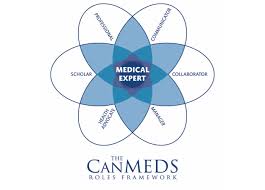
canmeds 1

He talked about the CanMeds framework that physicians had put into practice to see what is expected of a medical expert. This framework has been adopted around the world, where students and medical professionals are graded on the six branches of the model. But the same model has been adopted in Physiotherapy and Occupational Therapy groups as well.

The public expects a doctor to be a medical professional (obviously) but the above six qualities are expected as well.

Communicators. We are judged by other professions and the public on how we communicate. This includes writing reports in response to doctors and other practitioners that we refer to and from. Dr. Parhar also sat in with the professionalism group and spoke with them on how important it was to implement report or communication writing back to doctors.

It is an area that we are not very good at. During discussions later in the day, the feeling was that most thought a report to a doctor had to be complicated and frequent. Dr. Parhar spoke about how much he as a physician appreciates getting communication from RMT’s, but it just needs to be a report at the beginning of treatment and one at the end. Just a report that informs the doctor in areas of treatment and how treatment progressed, so they know what has been done with the patient.

That’s it.

Collaborators. This works with our communication. How are we interacting with the rest of the healthcare team? We can’t work in isolation, we should be communicating with our patients other practitioners and contributing to their healthcare plan.

Manager. Why can’t we be a case manager on behalf of a patient? We can see a recently injured patient 2-3 times a week for an hour at a time. A doctor will see this person once every 4-6 weeks for maybe half an hour. So why aren’t we a piece of this puzzle, or even the primary case managers?

Health Advocate. Access to care is so crucial, especially in a “patient centred” model of care. There is still a difficulty for doctor’s to explain to their patients why Registered Massage Therapy isn’t approved by their insurance company when it is needed. We need to help advocate for the patients because society trusts us as professionals based on our guidelines and standards of care.

Scholar. This is a difficult area for us. There was plenty of discussion throughout the day on research (in fact a guest speaker Dr. Martha Brown-Menard LMT, spoke to us specifically on research) and how important it is. The problem is that research is done at universities and big companies don’t necessarily want to fund research for massage.

As much as we are pushing for evidence based practice, qualitative studies are just as important. But we need to start doing the research if we want to advocate for more resources to back up our profession.

Professionalism. Is Massage Therapy going to continue to have an artistic side to it, or do we start to present ourselves in a more professional manner? Should there be a standardization so that when someone comes in for treatment a person feels like they are dealing with clinicians?

I’m as guilty of this as anyone, I like just going to work in what I’m comfortable in (which is usually cargo shorts and a t-shirt), but would I be more presentable or respected if I made sure to wear a golf shirt instead? While I don’t think this is something that will ever be mandated, it may just be some food for thought when it comes to your own practice.

Listening to all of those points coming from a doctor was more than rewarding. Knowing there are doctors out there that are also advocates for Massage Therapy says that we are at least on the right track.

When I started this blog, the whole intent was to have other therapists collaborate information on how to improve the profession and share knowledge. I was excited when each one of the coaches agreed to be part of it because they were willing to share.

Sitting in a room of other RMT’s that are passionate about their profession and improving it was impressive. It also showed that we have a ways to go in order for our profession to gain more respect. While it is leaps and bounds ahead of where it was 10, 15 or 20 years ago, we can never stop improving. As the CanMeds model increases throughout the world, Massage Therapists need to continue working on being Professionals, Communicators, Collaborators, Scholars, Managers and Health Advocates. As mainstream healthcare continues to develop we need to make Massage Therapy prominent in patient centred care.

No one is going to this for us, it is only through our efforts that we can prove to government and other practitioners that we belong in the public sector and mainstream healthcare. I realize as I write this post that it seems pretty heavy on the education side of things. There was so much more that came out of the discussions that day, it’s just hard to put it all down in one place. If nothing else, I think the discussion was a step in the right direction.

We were asked to bring the excitement that we were all feeling that day back to our colleagues and share in order to keep the momentum going. I hope I have at least managed to do that, although I know it’s just the beginning.

Removing Pec Minor Discomfort From Massage Treatments


He winced when I first started trying to dig in to the area.

Palpating along the ribs, I found it.

Getting him to activate the muscle I felt it pop up under my fingers.

Okay, this is going to be a bit uncomfortable.

Treating Pec Minor is always a bit of a daunting task, especially when the patient is hesitant to have it done.

And with good reason, its usually pretty uncomfortable and can be painful.

However, as a therapist that preaches modern manual therapy, there is a less painful way.

Pain Free Massage Therapy Techniques

Yes… absolutely like most manual therapists, I have caused a fair share of pain and discomfort at my hands in the name of tissue deformation.

I have not believed in that for about 3 years now.

Here is my updated Pec Minor Release.

Patient: Supine

Massage Therapist: standing on the involved shoulder side

Test-retest: posteriorly tip the scapula to assess for loss of shoulder internal rotation, make sure you push the scapula into a set position as the involved side is often anteriorly tipped.

Technique:

  • lightly place your fist or a ball into the pec major under the coracoid
    • no you don’t need to go underneath it or anything ridiculously painful
  • have the patient move actively into elevation until extra tension or discomfort is felt, then have them resist into elevation to activate the scapular stabilizers
  • this will reciprocally inhibit the pec minor and they (or you) should be able to elevate the shoulder into the next barrier
  • continue until the shoulder is at full elevation if possible
  • re-test shoulder internal rotation, if they are a rapid responder, this should change after 4-5 reps

If done correctly, this should not hurt at all, unlike most other passive or movement based “releases”

Give the repeated shoulder extension reset for home care exercises

With modern manual therapy, we don’t need to cause pain and discomfort to get positive results. Make sure when you’re treating pec minor that you test and retest before and after the treatment to see the difference you have made in the patients internal rotation, not just for yourself but also to prove to them the difference the treatment has made. After 4-5 reps in the treatment you should be able to tell the difference you’ve made, the difference is that you’ll do it pain free.

How Massage Therapists Can Recognize And Deal With A Heart Attack

“I have had a few times in practice where I’ve caught a myocardial infarction and called 911, if this has yet to happen to you, be forewarned, it will” – Robert Libbey RMT


I’ll never forget that day walking into the hospital.

He didn’t look like himself and wasn’t acting like himself.

He was too young for this to happen and I was too young to really understand it.

Years later he told me the story about, feeling chest pain at home and thought there was something wrong so he jumped in the car and headed to the hospital.

Halfway there he lost the use of his arms and had to steer with his knees.

My dad was in his thirties and had a heart attack. I use this story whenever I teach a First Aid course. You wouldn’t think an otherwise healthy guy in his 30’s would suffer a heart attack, let alone one with two young boys and a wife at home.

Thankfully he survived but had an issue with his heart a couple years later.

We had to change the way we did things, the way we ate and the way we lived.

He wasn’t sure how to recognize what was happening that day or even acknowledge that it was a heart attack.

How about you?

Could you recognize it if this happened in your clinic, or to one of your family members?

Differentiating Chest Pain In Your Massage Therapy Clinic

I’ve said it before and will continue to harp on it.

As healthcare professionals this is something we really need to be able to pick up on, which isn’t always easy to do.

If someone is having a heart attack, they really don’t want to admit it. Their mortality is staring them in the face at this point and realizing that something major is going on isn’t an easy thing to face, in fact most people will completely deny the possibility they are having a heart attack.

That day my dad didn’t want to admit things might be worse.

It would have been fatal if things has progressed anymore on the drive to the hospital. Thankfully he didn’t drive off the road when he lost the use of his arms.

We need to realize the differences in pain to understand whether someone is having a heart attack, indigestion or if something muscular is going on.

If you are going through your typical assessment before a treatment and your patient is having brief chest pain as a result of bending or breathing deep, it’s probably not a heart attack.

Some even feel that it is, or starts as indigestion. However, if it is a heart attack it will continually get stronger over time.

If someone is having a heart attack I have heard it described as “an elephant sitting on my chest”.

While writing this post, I called my dad to ask what the pain was like. He said:

“It felt like someone drove a sword through my chest, pain down both arms and through to the back, it was ten times worse than having any kind of indigestion”

The pain can range from mild to a description of squeezing, or tightness and constricting to a crushing feeling in the chest.

If one of your patients is having chest pain and it lasts longer than ten minutes, it’s time to get them some help.

Signs And Symptoms For Massage Therapists To Recognize

These are going to be a bit different between women and men.

As my dad mentioned he had pain going down both arms. Generally, it will be in the left arm as well as going up the neck and into the jaw. These signs are pretty much the norm when it comes to men.

With women, they quite often get low back pain. Women can also exhibit some soft signs, which are a little harder to pick up on, but just as important to understand and read because it sometimes goes unrecognized.

Some of these can be stomach pain, flu symptoms and some chest pain that changes with the level of activity. These symptoms are also common in those with diabetes and the older population.

There are a few other signs that usually don’t get talked about much (at least in basic First Aid courses).

Here are a few of the other things that you may see:

While you won’t see this every time, they are all signs that can help you make a decision as to what is happening with someone or how severe their condition is.

https://flic.kr/p/5ZsuFK

Photo by: Alessandro Bonvini

What Massage Therapists Can Do To Help

The first thing we need to do as Robert mentioned is call 911.

Stay calm!

When you call 9-1-1 the dispatcher needs some information from you and the calmer you stay, the better!

They need your address and this is the most critical piece of information because if they can’t get that from you, they can’t get help to you.

They will also ask for your return phone number. They need this to be able to call you back and get more information or to help the crews on their way locate you. It is also so that if you need help they can coach you through what you’re doing.

They will also try to get as much information about the patient as they can. Age, sex, physical condition, level of discomfort, pain and surroundings are all critical information for the arriving crew to have before they get there, so they know what they are getting into.

After that call is made, getting the patient into a position that provides them with the most comfort is the best thing we can do for them. Usually, this is going to be in a seated position leaning forward, but just go with whatever position they say is most comfortable.

Now I know most clinics aren’t going to have this on hand, but getting them some aspirin is going to help things out. And it has to be Aspirin, not Tylenol or Ibuprofen…Aspirin.

It works as a blood thinner so it can help relieve tension on the heart as well as help diminish clots. 

All too often this goes unrecognized or people don’t want to admit it, so they don’t ask for any help. Unfortunately, this could be fatal as it leads to cardiac arrest and the need for CPR.

The more you can do to recognize and be aware of what’s going on with your patients, the more you’ll be able to help and prevent things from getting to that point. Being able to recognize and differentiate the pain a person is experiencing is key to understanding what’s going on with them. Also knowing that the signs and symptoms can be different between men and women can go a long way to recognizing that there is an emergency happening. And remember, this is the only time it’s okay to ask about erectile dysfunction drugs!

“Heart disease is no laughing matter. After my father suffered a massive heart attack, I realized just how serious heart disease can be” – Cheryl Hines