Posts

Understanding Depression, Ways To Recognize And Help

A couple of weeks ago, I was on my way to the gym when my mom called.

She started the conversation by saying she was thinking about me. My response was “why?”

I hadn’t heard the news yet, but she let me know that someone I’m a huge fan of had died. As the news about his death rolled in, it was confirmed that Anthony Bourdain had taken his own life. I’d read some of his books, cooked his food from one of my favourite cookbooks, watched his shows, and basically loved everything he did. I looked up to him.

Strange that someone who you’ve never met, can have an impact on you. Some may even think, strange for a mom to think about their son because of what a famous person did. But, perhaps she was thinking of me because of the way he did it.

I’ve written a little bit about it on this blog before, but have never gotten really personal with it. I debated hard whether I would write this post because it’s so personal. Depression is something I’ve dealt with a lot in my life, (I’m not sure if depression is actually a genetic thing, but it’s something that is certainly prevalent in our family) and was faced with suicide for the first time when I was around 12 years old. My uncle had taken his own life, years later my best friends dad, then one of my mentors at the firehall,  just a few years ago my brother, and a couple of months ago, a childhood friend.

So, any time something like this happens, maybe it hits a bit close to home.

Of course, when it’s a famous person, inevitably there is a lot of media attention. People take to social media to voice their opinions, mourn, share stories, and ask questions.

Most of the time people are left bewildered how someone who has “the ultimate life,” could possibly do something like this, they have it all!?

Then, of course, a barrage of the comments centre around how suicide is a selfish act because the person isn’t thinking about what they left behind, what they’ve done to family and friends, or that they took the easy way out.

Many friends who I’ve talked with since Bourdain’s death, haven’t really dealt with depression in their lives, so they have a difficult time understanding what could lead to this. I’m sure every person who deals with depression has varied experiences and different ranges of severity, so I can’t speak for others, or their experiences, but I will speak of mine.

Now for the personal part.

What Depression Feels Like

I can’t make a blanket statement on this as it’s going to be different for everyone.

Depression isn’t just simply a case of being “down” or feeling “blue” for a little while, it goes far beyond that. We are all meant to have a range of emotions and some days not feel as good as we do others. How could we ever experience how great happiness feels if we’ve never experienced grief or sadness?

Sadness can come and go depending on the experiences we have during the day. When you’re depressed, it’s like there’s a scratch on a record being played that is constantly skipping, playing the same line of a song over and over again. Only the line of the song is negative thoughts and no matter how hard you try, you can’t turn it off.

The longer it goes, the worse the negative thoughts get, and the harder it is to turn it off.

Possibly the worst part, is that you know those thoughts are wrong, you know they’re irrational, but there’s nothing you can do about it, they just keep pounding into your head. Then, you start to believe them.

When you start believing them is when things get really tough. You start to pull away from others because those negative thoughts aren’t just a matter of a feeling of sadness, it’s a feeling of worthlessness. You start to think that no one cares, that you’re not loveable, that maybe, just maybe, you’re as worthless as the thoughts in your head.

You could be laying in bed with someone you’re totally in love with, and when they tell you they love you, you don’t really believe it because, why would they!? When you already believe the negative thoughts in your head, why would anyone else think any differently? You assume everyone else thinks the same thing.

As it persists, things continue on that downward spiral. Sometimes laying in bed just thinking “maybe the world is a better place without me,” “maybe my friends and family would find it so much easier not having me around.” And the thoughts just won’t shut off, they won’t go away.

Then some of the isolation begins. You pull away from everything social because you’re not likeable anyway right?, so why subject your loved ones to HAVING to put up with you being around. It’s such an irrational thought, your loved ones having to PUT UP with you. It makes no sense, but you just can’t help it, it makes sense to you at the moment!

One of the strange things is that it doesn’t matter how good everything else in life is going, you could literally experience the greatest highs, and still have those negative thoughts constantly spinning in your head. One of the greatest experiences of my career was travelling to Russia this year with hockey, it was a major accomplishment, but there was still a night where I had to lock myself in the bathroom to have a good cry…damn those negative thoughts!

According to Mental Health First Aid Canadasome of the outward signs of depression can have both a physical appearance and a shift in attitude. 

Some signs of a change in physical appearance can be:

  • Looking sad, dejected, or anxious.
  • Speaking slowly in monotones.
  • Have a lack of attention to their physical appearance (look unkept).
  • Slowed thinking and body movements, agitation, pacing, or unable to sit still.
  • Decreased energy, tiredness, and fatigue.

With changes in attitude, a person may say things like:

  • I’m a failure.
  • I’ve let everyone down.
  • It’s all my fault.
  • I’m worthless.
  • I’m so alone.
  • Life is not worth living.
  • No one loves me.

Take a moment and just think about what it would be like having those thoughts repeatedly playing in your head. So, yeah I can see and understand why these famous people with the “ultimate lives” can get to a point where it seems like their only option is to end it all.

Treating Depression

There has been lots of discussion about what works for treating depression, that we need to raise awareness, and we certainly need to talk about it (the main reason for me writing this post).

What I haven’t seen much on, is how does the depressed person feel about all of these things?

This article was being shared around last week about the great effects of resistance exercise in reducing depressive symptoms. While this is great (and is hopefully used as a preventative measure), when you’re going through dark bouts of depression, the last thing you want to do is exercise. Just getting out of bed can be hard enough.

Raising awareness, yes we need to do this and fortunately, mental health, in general, is becoming more recognized and talked about. However, when you’re dealing with it, the last thing you want to do is raise awareness around your mental health. There’s a lot of fear associated with it.

Again, maybe irrational thoughts, but all you can think is:

  • No one would want to date someone who deals with this.
  • I could get turned down for that job I’m applying for if they find out.
  • People are going to look at me differently.
  • I’ll get less professional opportunities if people know.
  • No one would want to read a blog post I’m writing.

Talking about it, yes let’s get this going! However, it’s important to keep in mind that whether we like it or not, there is still a lot of stigma surrounding mental health (at this point). So, the depressed person may not want to talk to anyone about it, because remember, it’s also possible they think that NO ONE cares anyway.

While exercise and massage therapy are both recommended as lifestyle and alternative treatments for mild to moderate depression, anything more severe, the person should seek medical attention. This can be both medical and psychological treatment. Some of the best scientific evidence points to antidepressants, Electroconvulsive Therapy (ECT), and Cognitive Behaviour Therapy (CBT) as the best approaches for the treatment of depression.

The best thing we can do is start building relationships with medical professionals who provide the above therapies, so we can refer our patients when they need it. 

Assessing Risk Of Harm

This is one of the reasons it drives me bananas when some of our regulatory bodies say the biopsychosocial approach is out of our scope. Not only is massage therapy recommended as a treatment for depression, it’s also our responsibility to recognize and refer out should our patient need it.

How do we handle it if our patient is dealing with a mental health crisis and it gets to be too much for them?

Mental Health First Aid Canada gives four steps as crisis first aid in these situations:

  1. Engage the person in a serious conversation
    • Connect in a personal way.
    • Ask if they are feeling hopeless, or engaging in risky behaviour.
    • Show sensitivity and let them describe their feelings.
    • Listen for anything that could be an invitation to talk about suicide.
  2. Ask about suicide
    • Are you thinking about killing yourself, or having suicidal thoughts?
    • Asking this will not encourage suicidal thoughts, but rather it shows you care and are willing to talk with them, which can be a great relief for them.
    • Creating this conversation can identify you as a safe person to talk to.
  3. Explore and assess risk
    • Ask if they have a plan in place.
      • Have they made arrangements, or have things they could use to do it?
    • Ask about prior suicidal behaviour.
      • If they do, see if they need extra support, or if there are things that helped them in the past.
    • Ask about their supports.
      • See if they have people to turn to (at this point it might be you).
  4. Engage them in a plan for safety
    • Try and make sure they don’t have access to the means of killing themselves.
    • Develop a safety plan for a manageable period of time along with emergency or crisis line information.
    • Try to ensure no access to drugs/alcohol.
    • Listen to them.
    • Refer them to appropriate professional help.
    • Connect them with their support resources (and try not to leave them alone).
    • If necessary call 9-1-1.
    • Ensure your own safety.

While I hope this is something you never have to deal with, it’s an important conversation to have, as it could quite literally save one of your patients (or loved ones) lives.

While this is just a blog post, it should not be used as a substitute for more education about mental health, or suicide. I would encourage anyone reading this (healthcare professional or not) to take a mental health first aid course to better equip you to handle these situations should you ever need it. 

Whenever a famous person succumbs to mental health issues and takes their own life, it raises lots of awareness online. Along with that is discussions and opinions about the act of suicide itself. People make statements like: “it’s a selfish act,” and “why couldn’t they think about the ones they left behind?” While those things are all valid statements, as the ones left behind are left with nothing but hurt, and questions about how they didn’t see it coming, or just disbelief that it could ever happen. It may seem like a selfish act, but as we talked about earlier in the post, the person doesn’t believe that anyone cares, loves them, or that there is any other way out. From my own experiences, I’m not concerned about whether the person was selfish, it’s more sadness that whatever was going on in life was so bad, that the only thing they thought would fix it, was to end it all. So please, if you have any concern surrounding this with one of your patients, assist them to get the help they need. 
Articles Of The Week July 1, 2018


There are always arguments to be had in our manual therapy fields, and this one ranks right toward the top. Trigger Points. We’ve all “treated” them using various methods, and the explanation behind what they are is debatable, and so are the methods of treatment. So, it’s good to see that both the trigger point and the treatment are being debated.

“Trigger Points – Myofascial Pathology, Or Fight Starter?” – Aran Bright

Throughout manual therapy professions whether massage, chiro, physio, kins, or any other one, there are antiquated explanations that are still being taught. However, in order for all of us to use best practice and evidence-based approach, things need to change. While it’s directed at physio’s, this article is applicable to all of us.

“Orthopaedic Physiotherapy Training In Canada; Reflections On Manual Therapy And The Orthopaedic Division” – Greg Lehman

As therapists we are great at taking care of our patients, but how good are we at taking care of ourselves? It’s really hard for an entrepreneur to fit in vacation time and recharge, but what if there were other ways we could help ourselves to recharge? It could be just 30 minutes a day.

“How To Take Mini Vacations At Work And Not Feel Guilty” – Daniel Olexa

All too often the general public associate’s pain with tissue damage. Hopefully, most of us medical professionals are promoting a different explanation. This article is a great explanation of how there is a medical trap with bad explanations. We can do better.

“Feeling Pain? Get Active: How To Recognise When You’re In A Modern Medical Trap”  – Jill Margo

The brain is more than amazing. This post shows how exposing a child to music education can actually make a difference in reading skills, language skills, and effective communication.

“A Childs Brain Develops Faster With Exposure To Music Education”  – Anita Nee

The Environment For Movement

I just got back from an enjoyable three-day multi-family camping trip. Like several other camping trips or vacations, it for some reason prompted me to write a short blog post. Which is good, because I should really be writing more frequent short blog posts and not just infrequent long blog posts.

What I found interesting about this trip is that for some reason my ten-year-old daughter spent a LOT of time biking. Which is unusual for her, because at home, she hardly spends ANY time biking. If you asked either one of us why, we might have said that biking is not one of her interests, or that she is just not the kind of person who likes biking. In other words, we would have explained her biking behaviour in reference to her internal psychological state.

But during the trip, for whatever reason, she was instantly transformed into the kind of person who really likes biking. She was on her bike within ten minutes of waking up, and then on and off until about ten minutes before going to bed at night.

What changed? Did she somehow become the kind of person who is into biking? Did she have a transformative biking experience that changed her mind? Was she convinced by parents or friends that biking is actually a fun thing to do?

No, because as soon as she got home she went right back to not riding her bike. The only thing that really changed was the environment. Something about this change made a radical difference in her movement behaviour.

We tend to assume that people’s movement behaviours are driven by internal states of the mind, or the fitness of the body, or personal preferences, or discipline, or intentions. All these factors certainly matter, but in some cases, the environment is the most powerful determinant.

Here at home, my daughter has access to a bike, places to ride, and friends to ride with. On the campsite, all these variables were altered a little bit in favour of more biking (perhaps most significantly in the absence of electronic devices), but these small alterations led to a huge change in her biking behaviour.

In terms of complex systems thinking, we could say that her movement behaviour underwent a nonlinear phase shift due to changes in environmental constraints.

I think we should all be more aware of how the environment affects our movement behaviour. And how small changes can sometimes make a big difference.

5 Variations On Cervical Retraction


The cervical retraction exercise is a classic and works very well for cervical pain, cervicogenic headaches, and general upper quarter complaints. Yes, posture does not directly predict or relate to pain any more than knee flexion causes knee pain. However, common prolonged or repeated activities often cause predictable triggers that should be avoided and novel movements in the opposite direction often desensitize the area and reset the symptoms.

Here are 5 variations on the cervical retraction to make it as comfortable and effective as possible. Remember, it’s the dosage of the home program that really promotes recovery between patient visits, not what you treat the patient within the clinic.

Articles Of The Week June 3, 2018

There is much debate about which treatments work best. Some even demand that some types of treatment don’t work at all, while others are the gold standard. But, in reality, who are we to say which is best, and in turn taking the choice away from the patient? This is a great article debating just that and is WELL worth the read.

“Using The Socratic Method Debate On The Debate About Passive Treatment” – Carl Davies

Hearing stories from those who deal with chronic pain can be a crucial component of being a therapist. This story is a good one. After being fearful of movement, a great therapist gradually exposed the patient to movements with a good explanation, which had a profound effect. Listening to the patients story, and some good education can go a long way in helping patients in pain.

“Why Goldilocks Is My Rehab Heroine” – Cheryl Lee

I don’t think any of us learn enough about business coming out of school, and going into business for yourself is a scary thing! However, all of us are small business owners, even if we don’t own the clinic. So, here’s some great advice from a successful entrepreneur in our industry on how to get started as a massage business owner.

“How To Start A Massage Business” – Rajam Roose

We all know there are lots of ‘myths’ within our industry. Here are seven myths related to health that you may be asked about in your practice. While the author doesn’t go into too much depth in their explanations, they are definitely myths we can forget about.

“7 Health Myths We Need To Forget About”  – Steven Baldwin

There are many aspects that can make us a good therapist. However, probably one of the most important, is how well we can coach our patients when it comes to homecare, or any kind of exercise prescription. If we are all focused on patient centred care, coaching and communication are crucial to beneficial outcomes for our patients.

“How Good Are We At Patient Education?” – Roma Forbes

Are Painful Flare Ups To Exercise, Just Like A Sunburn (and why we might need analogy anyway)

Whilst Exercise CAN be a wonderful tool to use during the rehab process we must remember it is not a stick on, we can’t just fire and forget or plug and play and for every success, there are also failures. There just is not such a thing as a magic bullet in rehab.

Sorry about dat!

Before we get to the analogy stuff we might want to first ask WHY we might want to help people understand what is happening to their bodies and how ANALOGY can help with that?

In some cases, it can be much more about HOW we do things rather than WHAT we actually do.

Why? 

For all the studies we have extolling the virtues of exercise, although make sure you consider the effects sizes, an important question to ask is how generalisable are they to the real world? If I was being all sciencey and shit we could term this the external validity of a study.

Why might these studies lack external validity? In the tightly controlled world of the scientific study participants probably tend to adhere a little bit more to the protocol laid out than they do on their own, otherwise, studies would never get finished. Researchers can also employ things like the “intention to treat” analysis (ITT) that are designed to scientifically smooth out things like dropouts and missing data.

Out in the real world when we throw in the complications of life, exercises, however evidence-based, in some cases can tend to fall by the wayside. This is a problem with human beings they don’t always just fit neatly into EBM boxes. In fact, they can render all the science a touch redundant through things like their beliefs, preferences and lifestyles.

Differences in the definition of adherence used, measurement and estimative of how many patients do not comply with their prescribed exercises vary, but evidence converge on a figure of 50% or higher”  *HERE*

We can all agree that that is a pretty high percentage of shit that is not getting done! What we CAN say is exercise is likely to infer some benefits IF IT GETS DONE! SO how do we go about doing that? And that, of course, is the $1 million question!

Barriers

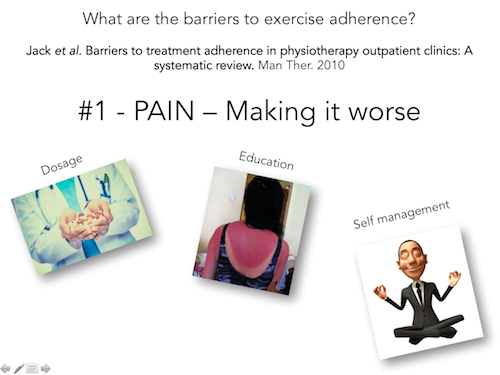
This is an awesome piece of research that looks at barriers to people adhering to therapeutic exercise programs *HERE* One of the major reasons that people don’t adhere, or a much better term to use, commit, to exercises or exercise programs when they have pain is the fear of INCREASING that pain.

Here is a slide from my recent presentation at the San Diego pain summit.


Now, this is completely understandable. Our fears drive our behaviours, so if I am scared of making the problem worse that may drive me to, well, simply not do it. It may then be key to help people make sense of what they feel and how they can manage that.

For a lot of people, the science of both pain and exercise are pretty alien subjects. What’s the difference between exercise-induced discomfort and actual pain? For someone who has never experienced the former then perhaps not a lot! I have been pretty sore from training before and found some activities really quite painful.

The likelihood of getting some DOMS from prescribed exercises for someone with no real history of exercise and a low ‘zone of homeostasis’ could be pretty high, so it is vital we can put these sensations into perspective, allay fears and help people to SELF-manage their rehab.

A useful phrase I picked up a long time ago is “go to the P in Pain not the Y in Agony” which is a really nice way to say go into some discomfort, which of course is normal, but try to avoid rip-roaring pain. We still don’t know if painful exercise is actually bad for outcomes but certainly, it may dissuade someone from carrying on with it.

Things can and will go wrong and setbacks are normal. These setbacks can be influenced by a whole bunch of factors including stress and lifestyle that can negatively affect recovery, and no rehab plan will ever follow a linear upwards trajectory, especially if we are attempting to push the envelope and ‘vaccinate’ against future reoccurrences.

*HERE* we see psychological stress actually impairs recovery from exercise so we must be mindful of this. It may not be the intensity of the sensation that some struggle with but how LONG it goes on for. Desired adaptations such as strength might also be affected by stress too. *HERE*

Pain is often accompanied by worry and stress and could be both a cause and an effect of the current state of the individual. This is why we must be aware that our rehab programs carry the possibility that they could cause an adverse reaction in times of stress.

Analogy

Equipping people with the knowledge to both understand AND address these factors is vital for self-efficacy, another key player in the COMMITMENT to a rehab program.

An analogy is a fantastic way of helping people understand subjects that they have very little background in and for many folks, both pain and exercise fall neatly into this bracket. One of my favourite analogies for exercise discomfort AND pain is SUNBURN. The reason for this is it (hopefully) places the pain or discomfort into perspective and allows it to be seen as a temporary thing and one that can be easily modified.

Rather than viewing an exercise as simply being WRONG, a comparison to sunburn allows it to be viewed more as an issue with the dosage applied and the bodies response. We generally don’t see the sun as a BAD thing, of course, some do but we could put that on the spectrum of fear avoidance! Most people will get sunburn at some point in their lives and just see it is a little bit too much of a GOOD thing!

So what do we do if we overdose on the sun? Generally just ALTER the dosage, simply get less sun the next day by sitting under the umbrella or covering up my burnt bits with a towel, we may have just tried to rush the natural adaptation.

The negative physical reaction is only temporary, often just like the pain triggered from overdosing on exercise, the angry red skin and spiky feeling when in the shower will, of course, go away if I just alter the dose and let nature run its course. What we do see if dosed correctly is a slow natural adaptation that leaves us positively glowing.

What do you usually do next after burning? Well just be more careful when re-exposing yourself. Spend less time in the sun or apply a higher factor. We don’t freak out, in fact often we berate ourselves for being stupid! We know this happens after all. We can do the same with our exercises, just take a little time off or reduce the amount we do before building up again.

Why might we overdose? Perhaps we have been previously been underdosed. Just like coming out of a long sunless winter, not having exercised for a while probably reduces the amount I can tolerate and hence potential adverse reactions. This may explain why just a few sets could leave me pretty sore.

If we have previously been good at a sport we tend to be able to play at a much higher intensity than perhaps we can CURRENTLY handle. In fact being good at something could actually be a risk factor for some! Our skill level may far outweigh our tolerance for the level of intensity we can play at. The same is true of tanning, we tend to remember the lazy long days at the END of a holiday applying Hawaiian tropic rather than the blotchy days in the beginning, piling on factor 30.

Some people can exercise till the cows come home and never feel a thing, a bit like those really annoying people who go an amazing shade of brown by just looking at the sun! We may be predisposed genetically to being LESS tolerant of physical activity. We see discussion of the role of genetics in sensitivity *HERE*

People with fair skin and red hair are often less tolerant of the sun by nature of their Celtic heritage and those of Mediterranean or African origin far better genetically equipped to handle a greater dosage of the sun.

Now, no analogy is free from a negative misinterpretation. Whilst the sun could be seen as having dangerous consequences such as skin cancer from extreme overdosing we also see problems with underdosing such as depression from reduced serotonin. Like all things, it has an OPTIMAL dosage, after all too much or little water or oxygen can also kill you too!

How can we alter the dosage?

  • Frequency – How often. More is not always better.
  • Intensity – How heavy or how fast.
  • Volume – How much. Sets, reps and rest.

Read more here about dosage *HERE*

Take Homes

  • People don’t just fit neatly into science
  • Increasing pain is a real worry with rehab exercises
  • Arm people with information about what to expect and what they are feeling
  • Be smart in the first place – Less can be more.
  • Self-management. Give them the tools to manage the dosage.
  • Give support. If it does go wrong to help people get back on track