Free Massage!


Do you ever feel like you have a sign on your forehead that says “Free Massage?”

Every day on my social networks, I see massage therapists talking about being asked to do free massage. “Come and do free chair massage at our event and it will get your name out there….” never mind that you’ve been practicing for 15 years and your name is already out there.

I recently saw on FB post where a chiropractor wanted someone to come to his office and do a week’s worth of free massage so he could get the client feedback and decide whether or not he would hire the person…I guess he thought she just wouldn’t need any rent money or groceries that week. If he’s located near a massage school that’s turning out graduates or an area that’s saturated with massage therapists, he could feasibly keep the “audition week” going for a long time–and quite probably billing insurance for the massage that he’s not even paying the therapist to perform.

At the massage school I attended, back in the day, we were required to perform 25 hours of community service…free massage on a deserving population. 15 years later, I still don’t mind performing free massage on a deserving population. I occasionally volunteer time to what I think is a worthy cause.

I once gave weekly massage to someone for almost a year because he had spent nearly a year in the hospital, his medical bills were in the millions of dollars, and he just plain needed the work and couldn’t pay. One of my staff members has given a lot of massage at an abused women’s shelter. Another did deeply discounted work on someone who was seriously injured and didn’t have any insurance, and many of us have done that kind of thing at one time or another, for nothing other than the warm fuzzy feeling of having helped someone.

If there is an event going on that I think we need to have a presence at, I will pay staff members to do chair massage; I don’t expect people to work for free. We just can’t and/or won’t go everywhere we are asked to go. If the event is more than ten miles away from my office, I’m not really inclined to go there. There are plenty of massage therapists in our county, and if there’s a health fair that’s all the way at the other end of the county and plenty of practicing therapists between here and there, I’d rather let one of them have it.

I have recently been receiving invites to an event in Shelby, NC. That’s 25 miles away from here and I know at least half a dozen therapists that practice there, so I’m not going to go encroach on their territory. The last time the organizer called, I told him he was wasting time by continuing to call me about it and suggested he contact therapists from that area. I also turned one down that was relatively close, but on a holiday. When the woman called me, I said, “thank you, but our staff members want to spend the holiday with their own families that day.” Not only do they want us to do free massage, they also want us to pay them for a booth to do it in.

Sometimes MTs are distressed or hesitant about saying “no,” because “it’s at my mother-in-law’s church,” or “one of my clients asked me to do it, but it’s 30 miles away,” and that kind of thing. If you’re a new therapist, or an old one who’s feeling torn on this issue, then here’s the answer: “Thank you for thinking of me, but I already have clients booked for that day.” Or you can say “Thanks, but I don’t give my services away,” with no excuse. You don’t need an excuse.

If you have the time, and so much money you don’t have to worry about paying your bills, then feel free to give away all the massage you want to. Say yes to everyone who asks. You’ll probably get some business out of it, but keep these thoughts in mind: Some people will do anything just because it’s free, that they would never think of actually spending money on. Some people who are already consumers of massage and already have their own therapist of choice will sit down and get the massage, again, just because it’s free. And many times, people don’t place much value on something they get for free.

If you need an actual return on investment for your time, then you need to pick and choose what you’re going to participate in. Realistically, you stand a much better chance of getting business from an event that’s 5 miles away from your office than one that’s 25 miles away from your office. Some events, like an annual festival, attract a lot of people from out of town that are never going to become clients, but you’ll have to massage them along with any locals who might potentially become clients.

Your dentist isn’t going to do your root canal for free. Your doctor isn’t going to do your appendectomy or deliver your baby for free. The plumber, the electrician, the washing machine repairman isn’t coming to your home for free. You can’t walk into Walmart and load up on free goods, but for some reason, many people seem to expect that massage therapists are always available to give it away.

Here’s the reality check: most of us have overhead directly related to our work. It also costs money to get educated, to get licensed, and to keep up with continuing education requirements. It costs money to run our homes and our lives–just the same as it does for the people who are soliciting us to come and do free massage. We have mortgages, car payments, student loans, and debts to pay. We need food and utilities and medicine and school tuition and child care just like everyone else.

Doing free massage is sometimes a good marketing opportunity. It’s always providing a public service, and you should do it only when you genuinely want to. Don’t allow yourself to be talked into doing it when you don’t want to, and don’t allow yourself to feel guilty for turning anyone down.
Motivational Interviewing In Your Clinic

A great deal of our work as therapists involves helping people to make changes in order to get better outcomes, be it for general health and well-being, reductions in pain, or increases in mobility.

Our training and education means that we know a lot about what people need to do to achieve these outcomes. We are smart and we know it! We assume the patients coming in to see us, know that too. So it should be simple right, we tell them all the things that they need to know, and they go away and do it. But here lies the problem, no one really wants to be told what to do.

Take for example the person who has recently had a heart attack but is also a smoker. They are very likely to be informed of the fact that continuing to smoke is going to contribute to poor health outcomes including increasing the risk of another heart attack. With such a frightening near death experience, one might assume that being given sufficient information, combined with the fear of the experience would be enough to make someone stop smoking.

However the studies tend to tell us that only about half the people in this situation will actually quit smoking! (1) Mind blowing isn’t it? What this and many other studies in similar fields of healthcare continue to show us is that information and fear are not enough to change behaviour, no matter how dire the consequences. (2)

Changing Our Approach For Better Outcomes

Self management forms a big part of the picture in managing all chronic diseases. As we start to view pain with a more modern and science based understanding, our approach to treating it should start to shift away from trying to “fix” the patient and towards an empowering model of care that encourages the patient to take their health into their own hands.

Sounds easy doesn’t it?,  but many of us have been experiencing as practitioners what an uphill battle this is. Particularly in our western culture where there is an understanding around medicine being able to “fix” everything, so that the mere presence of pain is viewed as being “wrong”, and the understanding that as a consumer based system,  you just have to pay for the “thing” (manual therapy/ acupuncture/ surgery/ injections etc) and it will be done to you and will be effective.

Unfortunately, we know it doesn’t work like that.

Single modality approaches for treating any pain condition, but particularly chronic pain, are largely unhelpful in the long term and science tells us that adopting an active approach is far more likely to lead us to better outcomes. (3)

In treating pain and getting people to adopt behavioral change, some of the information we provide to help, might be of a therapeutic neuroscience education (TNE), explaining pain, pain education approach. Along the lines of what we see in situations like smoking cessation, weight loss and exercise programs, providing the information doesn’t always translate through to the outcomes we might hope.

That is not to say that we don’t use it.

The research tells us it has value (4-7) , we just understand that it is one part of the process, the information and context a person might use when deciding on taking a multidisciplinary and active approach to treating their pain.

Motivational Interviewing

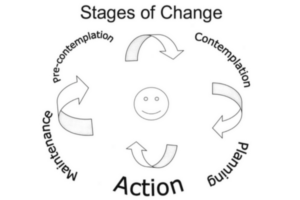
Motivational interviewing is a cognitive behavioral technique that helps patients to identify behaviors that may be preventing them from achieving optimal management of a chronic condition. It has been used in many healthcare settings which require behavioral change for better outcomes such as addiction medicine, oral-health self care, smoking cessation, weight loss, medication compliance and diabetes self management. It identifies a cycle that people tend to go through (and often go back around and around) in processing a change in behaviour.(2)


The process of motivational interviewing is one that provides structure around helping a person to find their own motivation, the idea being that if a person has made the choice for themselves they are far more likely to follow through with change, compared to when it is something that has been forced upon them.

It is a process that requires first establishing a level of rapport with the person and then helping them to identify what behaviors they would like to change. Within the approach there are some specific techniques that can help the practitioner to elicit in the patient a better understanding of what his or her thought processes are in relation to the problem. Then through a process of reflective listening and open ended style questioning, helping the person to identify how important the change is to them and how confident they are in being able to make those changes. From there a structured, but collaborative approach can address the barriers to change, identify measures of support and create a plan to move forward that fits with the patient’s own motivation.

The best thing about motivational interviewing is its accessibility. It is a process that has been used in industries other than just psychology, (sales and human resources to name a few). This means that it is easy to learn about it and that applying it in the clinic is not an “all or nothing principle”.

You can start to learn about some of the elements and apply them straight away – the easiest way is to refine your listening and reflecting skills and resist the urge to jump in straight away and tell people what they “should” be doing. There are lots of resources available in the form of short courses, blog post summaries, books and journal articles. So if you are feeling motivated, get your google on and work out what your next best step is to start delving into some motivation interviewing skills! (2)


References:

1. van Berkel TF, van der Vlugt MJ, Boersma H. Characteristics of smokers and long-term changes in smoking behavior in consecutive patients with myocardial infarction. Prev Med 2000, Dec;31(6):732-41.
2. Bundy C. Changing behaviour: Using motivational interviewing techniques. J R Soc Med 2004;97 Suppl 44:43-7.
3. O’Keeffe M, Purtill H, Kennedy N, Conneely M, Hurley J, O’Sullivan P, et al. Comparative effectiveness of conservative interventions for nonspecific chronic spinal pain: Physical, behavioral/psychologically informed, or combined? A systematic review and meta-analysis. J Pain 2016, Jul;17(7):755-74.
4. Louw A, Diener I, Butler DS, Puentedura EJ. The effect of neuroscience education on pain, disability, anxiety, and stress in chronic musculoskeletal pain. Arch Phys Med Rehabil 2011, Dec;92(12):2041-56.
5. George SZ, Childs JD, Teyhen DS, Wu SS, Wright AC, Dugan JL, Robinson ME. Brief psychosocial education, not core stabilization, reduced incidence of low back pain: Results from the prevention of low back pain in the military (POLM) cluster randomized trial. BMC Med 2011;9:128.
6. Van Oosterwijck J, Meeus M, Paul L, De Schryver M, Pascal A, Lambrecht L, Nijs J. Pain physiology education improves health status and endogenous pain inhibition in fibromyalgia: A double-blind randomized controlled trial. Clin J Pain 2013, Oct;29(10):873-82.
7. Moseley GL. Evidence for a direct relationship between cognitive and physical change during an education intervention in people with chronic low back pain. European Journal of Pain 2004, Feb;8(1):39-45.

Is Massage Moving Fluids And Causing Dehydration?

I recently listened to a presentation which talked about online arguments and how to handle things appropriately.

One of the points brought up by the presenter is to make sure you actually give credit to a person for putting themselves out there and being vulnerable. Whether the person makes a comment, writes an article or is just sharing information, it is important to recognize their effort.

A week or two ago an article was being circulated arguing that said getting a massage if you’re hungover is probably a bad idea and will make you feel worse because of the massage contributing to dehydration. While the writer made a great effort to inform people, the information isn’t exactly accurate and sadly is something still being taught in our massage education system.

Like so many of the other myths out there, we have to change our understanding and more importantly our patients understanding of what massage does and doesn’t do.

Is Massage Moving Fluid?

We’ve heard so much over the years about how massage increases circulation.

When I first started working in hockey, there was a player on the team who had a major health scare. He had blood clots in his lungs as a result of a Deep Vein Thrombosis and was put on blood thinners as a result. Once the clots were remedied, he went back to playing hockey but had to remain on the blood thinners. According to what we had been taught in school, this would have been a contra-indication to getting a massage. Being a worried student, I asked one of my teachers if a massage would increase his circulation enough to be a concern? His answer was profoundly simple – “no more than playing hockey would.”

That simple answer changed everything for me.

When we look into the research available concerning massage and blood flow, the results are again staggeringly simple. What do most people come in to get massage for? To relax!

Study(1) after study shows that getting a massage actually decreases blood pressure and heart rate. Other studies have shown that massage post exercise actually impairs blood flow and removal of lactic acid (another one of those wonderful myths), not increase it. While focused on the effects of sport massage, another study showed that massage did not increase femoral artery blood flow, but did increase skin temperature and skin blood flow to the area being treated (in this case the anterior quads). This showed a possibility of muscle blood flow being diverted to the skin, but also shows limited possibility of any metabolic change. Or the increase in skin temperature, could just be conduction of heat from the therapists hands?

One review on the subject points out that while some studies support the idea of massage increasing local blood flow it would also depend on the type of stroke used. The squeezing effect of some massage strokes could help to promote venous return (due to effect on skeletal muscle pump), but also points out the same strokes could temporarily occlude arteries causing a temporary reduction of blood flow, which would in turn cause an increase in blood flow when the pressure is released.

Overall there is not much evidence to support the idea of massage increasing circulation, or moving fluids around and certainly doesn’t increase it more than the effort it took for the patient walking into your clinic.

Photo by: RMTBC

Dehydration

There are a few ways to become dehydrated

  1. Sweating too much (exercise, hot temperature).
  2. Diarrhea or vomiting. 
  3. Urinating too much (i.e.: breaking the seal when you’re out drinking). 
  4. Fever. 
  5. And of course, just not drinking enough fluid.

Now, if someone is coming in after a night out on the town and are a bit (or a lot) hungover, they are probably already a bit dehydrated because alcohol is a diuretic, which in turn causes you to pee a lot. Then water loss is greater than water gain, and if body mass is reduced by 2% because of fluid loss, this causes mild dehydration. When blood volume decreases because of the fluid loss, blood pressure decreases, the kidneys and various nerve impulses trigger the thirst centre in the hypothalamus, telling us to drink fluids.

The other things that stimulate thirst:

  1. Your mouth is dry from decreased amount of saliva.
  2. Baroreceptors in the heart and blood vessels detect lower blood pressure.

I know what you’re thinking: “you just wrote a paragraph on how massage lowers blood pressure and now you’re telling me lower blood pressure causes dehydration!”

Not so fast.

The baroreceptors are sensing lower blood pressure and increasing thirst not dehydration. If your patient had been out drinking the night before, they’re already behind the eight ball as far experiencing some level of dehydration, so their blood pressure is probably already down to some degree because of the decrease in blood osmolarity. When we look at the mechanisms that actually cause dehydration, there is nothing happening in a massage that is causing sweat, diarrhea, urinating or fever. Nor is it possible for a massage to decrease body mass by 2% (otherwise we’d all be a lot busier!). Plus if a treatment could drop blood pressure that much, every person we treat would need to drink after their treatment.

While your patient probably wasn’t feeling great when they came in, a massage isn’t necessarily going to make them feel all that much better because their body is basically telling them they’re an idiot from the night before (my body has said this to me several times). The massage isn’t going to make them any more dehydrated than if I was at my buddies place and his kids were climbing on my back while I laid on his couch. But neither one is going to make me feel all that pleasant. So while it is nice to give your patients that bottle or glass of water after their treatment, can we do it just cause it’s nice, feels good and is good for them? And can we please stop telling them it’s because they’re dehydrated or the massage has released toxins that need flushing out?

References:

  1. Alan David Kaye, Aaron J. Kaye, Jan Swinford, Amir Baluch, Brad A. Bawcom, Thomas J. Lambert, and Jason M. Hoover. The Journal of Alternative and Complementary Medicine. March 2008, 14(2): 125-128. doi:10.1089/acm.2007.0665.


Massage May Provide Short-Term Neck Pain Relief, BUT….


My Facebook feed was recently flooded with multiple shares of a summary of massage therapy research findings for various health problems from the Association of Massage Therapists (AMT). Because of my interest in musculoskeletal pain and dealing with clients having such pains regularly, I took a closer look at the studies cited for neck and shoulder pain.

Among the systematic reviews and meta-analyses cited, two of them are Chinese reviews, one Canadian, and one Cochrane Review, which was authored by American and Canadian researchers. While three of the reviews find massage therapy to have short-term pain relief effects and one review found “moderate evidence” of massage therapy on decreasing neck pain — stated on AMT’s summary — there is more to the story that made me question the strength of the evidence.

While all of the reviews found that massage therapy has immediate pain relief and any long-term benefits is unknown, there are a few problems the authors encountered.

Massage Definition Is Too Broad

In the review by Kong et al., the authors identified many types of massage therapy among 12 eligible studies reviewed: Swedish, Chinese massage, Thai massage, slow-stroke back massage, manual pressure release, and myofascial band therapy.(1) Likewise, the Cochrane Review addressed a similar problem, “e.g. Traditional Chinese massage, ischaemic compression, self-administered ischaemic pressure using a J-knob cane, conventional Western massage and occipital release.”(2)

The Ottawa review stated, “It was difficult to determine the effects of type and dosage of massage because the RCTs employed different techniques, durations, and treatment protocols. Most studies of massage therapy combined various techniques, which were likely applied differently by each therapist.”(3)

 The problem is that we don’t know for sure which type of massage is more or less beneficial than another type of massage for treating neck pain. Do I need to do kneading, skin stretching, Thai massage? Should I use the J-knob cane? Because we cannot readily identify what works better, we need to be careful when deciding what technique to use — not because it’s our favorite modality, but because the client or patient perceives it as beneficial.

Massage Is No Better Than Most “Active Therapies”

When compared to other types of treatments, massage isn’t better — or worse. Among 13 eligible randomized-controlled trials, Cheng and Huang found that “Although [massage therapy] did not show significant immediate effects on pain relief compared with active therapies, [massage] showed superior immediate effects on pain relief versus traditional Chinese medicine.”(4) However, they reported that it is no better than traction (n=3) and acupuncture (n=2) and other manual therapies (n=2) had better pain relief than massage.

Kong et al. and the Ottawa review found similar results.(1,3) The former concluded that massage therapy “does not show better effects than other active therapies on pain relief.” There was no evidence indicating that massage was effective in improving functional status of neck and shoulder pain.

The Cochrane Review, however, is more critical — as it should be with Cochrane Reviews. The authors stated, “There is no difference in pain intensity, physical function and quality of life when massage is compared with other therapies such as manual therapy, acupuncture, education, exercise and multimodal intervention. However, studies that compare one active treatment versus another active treatment require larger sample sizes than studies that compare an active treatment with a placebo. Thus, it is impossible to determine whether the ‘no difference’ findings in the studies comparing active treatment with active treatment reflect true equivalence or merely sample sizes too small to detect a difference.”(4)

The Review also found no differences when different massage therapy techniques were compared among each other. They also added this little gem: “Even when statistical significance was found, such as an improvement in pain with the combination of ischaemic compression and passive stretch compared with individual treatment, the lack of replicability of the study precludes making a statement about the effectiveness of one massage technique over another.”(4)

In other words, we should not make broad statements saying that one type of massage is better than another type of massage or treatment. And we should take these results with the likely possibility that they could be wrong should better evidence disconfirm these findings, which is something we should all consider when reading and interpreting research.

Massage Therapy Is Better Than Inactive Therapies

But that’s great news, isn’t it? Umm…not really. Patients who receive massage therapy obviously feel better than those receiving “standard” medical care or are on the wait-list. This was reported in all four reviews.

There are two problems with this thinking:

First, having some degree of socialization will elicit some change of pain perception, often for the better. So someone in pain who is interacting with another person will likely have a greater reduction in pain than those who receive no or minimum care. 

For example, a randomized sham-control study of Reiki found that cancer patients with who were treated by a real Reiki Master had no better outcome than those treated by an actor pretending to be a Reiki Master, who simply mimicked the moves. However, both groups reported to feel better and have less pain than those receiving standard care. The authors concluded, “The findings indicate that the presence of [a registered nurse] providing one-on-one support during chemotherapy was influential in raising comfort and well-being levels, with or without an attempted healing energy field.” (5)

Another study in acupuncture also found similar results where real acupuncture was no better than fake acupuncture in alleviating knee pain for patients with osteoarthritis, but these two groups had better pain relief than those receiving standard care.(6)

The second problem is that we don’t know how well the trials were blinded in the reviews. Control groups that are not blinded during the selection may likely experience higher levels of pain, knowing that they aren’t receiving a massage or another type of care. Cheng and Huang reported, “There were serious flaws in blinding methods of most Chinese RCTs. It is difficult to blind the patients and impossible to blind the therapists, but blinded assessors and concealed allocation must attempt to make up for the lack of blinding. However, some Chinese RCTs did not perform these compensated methods. Thus, these studies could not be considered to be of high quality.”(4)

Small Sample Fallacy

Few of the selected studies had more than 100 subjects, which makes these studies to be more prone to the small sample fallacy. Smaller samples increases the odds of getting a false positive or a false negative because the samples do not accurately reflect on the actual population examined.(7) They can also over-estimate an association between two or more variables and may not reflect on the true effect due to their low statistical power.(8,9) Publication bias, selective data analysis, and selective reporting of outcomes are more likely to affect such studies, as well as poor experimental setup. Therefore, systematic reviews are only as good as the quality of the trials examined.

On publication bias, Buttons et al reported, “A ‘negative’ result in a high-powered study cannot be explained away as being due to low power, and thus reviewers and editors may be more willing to publish it, whereas they more easily reject a small ‘negative’ study as being inconclusive or uninformative. The protocols of large studies are also more likely to have been registered or otherwise made publicly available, so that deviations in the analysis plans and choice of outcomes may become obvious more easily. Small studies, conversely, are often subject to a higher level of exploration of their results and selective reporting thereof.”(9)

Philosophy professor Kevin DeLaplante of the Critical Thinking Academy gave a few examples of how the small sample fallacy in research could misinform national policies and cost us billions of dollars.

The Good News

Given the examination of the evidence on neck and shoulder pain, I wonder what other things the AMT’s summary of massage research isn’t telling us. If we read the full research papers, would we find similar problems for low back pain and pain relief of cancer patients?

While there are problems with current massage research, such as low-quality of evidence, this does not mean that we should not perform massage therapy for those suffering from neck and shoulder pain. What we should consider are the limitations of what massage can do and what we may say to our patients or clients. Short-term pain relief may provide patients and clients a positive mood change, which may decrease their sensitivity in their nervous system or their catastrophication of pain.

It may help them sleep better, encourage them to move more, and give them optimism that they do not have to live with pain for life. They should be well-informed about what massage therapy can do and cannot do for them, just as we massage professions should be informed about what the massage research really says.

References:

  1. Kong LJ, Zhan HS, Cheng YW, Yuan WA, Chen B, Fang M. Massage Therapy for Neck and Shoulder Pain: A Systematic Review and Meta-Analysis. Evidence-based Complementary and Alternative Medicine : eCAM. 2013;2013:613279. doi:10.1155/2013/613279.
  2. Patel KC, Gross A, Graham N, Goldsmith CH, Ezzo J, Morien A, Peloso PMJ. Massage for mechanical neck disorders. Cochrane Database of Systematic Reviews 2012, Issue 9. Art. No.: CD004871. DOI: 10.1002/14651858.CD004871.pub4
  3. Cheng YH, Huang GC. Efficacy of Massage Therapy on Pain and Dysfunction in Patients with Neck Pain: A Systematic Review and Meta-Analysis. Evidence-based Complementary and Alternative Medicine : eCAM. 2014;2014:204360. doi:10.1155/2014/204360.
  4. Brosseau L et al. Ottawa Panel evidence-based clinical practice guidelines on therapeutic massage for neck pain. J Bodyw Mov Ther. 2012 Jul;16(3):300-25. doi: 10.1016/j.jbmt.2012.04.001. Epub 2012 May 9.
  5. Catlin A, Taylor-Ford RL. Investigation of standard care versus sham Reiki placebo versus actual Reiki therapy to enhance comfort and well-being in a chemotherapy infusion center. Oncol Nurs Forum. 2011 May;38(3):E212-20. doi: 10.1188/11.ONF.E212-E220.
  6. Suarez-Almazor ME1, Looney C, Liu Y, Cox V, Pietz K, Marcus DM, Street RL Jr. A randomized controlled trial of acupuncture for osteoarthritis of the knee: effects of patient-provider communication. Arthritis Care Res (Hoboken).2010 Sep;62(9):1229-36. doi: 10.1002/acr.20225.
  7. Kalla S. Statistical Significance And Sample Size. Explorable.
  8. Hackshaw A. Small studies: strengths and limitations. European Respiratory Journal. 2008 Nov; 32 (5) 1141-1143.doi: 10.1183/09031936.00136408.
  9. Button KS et al. Power failure: why small sample size undermines the reliability of neuroscience. Nature Reviews Neuroscience 14, 365-376 (May 2013) | doi:10.1038/nrn3475.

5 Habits To Start Your Work Week!

1: Reviewing This Week’s Calendar

This is similar to how we end our week. It’s good to have this as a habit at the beginning and ending or the week.

Make note of any business contacts you need to meet with or contact this week. Make a short list of who needs to be contacted and set tentative dates and times to do so.

https://flic.kr/p/9bUbH3

Photo by: Dafne Cholet

2: Arriving At The Office 30 Minutes Earlier

“But I don’t have time to have the time to get into the office earlier!”

Time Management is Life Management!

The biggest problem most people have is “Time Poverty!”

We perceive that we are short of time in almost all areas of our lives. The truth is, is that everyone has the exact same amount to time to do things within each and every day. It’s what you do with that time that is of most importance!

Developing Time Management Habits enables you to work smarter, not harder.

Managing time for a successful practice goes beyond your practice. It must include all facets of your personal and professional life.

Personal and business lives have a symbiotic relationship. When one suffers or prospers, so does the other.

Getting into the office affords you time to gather your patients files for the day. Review each file and reflect on what was treated, accomplished previously and formulate a game plan for today’s appointment. Even though that plan can be thrown out the window if the patient arrives with new complaints, at least you went through the process of planning and reflecting.

Performing these on a regular basis develops within you the ability to become faster at it.

3: Planning Your Weekly Errands.

Staying with the Time Management topic, reflecting on your weekly calendar allows you the opportunity to best attempt to balance work and life schedules.

Groceries need to be bought, kiddlets need to be picked up and taken to various activities, food needs to be planned and then there is your clinic and all the aspects that go along with it.

Supply runs, and so on all need to be scheduled.

Life can seem overwhelming.

What has been shown to work best is to sit down and plan the week. Sometimes it’s a great way to get the family involved. Everyone gets to plan out the “Family Schedule”. It’s a great bonding time for everyone to come together and recognize each other’s contributions to the family.

Option 1:
Get a big calendar desktop paper that can be posted on the way and start filling it in. Everyone gets a colour.

Option 2:
These days, everyone seems to “Be Connected” through technology. Technology has made it simple to have everyone’s calendars synced to each other. Have a Family Calendar that everyone contributes to and receives updates on.

We all know that “Life Happens” and unplanned events can happen.

Your Stress level during these time will be far less knowing that you have effectively planned your time for the week and altering the planned events will be easier.

Photo by: StartupStockPhotos

4: Planning Your Meals! Meal Plan

Nutrition is more important for manual therapists due to the fact that we have a very physically demanding profession.

Some days it really feels as if we are endurance athletes!

Planning good daily nutritional intake to support our athletic activities (treating patients) is imperative to our performance, our ability to serve our patients to our highest ability!

It’s quite easy to get into the habit of stopping for some quick food somewhere only once. But as the “only once” time happens again and again, before you know it, it’s everyday. NOT the habit we want!

Planning food can be incredibly easy as long as you keep it simple. Plan out your daily eating habits for each day of the week. Copy and past that week into the next week and so on. You have just created your grocery-shopping list for the week.

5: Look Ahead To Your Weekend!

Think about something fun to arrange.

Something that gets you out of your routine.

Something that surrounds you with positive people and activities.

Too often we do not effectively plan our weeks, work becomes all-consuming and by the time the weekend roles around, we are exhausted. By planning your week efficiently, you create a life where you are energized throughout each and every day and when the weekend is reached, you have planned exciting events and activities to look forward to and positive people to spend time with.

Remember that sometimes we all need some down time and taking a weekend to relax, reflect and re-energize is prescribed. Take those times and enjoy them.

Be sure to include some outdoors activities just to keep you moving!

Don’t feel bad if you don’t get through all of these. This exercise is to get you into the habit of beginning your week productively and positively!

Can Massage Therapy Lengthen A Muscle?

I once heard someone tell a patient during treatment about how careful they had to be, or they could rip the persons fascia.

I was speechless.

As impossible as that sounds (well, because it is impossible) there obviously seems to be some belief out there that the force used during a treatment could do this kind of harm (I don’t know where the therapist learned they were capable of this, so can only assume it was learned somewhere).

I also remember learning in college that when you’re working with athletes you did not want to work on them or stretch them before competition because you could lengthen their muscles and mess up their stride.

Just recently I read another article encouraging runners to use massage therapy to lengthen their muscles.

Well if we know it is impossible to apply enough force to rip fascia with our hands while doing manual therapy, is it actually possible to apply enough force to actually lengthen a muscle?

Do Muscles Lengthen?

First off it’s probably most important to understand the affect we are having on the muscle to understand whether it would actually lengthen.

When we are applying pressure to specific areas of the body, it seems we aren’t going as deep as we think we are (or at least as deep as I thought we were going).

While this study was directed at spinal manipulations for chiropractors, it shows that the friction between the skin and underlying fascia in the thoracic spine was negligible. Or in other words, when we are applying pressure to an area we aren’t getting down to the level of hitting muscle.

However, what we are doing is affecting the nervous system.

Alice Sanvito has a great article, explaining what is happening when we massage people and explains it much better than I would be able to. You can read it here.

Essentially when we are giving a massage, mechanoreceptors in the skin are sending a message via the nervous system to the brain. The brain then sends out a signal and allows change in the area to happen (that’s the quick simplified version).

In order to have an affect that could lengthen a muscle, the pressure would have to be significant. One study showed that in order to cause change to an 18mm segment at the distal end of the IT band, forces would have to be in the range of 25-67kg of force, and at this point the force would cause damage.

This is the kind of force a chiropractor is using when doing a grade five manipulation.

More importantly (as the same study showed) we aren’t specific enough in a treatment to be able to cause this kind of change. Our force is distributed through a much wider surface (ie: palm of the hand, elbow, forearm etc) and effects more of a region or a muscle group, not just one specific area of a single muscle.

Since we know when delivering a massage, we are affecting the nervous system there is no way for us to be specific enough to affect just one nerve.  It would always be a bundle of nerves which again would be too broad to say we are lengthening on specific area.

Another study actually did the math to determine what kind of force it would take to change or lengthen fascia and determined, to even produce 1% change requires forces outside of human physiological range.

Animal studies have shown that stretching can cause tissue to change, but only when immobilized or placed in the stretch position for extended periods of time (days or weeks). Clearly not for the duration of a couple of minutes during a massage therapy session.

So when we feel a change when working on a patient, those changes are more likely to be a result of a change in sensation for our patients.

Photo by: 3dman_eu

Length Tension Relationship And Extensibility

This is what we should be communicating to our patients.

Length Tension Relationship can be defined as:

the relation between a muscle’s length and the force it generates when fully activated.

This is where we could possibly be making a change.

Our muscles have a resting length and this is where the muscle can develop the most tension. When the muscle gets stretched manually or massaged, the tension can change (at the level of the sarcomere).

As we discussed earlier, when the brain gets a signal from the application of massage it can decrease the tension in the muscle.

But our muscles also have extensibility, which means they can be stretched to that resting length and a bit further, which is where a decrease in tension and strength would occur.

For example, if you’re doing a contract-relax stretch on a patients knee flexion you will probably feel more force from them at 45° than at 100°.

However the muscle did not actually increase in length, its extensibility is just allowing it to go past the resting length a few more degrees. And most of this is just temporary because of the fact it is predominantly a change in sensation. So at no time are we actually “lengthening” a muscle. But because of our effect on the nervous system, the altered sensation can change its length tension relationship and maybe a bit more of its extensibility. It is important for us to be able to explain things like this to our patients (maybe not down to a scientific level) so they understand exactly what we are doing to help them. Especially when a runner has been told to get a massage to lengthen their muscles.