Articles Of The Week April 8, 2018


We can all probably look back and remember what it was that made us choose this fine profession. This post discusses what made a fellow therapist choose this, but also some great advice for practitioners, whether you’re a new grad or a seasoned vet!

“Why I Became A Massage Therapist” – Taylor Laviolette

This seems to be a recurring theme. Doctors prescribing opioids and other treatments that don’t really work for low back pain, when looking at social, psychological and other factors do. Great to see more mainstream media spreading the word.

“Ineffective Treatment Often Prescribed For Lower Back Pain” – Rina Shaikh-Lesko.

“It may not be surprising that people with chronic pain don’t necessarily like the idea of accepting it.” But this article shows some research where this could be a valid approach.

“Is Chronic Pain Something More People Should Accept?” – Clare Foran

Ever recommend foam rolling to your athletes as part of their warmup routine? Will it actually make a difference? Well, maybe for a short time, but foam rolling might be better used at other times.

“Foam Rolling May Increase Range Of Motion In The Legs, But For A Very Short Time” – Nick Ng

It’s great to see that some massage therapy associations are getting in on the act of spreading evidence-based information. The AMT (Association of Massage Therapists in Australia) does a great job dispelling the myths around pregnancy massage with this post.

“10 Pregnancy Massage Mythconceptions” – Sharon Livingstone


The #1 Secret And A Jedi Mind Trick To Make Planning Not Suck

“If you fail to plan, you are planning to fail” – Benjamin Franklin

Why am I so resistant to planning?!

I suppose, like most people, I’d rather be “doing” than planning. All that thinking. It doesn’t feel as rewarding as the instant satisfaction that comes from action: even if it’s answering and erasing emails.

And, yes, planning can be hard to do – documenting and prioritizing ideas. Estimating (aka guessing) how much time I need, versus how much time I have, to get work done can be tedious.

And, true confession time, because I see myself as a sort of free-wheeling over-achiever, writing down goals and planning them out, kills the spontaneity and introduces a level of accountability that can be anxiety making. It feels like a set-up for an annual performance review.

The worst – when I do put together a plan I feel good about, it’s out-of-date almost immediately. The sad truth:  plans are just that – plans. And, like life, they change. It’s the nature of the beast.

So… why do I persist?

Well, when I first started my coaching practice, I didn’t plan. And, a big product launch for my first group program, in plain language, tanked. It bombed. No registrations. Nada. Crickets.

As the launch was circling the drain, I realized what I’d done wrong. I hadn’t planned. Oh, I was smart enough to plan the daily tasks – the tactics. I engaged a great team, but, I hadn’t adequately thought through the bigger picture, strategic chunks of work. I missed accommodating for a big risk:  I’m not that well-known.

As a result, I hadn’t engaged people around me who are considerably better known, liked, and trusted than I am with (much) larger email lists who could have reached out to their audiences to vouch for and promote me. Now, facing disaster, it was too late in the timeline for them to effectively step in and bail me out.

Based on this experience, I realized planning and I had to come to terms – I had to find a way to get over my entrepreneurial ego and accountability anxiety.

My First Exercise In Planning

Here’s my secret (the jedi mind trick).

I sat quietly, closed my eyes, and pretended it was one year from today. I cast myself into the future and imagined I was having dinner with my best friend to celebrate my successes. I thought about what I’d tell her about my accomplishments. What had I achieved?  How did it feel?  What did I learn?  What changes did I make to get the amazing results I was so proud of?

When I opened my eyes, I had more clarity and excitement about my goals for the coming year and the process for achieving them.

But that wasn’t my only discovery.

The imagining exercise changed the story I tell myself about the planning process. I stopped thinking, “Ugh – planning, shoot me now.” Instead, I began asking myself, “How can I make the planning process easy and fun?”

For me, easy and fun means focus.

First, and this step is super important, I describe the qualities of my ideal client.  These are the only people I want to serve because they love what I do and I love working with them.  It’s not to say, I don’t work with other people, but these are the people I actively seek out.

The 4-Step formula I use to describe my ideal clients works like this: “I help people who are [characteristic #1] and [characteristic #2] to achieve [immediate outcome #1] so that they can achieve [big outcome].

For example, in a massage therapy practice, this formula could become: “I help people who are [active in sports] and [have sustained a sports-related injury] to [return to health] so that they can [play competitive hockey again].” Another example could be: “I help women who are [35-45] with [chronic back pain] to [provide stretching/strengthening exercises] so that [they can enjoy the freedom that comes with living pain-free].”

Once I’ve defined who I’d love to work with, I think about what I need from them.  For example, I love to work with people who are committed to doing the exercises I suggest, show up on time, happily pay my fee, and provide referrals.

Next, having identified my ideal client, I think about ways to reach out to them. And, of all the ways I identify, I focus on only 2-3 (instead of 5-6) Big Hairy Audacious Goals or opportunities that are exciting, inspiring, and challenging enough to carry me through the year.

If you love sports and you’d love to work with athletes who are challenged by sports injuries, you’re going to want to build relationships with people who work with them: coaches, trainers, and sport med doctors to establish your reputation and obtain referrals. You may even want to volunteer with sports teams to help players recover from, or mitigate injuries.

On the other hand, if your ideal clients are office workers who suffer from neck and lower back pain because they sit at desks all day working on computers, you may want to build relationships with corporate health and wellness coordinators and offer “lunch and learn” sessions or chair massages to build relationships with prospective clients.

Then, I identify what Brendon Burchard, a leading high-performance coach and best-selling author, calls the “needle movers” – the five big steps needed to move each goal forward. These five big moves, or chunks, can include many activities but they keep me from getting too lost in the details.

Photo by: image4you

Making Big Moves

If one of the opportunities I identified was “relationship building”, my five steps might be: identify relationships (successful massage therapists, doctors/chiropractors, team coaches, corporate health and wellness coordinators); speak with key people; identify opportunities (volunteering or speaking engagements); create an offer (e.g. a free consultation); and, develop support materials (e.g. a website or a Facebook page where people could learn more about the benefits of massage therapy, how to select a reputable massage therapist, and get to know, like, and trust me).

For example, when Burchard wanted to produce a best-selling book, he chunked the project down into five steps:  finish the book; cultivate an audience; get an agent; create an offer (e.g. an online promotion that could include a free webinar); and, develop a partnership-focused launch (i.e. engage people who are influencers with email lists to promote the book).

Planning Hack Alert!  Research.

In Burchard’s case, he researched and interviewed authors to learn the process they followed to attain best-seller status for their books. As you can imagine, this helped him benefit from their learnings, avoid mistakes, and build his network. In my case, I find ways to research the level of interest my clients have in the product(s) I’m considering launching to support each Big. Hairy. Audacious. Goal.

Flexibility is the last thing I now build into my planning process because… life happens. Once I decide on my chunks or my “needle-moving” five steps, I plan the first 3 months of my year carefully and I review how I’m doing each week so I can make adjustments. The rest of the year is loosely planned. I know what “chunk” – or big accomplishment – I want to focus on or complete every 3 months but the daily and weekly tasks remain to be fleshed out.

This level of flexibility is important.

I think many people get frustrated with planning because they try to get too detailed too quickly. They spend a lot of time – and do an amazing job – plotting out every little task. Then, circumstances change. They get overwhelmed at work, a task takes longer than anticipated and they get discouraged.

I leave room in my plan to “breathe”.

For example, Mondays are research and writing days. I set aside Friday or Sunday afternoons to reflect and readjust. I’ve learned to accept that planning is a fluid, ongoing process. Once you decide where you’re going, it requires a series of adjustments to stay on track – and that’s ok.

A final big change – I don’t check email (or Facebook) first thing in the morning anymore. Instead, I take a close look at my day and take Burchard’s “needle-moving” approach one step further by identifying the “needle-moving” activities that need to happen. Is there someone I need to call?  An article I must complete? In this way, my annual Big Hairy Audacious Goals get “baked in” to daily tasks, reviewed weekly, and assessed quarterly. Planning has become an ongoing review rather than a one-shot horror show that only takes place once a year – or under duress. And, it’s more engaging because it’s designed to be easy and fun.

Articles Of The Week April 1, 2018


This is great to see! A full interview with someone who has spent 4 decades treating veterans for pain, and is saying there is more to treating pain than opioids. He promotes a biopsychosocial approach and active movement therapies. Hopefully, his interdisciplinary approach will catch on!

“Researching Nondrug Approaches To Pain Management” – Robert Kearns PhD

When we are treating someone on our table, there is a lot of interaction going on. Mainly with the brain. We have to be careful how much credit we take for what we’re doing and empower the patient (and their brain) for their role in the whole process.

“Hey Hey, Ho Ho: Those Bogus Outdated Ill-Informed Egotistical Operative Tissue-Based Treatment Models Have Got To Go” – Diane Jacobs

With so many myths in our industry, this is one I had never actually considered. Fortunately, in this post, Harriet explains where the myth of drinking eight to ten glasses of water a day started, and why it’s false (could also lend itself to the myth of having to drink water after a massage).

“Do I Really Need To Drink 200 Ounces Of Water A Day?” – Harriet Hall

MORE MYTHS! This post goes to work on dispelling the myth about massage releasing or flushing toxins from your body (again lends itself to the myth of having to drink water after a massage).

“Old Myths Die Hard: The Truth About Toxins” – Sandy Fritz

This is really cool! We all know how important touch is, but this post explains why and how the body actually responds to it all, from the touch up to the brain.

“Touch And Pain” – Guro. E. Loseth, Dan-Mikael Ellingson, and Siri Leknes

Is Movement Therapy Rocket Science?


Pain and movement are pretty complicated, right? In a sense yes. But in another sense no. Pain and movement are not complicated, they are complex, which is a different animal.

Imagine you are Elon Musk trying to send a rocket ship to the moon. What sort of thinking process, analysis, modelling, research, predictions, and methods of control would help solve this problem? How would that process be different from solving the problem of say, raising a child? 

I’m sure you can think of many ways these tasks are different. For example, raising a kid requires diapers. Wait, does it really? Is that paleo? And here’s another thing: a quick google search tells me that astronauts actually wear something called a “maximum absorbency garment” on takeoff. Let’s face it, that’s basically a diaper.

But I’m getting off track here. Even if the need for diapers is not really a legitimate difference between rocket science and child-rearing, there are still many other differences that actually relate to the subject matter of this post. So here are some similar distinctions that help get to the point:

  • Designing a social media platform versus getting millions of people to use it
  • Building a highway versus reducing traffic congestion
  • Removing a brain tumour versus maintaining general health
  • Winning a war versus keeping the peace

What’s the difference?

According to an idea used by systems theorists, the first set of problems are complicated, while the second set is complex. Although these words sound similar, they describe two different systems that need different approaches to create desired change. Complicated systems are usually built from design, and include cars, computers and buildings. Complex systems were not built but evolved, and include living things, ecologies and economic systems.

Health professionals, including those working with movement and pain, often attempt to address complex problems as if they were merely complicated. As explained below, this is very much like the drunk who loses his keys in the alley but looks for them under the lamppost because the light is better there.

Read on for more information on how to tell the difference between these different systems and why it matters. The basic idea is that most problems with movement and pain are probably more complex than complicated. Surprisingly, recognizing this fact will probably simplify your approach to improving them.

Some Definitions

A system is a set of parts that work together to perform a common function. Both complex and complicated systems have many different parts and subparts that are very interrelated so that the behaviour of one part will affect other parts and the system as a whole. But there are crucial differences.

One is that a complex system does not have any means of central control. The orderly behaviour of the system “emerges” from the interaction of all the subparts. For example, a bee colony can accomplish amazingly sophisticated tasks like building a nest, but there is no single bee that knows how to build it. Instead, each bee is just following its own simple algorithm for behaviour. The intelligence that builds the nest lives in the interactions between the bees  – it is far greater than the sum of its parts. We, therefore, say that the hive’s intelligence is “emergent” or “bottom-up”,  as opposed to centralized or top-down.

Architecture without an architect

By contrast, a highway is a complicated project. Unlike a bee’s nest, it is built according to a central plan.

Everything is designed, predicted and controlled by experts at the top of a chain of command. These experts have the ability to gather all the relevant data about the project and order changes in every relevant variable. If something goes wrong, they can diagnose the reason for the dysfunction, and prescribe an appropriate correction. So the problem of building a highway is solved according to a very precise process, whereby proper analysis of all the parts leads to a complete understanding of the whole. (This is basically reductionism.)

Now imagine there’s traffic congestion and we want to reduce it. Can we follow a similar reductionistic, command and control process to solve the problem? No, because traffic levels depend on many factors that are unmeasurable, unpredictable and uncontrollable by any central planner: weather, accidents, and thousands of decisions by individual drivers, which are all made in relation to the anticipated and actual behaviour of other drivers and events.

Traffic congestion is, therefore, a complex problem not a complicated problem. That doesn’t mean you can’t solve it, but you do need a different approach. You can’t control the behaviour of drivers, but you can encourage it to change, maybe by building public transit, making carpool lanes or creating tolls.

The effects of these measures might be somewhat predictable, but there will always be uncertainty. It’s kind of like dealing with a toddler – some things that work with one kid will totally backfire with another. And you can’t force them to behave, but you can guide them in certain directions through changing incentives and environmental constraints.

So what do you think? Is improving movement performance and reducing pain more like building a highway or reducing traffic? More like rocket science or more like parenting?

Here’s a chart with more distinctions to help you decide.


Consider the work you do with your clients in light of these factors.

For example, does it absolutely require many years of training? If you are doing surgery or administering anaesthesia, then yes absolutely. If it’s helping someone lose weight or making someone feel better after a massage, then training certainly helps, but it is not absolutely required (and won’t guarantee success either.)

Here’s another question: Are you able to understand and solve problems by measuring and controlling all the relevant variables? Or, are there many crucial variables that are beyond your knowledge and control?

The Body Is Complex

Most of what happens in biological systems, including the human body is complex. The body is composed of billions of cells, none of which are any smarter than a bacteria. The intelligence which creates motor control, sensation, perception, including the perception of pain, emerges from the relatively idiotic interactions of all these billions of cells. There’s no one in charge. Unlike a car, the system was not built. It grew.

However! Just because the body is complex, that doesn’t mean that all problems related to the body are complex, or even complicated.

For example, a broken bone has a simple cause and a simple solution. Many other complaints that arise quickly in the body might be related to simple or merely complicated problems, such as acute injuries or even repetitive stress injuries. But many other areas of concern for movement therapists are complex.

Biomechanics is complex.

Motor control is complex.

And chronic pain is definitely complex.

Here’s a simple proof: World-class experts in these areas readily confess their ignorance about even the simplest matters:

Given this level of uncertainty, the problems of movement and pain look more like raising a child than rocket science. Expertise is clearly useful, but (given current levels of knowledge) it does not lead to a full understanding and control of the issues, and cannot be expected to significantly outperform good common sense.

That doesn’t mean you can’t make progress reducing chronic pain! Simple common sense interventions work for chronic pain, just as they work to raise a healthy child.

  • Get support from family, friends and healthcare practitioners. Go to a PT. Get a massage.
  • Learn more about pain. Maintain an optimistic outlook and internal sense of control.
  • Experiment or play with different ways to move. Confront your fears.
  • Apply a Goldilocks level of exercise stress to the painful area to encourage adaptation without further injury.
  • Exercise, sleep well, eat well and try to reduce stress.

None of these tactics are the kind of targeted, scalpel-like interventions that make highly predictable changes in complicated systems. They don’t involve the kinds of algorithms, recipes or blueprints sold by movement gurus.

But they work! Especially under the guidance of someone who is skilled in their application. And they are far simpler, cheaper, safer and honest than interventions that treat the body more like a machine than a living thing.

Articles Of The Week March 25, 2018

As a follow up to the article he published last week, Curtis shows us how important pain science explanations are vs. biomechanical explanations when communicating with our patients.

“Biomechanics Vs. Pain Science Part 2” – Curtis Tait

How do you explain tension headaches and their treatment to your patients? This post is full of information you could use to explain why Massage Therapy can help treat their headaches.

“Massage Therapy For Tension-Type Headaches” – Richard Lebert

We all know how important exercise is. As a result, some schools are getting more involved in exercise education for professionals using exercise as treatments for various pain and mental health issues. In fact, it is predicted that exercise recommendations are going to increase from world health organizations because of our sedentary lifestyles (which is part of the reason these schools are ramping up programs).

“How Exercise Prescriptions Could Change The NHS” – The Guardian

There are many facets to pain, and many variables on how to manage it. So, do pain management programs actually get people ‘doing’ in real life? Well, it could depend on the relationship between doing/performing and coping/adapting.

“Do Pain Management Programmes Really Influence ‘Doing’ In Daily Life” Bronnie Thompson

This is a pretty scary warning, but certainly one worth looking at. It turns out there can be catastrophic injuries from epidural steroid injections for back pain. Could be some useful information if one of your patients is considering one of these type of injections for their pain.

“FDA Warns About Dangers Of Epidural Steroid Injections For Back Pain” – USA Health Times

Will Any Old Exercise Help Your Patient?


So the real question should be, how specific should we be with our exercise prescription?(Now this could have turned into an epic blog, but I have decided to keep it brief and readable!)In my opinion, WE SHOULD ALWAYS BE SPECIFIC.

Now that’s a pretty emphatic statement so I should probably add a bit of nuance to that. For some people, the term specific means that we should use a SPECIFIC exercise for a SPECIFIC problem.

The world of therapy is littered with exercises that have been held up as the ‘best’ exercise to fix a certain issue and not achieved that status, think TvA activation exercises for back pain or VMO exercise for knee pain. Being specific in this way does not appear to be warranted with the current evidence base we have.

We could also be specific to some form of physical quality like strength or range of movement.

We see that in many cases when it comes to MSK pain going after a specific physical quality also does not seem to yield better results, there ARE a couple of examples of when being specific is important and I will discuss those later.

I might be bold and stick my neck out and say that non-specific pain (meaning we cannot pinpoint the source), of which we seem to have a bunch of around the body, probably needs a non-specific approach to exercise. This means that we cannot strongly suggest a singular exercise or a type of exercise that focuses on a physical/biomotor quality.

So Why The Need For Specificity?

So, everything I have said so far may seem to point towards there being no real need to be specific.

Does that mean that we can just give someone any old exercise and expect to see a positive result from it?

I don’t think so. Any application of exercise should come with some form of reasoning and we should start with the end in mind. What SPECIFIC effect do we want from our exercise? This will be SPECIFIC to the person and their current issue or goal.

This means that the reasoning approach is always specific but the application may not always be the same. So rather than be SPECIFIC to a type of exercise or presentation we are being SPECIFIC to the PERSON standing in front of us.

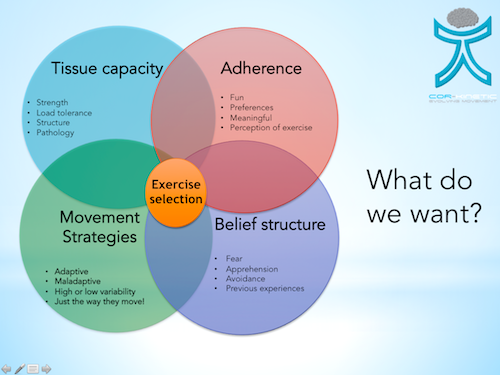
What Do We Want?

Screen Shot 2017 04 10 At 17.33.20

There are many different outcomes that we may want to achieve from our application of exercise and we find we can influence lots of different elements of human function.To make things a bit simpler and more organised we could make some broad categories.

Capacity

This could be tolerance of a specific tissue such as a tendon or muscle although we still have not quite worked out the relationship between pathology and pain here. There may also be clearly defined scenarios where we see the need for specific biomotor qualities, such as strength needing to be addressed postoperatively.

Pain

Pain relief maybe another specific outcome that you want to achieve from your exercise prescription.

It seems there that lots of types of exercise may create analgesic effects. Isometrics are the flavour of the month at the moment, but both strength training and cardio training also have the potential to create analgesic responses.

I am still slightly on the fence about the usefulness of short-term responses for all but I can see a clinical need for some groups of patients.

Belief

As we start to move away from a tissue focused view of exercise and movement, the concept of beliefs around exercise becomes much more important concepts such as fear avoidance and exposure-based therapies are starting to gain traction, and rightly so, especially as their role in actually getting people moving is starting to be appreciated more and more.

We might have to be very SPECIFIC to a movement but that movement is probably very SPECIFIC to the individual as well.

Adherence

It might not matter what the exercise or its aims are if it doesn’t get done in the first place. This is a great example of when non-specific is really quite specific. We may have to be specific in:

  • Location
  • Type of equipment
  • Preferences & enjoyment

to get someone moving again.

Movement

It has been hard to pin down many SPECIFIC movement ‘problems’ that we reliably see as a cause for pain. Our understanding of the mechanisms behind the pain experience are broadening and we see modern concepts such as the decoupling of SPECIFIC movements from pain responses as a plausible reason for using a movement based approach, but again these seem to be quite SPECIFIC to the individual.

Variability that is either too high OR too low might be relevant to pain, maintenance of pain and injury, or not! who knows?

It might be that just MOVING is what many people need!

Being Specific – Where’s Your Data!?

This does not mean that there are NO specifics we should aim for across people but they DO need to be clearly defined.

An example here might be, return to play for ACL rehab. Better outcomes have been shown if patients achieve RTP markers of almost equal, within 10%, of quadriceps strength and also hop performance.

We also see the specific use of eccentric contractions with the prevention of hamstring injuries over concentric strength work. The key here is if you ARE being specific that you have some form of data to back it up.

Remain Vigilant To The Specific Response

All exercise gives individual responses, it’s not just fire and forget.

Lots of exercise research is based around comparing the means of two different groups to look for a statistically significant difference or variation between the two groups. While this type of analysis does point towards a trend for an effect, in reality, it gives us little idea about individual responses to exercise so it is important to monitor someone’s response rather than just expect your reasoning process to have a successful outcome.

An exercise could make someone better, worse, or simply have no difference.

It is important to know that many exercise interventions don’t achieve spectacular results. The actual effect is often around the minimal clinically important difference (MCID). The MCID is the smallest difference that a patient is likely to see as important to them. Although this number varies across studies is generally around 2 points on an 11 point 0-10 VAS scale.

We must always be prepared to adjust the exercise type or dosage based on the SPECIFIC response from the patient.

Summing Up

  • We always need to be SPECIFIC
  • Not always in the same way
  • Always ask “what do we want?” from the exercise
  • Lots of different effects across the BPS spectrum
  • Want to be specific? Have data!
  • Always remain vigilant to the effectiveness of your exercise