
Can Massage Therapy Help Scoliosis?
Her text read: “Hey old man, I’m going to invoke my ‘you’re family so I need your professional opinion’ rite”
My cousins’ oldest daughter was diagnosed with scoliosis and was told that spinal fusion surgery was the only option, it was progressing fast.
On a daily basis her pain was a 6-7 out of 10.
She was experiencing a lot of hip pain and had issues raising her arms above her head.
The scoliosis had gone undetected until she started having some TMJ issues and the family chiropractor discovered it.
At the time of diagnosis she said it was a 41/43 curve.
When I asked if they were told the cause, they said it’s usually hereditary but there is no family history, so it may just be a random condition.
In her case it is a curve to the left (levoscoliosis), however the most common is a curve to the right (dextroscoliosis) which is another reason why doctors had chalked it up to a random occurrence.
Types Of Scoliosis And Surgery
There are six different types of scoliosis and most of the time the cause is unknown (as in my cousins case) but can also come on because of a neuromuscular condition or as part of a separate syndrome a person is dealing with.
They will typically present where the spine has “S” curve or a “C” to the right or left side.
In cases of idiopathic (unknown) scoliosis they are grouped into three different categories:
- Congenital
- you are born with the condition
- Early onset
- occurs between birth and 10 years of age
- Adolescent idiopathic
- happens between the ages of 10 and 18
Now when she told me the curve was a 41/43 I didn’t know what that meant, so I reached out to a couple of chiropractor buddies of mine to see how this they come up with that number and what it means.
This is done by using an assessment tool called the “Cobb Angle” and according to clear-institute.org this is how the measurement is done:
Lines are drawn along the top of the superior tilted vertebra and the bottom of the inferior tilted vertebra. Two more lines are drawn at an angle of 90 degrees to these lines, perpendicular so that they intersect. The resulting angle is measured, and the number is expressed in degrees.
The main methods of treatment in these cases is through bracing or surgery.
Bracing is used when the curve is small in children that are still growing.
Surgery is recommended when the curve is 45-50 degrees or more and depends on how much growing is left for the child to do. Metal rods are fused to the spine to limit the how far the curve can further develop and the use of bone grafts fuses together with the existing bone to form one unit with the spine.
There are two types of surgery, one is done from the back of the spine and the other is done from the front.
One review of scoliosis surgery showed that idiopathic had an average of 6.3% complications, 0.8% neurologic deficits and a 0.02% mortality rate and encouraged this data to be used in the decision making process before agreeing to surgery. (1)
New developments in surgery have seen the use of growth friendly implants instead of a full spine fusion, which allows the spine to grow while correcting the deformity, however it requires multiple surgeries and in turn more complications. (2)
But is surgery the only solution?
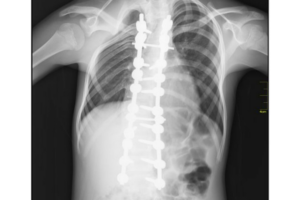
Photo by: © Nevit Dilmen [CC BY-SA 3.0 (http://creativecommons.org/licenses/by-sa/3.0) or GFDL (http://www.gnu.org/copyleft/fdl.html)], via Wikimedia Commons
Scoliosis And Massage Therapy
There is definitely some differing opinions on the best form of treatment, especially as the scoliotic curve progresses.
Some research says the only solution is surgery as it is the most permanent form of intervention and physical therapy will be a constant work in progress.(3)
However there is an argument being made that a more conservative approach that would include observation, scoliosis specific exercises and bracing is effective. The mini review showed that the use of exercise and proper bracing can reduce a curve larger than 45 degrees in 70% of adolescents which could alter surgery indication to above 50 degrees.(4)
There is a great resource outlining exercise and bracing approach from seven different scoliosis schools and their approach, which you can look at here.
Overall there isn’t a ton of research I could find based on massage therapy and scoliosis, dealing with treatment around the adolescent idiopathic level. However there is strong evidence on the use of massage and reduction in pain with adults who have scoliosis.
We won’t be able to correct a curvature, but providing pain relief and improving quality of life is important to anyone who has this condition. In college we were taught massage should be provided to the concave side of the curve, due to the tightness and tension of the muscles pulling the spine in that direction. Stimulatory techniques were to be applied to the convex side to promote strengthening those muscles to assist in correcting the curve. Overall the use of massage/physical therapy and exercises can be a beneficial treatment which could possibly delay a surgery, or possibly prevent surgery. However as the Scoliosis Association of the UK points out, the need for surgery usually isn’t urgent and the more important consideration is how the child and the family feel moving forward. If we can be a source of pain relief through the use of massage and movement exercises, as well as a source of information for anyone dealing with this, then perhaps we can help improve that quality of life whether the family chooses surgery or not, because no kid should have to live with pain everyday.
References:
- Reames D, Smith J, Fu K, Polly D, Ames C, Shaffrey C, et al. Complications in the surgical treatment of 19,360 cases of pediatric scoliosis: a review of the Scoliosis Research Society Morbidity and Mortality database. Spine [serial on the Internet]. (2011, Aug 15), [cited December 18, 2016]; 36(18): 1484-1491. Available from: MEDLINE with Full Text.
- Yang S, Andras L, Redding G, Skaggs D. Early-Onset Scoliosis: A Review of History, Current Treatment, and Future Directions. Pediatrics [serial on the Internet]. (2016, Jan), [cited December 18, 2016]; 137(1): Available from: MEDLINE with Full Text.
- Greene J, Sallee D. Scoliosis in teenagers and common treatment and intervention methods – a systematic review of SportDiscus and AMED literature. Virginia Journal [serial on the Internet]. (2015, Fall2015), [cited December 18, 2016]; 36(2): 13-18. Available from: SPORTDiscus with Full Text.
- Sy N, Bettany-Saltikov J, Moramarco M. Evidence for Conservative Treatment of Adolescent Idiopathic Scoliosis – Update 2015 (Mini-Review). Current Pediatric Reviews [serial on the Internet]. (2016), [cited December 18, 2016]; 12(1): 6-11. Available from: MEDLINE with Full Text.


- Episode #29 Dealing With Burnout - May 25, 2026
- Episode #28 With Great Educational Power, Comes Great Educational Responsibility - May 25, 2026
- Episode #27 Myofascial Release And CLB, What Does The Evidence Say? - May 25, 2026



Great article! It is super informative on nonsurgiccal treatment options. I’ve done some research into schroth physiotherapy and other nonsurgical tratment options, I’m going to include 2 links that might be helpful in your own research the first is to an article from scoliosis care centers that explains what schroth physiotherapy is much better than I can in just one comment https://scoliosiscarecenters.com/schroth-physiotherapy/
And the next link I am posting is for a study that supports that schroth physiotherapy improves spinal curvature https://www.ncbi.nlm.nih.gov/pmc/articles/PMC3847831/ it’s a peer reviewed study and it’s from a reliable source. So there is some science backing it up which is great!
I’ll try to take a look at those when I get a chance, thanks Greg